
Music Hall Artistes Of Abney Park
Meet me tomorrow on the steps of St Paul’s Cathedral and we will spend the afternoon walking eastward together through the square mile to explore the wonders and the wickedness of the ancient City of London.

Click here to book for The Gentle Author’s City of London walk on Sunday 4th June
In Abney Park Cemetery I sought the graves of the Music Hall Artistes resting there. John Baldock, Cemetery Keeper, led me through the undergrowth to show me the memorials restored by the Music Hall Guild and then left me to my own devices. Alone in the secluded leafy glades of the overgrown cemetery, I swore I could hear distant singing accompanied by the tinkling of heavenly ivories.

George Leybourne, Songwriter, Vocalist and Comedian, also known as Champagne Charlie (1842 – 1884) & Albert Chevalier (1861- 1923), Coster Comedian and Actor. Chevalier married Leybourne’s daughter Florrie and they all rest together.

George Leybourne – “Champagne Charlie is my name, Champagne Charlie is my name ,There’s no drink as good as fizz, fizz, fizz, I’ll drink every drop there is, is, is!”

Albert Chevalier – “We’ve been together now for forty years, An’ it don’t seem a day too much, There ain’t a lady livin’ in the land, As I’d swop for my dear old Dutch.”

G W Hunt (1838 – 1904) Composer and Songwriter, his most famous works were “MacDermott’s War Song” (The Jingo Song), “Dear Old Pals” and “Up In A Balloon” for George Leybourne and Nelly Power.

G W Hunt

Fred Albert George Richard Howell (1843 – 1886) Songwriter and Extempore Vocalist

Fred Albert

Dan Crawley (1871 – 1912) Comedian, Vocalist, Dancer and Pantomime Dame rests with his wife Lilian Bishop, Actress and Male Impersonator. He made his London debut at nineteen at Royal Victor Theatre, Victoria Park, and for many years performed three shows a day on the sands at Yarmouth, where he met his wife.They married in Hackney in 1893 and had four children, and toured together as a family, including visiting Australia, before they both died at forty-one years old.

Dan Crawley

Herbert Campbell (1844 – 1904) Comedian and Pantomime Star. The memorial behind the tombstone was erected by a few of his friends. Herbert Campbell played the Dame in Pantomime at Drury Lane for forty years alongside Dan Leno, until his death at at sixty-one.

Herbert Campbell, famous comedian and dame of Drury Lane

Walter Laburnum George Walter Davis (1847 – 1902) Singer, Patter Vocalist and Songwriter

Walter Laburnum

Nelly Power Ellen Maria Lingham (1854 – 1887) started her theatrical career at the age of eight, and was a gifted songstress and exponent of the art of male impersonation. Her most famous song was ‘The Boy I Love Is Up In The Gallery.” She died from pleurisy on 19th January 1887, aged just thirty-two.

Nelly Power – Vesta Tilley was once her understudy
Mike Henbrey, Collector
Meet me this Sunday on the steps of St Paul’s Cathedral and we will spend the afternoon walking eastward together through the square mile to explore the wonders and the wickedness of the ancient City of London.
Click here to book for The Gentle Author’s City of London walk on Sunday 4th June

Mike Henbrey (1943-2015)
I met Mike Henbrey in the summer in the last few weeks of his life. I visited him each Saturday afternoon for a month and all these years later I still think of him. On the outside, his council flat looked like any other – but once you stepped inside and glimpsed the shelves of fine eighteenth century leather bindings, you realised you were in the home of an extraordinarily knowledgeable collector. High up in the building, Mike sat peacefully in his nest of books, brooding and gazing out at the surrounding tree tops through his large round steel glasses and looking for all the world like a wise old owl.
Walls lined with diverse pairs of steel dividers and shelves of fat albums testified to his collections of tools and ephemera. It was all the outcome of a trained eye and a lifetime of curiosity, seeking out wonders in the barrows, markets and sale rooms of London, enabling Mike to amass a collection far greater than his means through persistence and knowledge.
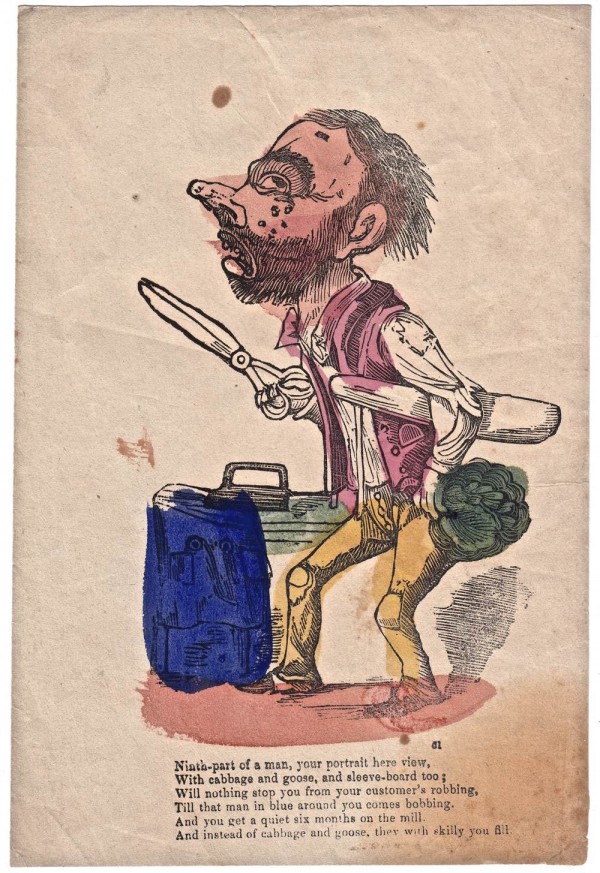
“Of all my collections, the Vinegar Valentines are the one that gives me the most pleasure,” he assured me with characteristic singularity, despite his obviously kind nature. ‘Vinegar Valentines’ were grotesque insults couched in humorous style, sent to enemies and unwanted suitors, and to bad tradesmen by workmates and dissatisfied customers. Unsurprisingly, very few have survived which makes them incredibly rare and renders Mike’s collection all the more astonishing. Immensely knowledgeable yet almost entirely self-educated, Mike was drawn to neglected things that no-one else cared for and this was the genius of his collecting instinct.
Of course, I regret that I never got to pore through all of Mike’s books and albums, but I had to resist this impulse in order to record his own story and learn how it was that he came to gather his wonderful collection.
“I was born in Chingford in 1943 but, unfortunately, we moved to Norfolk when I was eight. I never liked it there, it was a lonely, cold and draughty place. My father James was a furrier and his father – who was also James – had been a furrier before him in the East End, but they moved out. My mother, Laura Lewis, was a machinist who worked for my father and I think she came from the East End too. I grew up playing in the furriers because my father had his factory in the back garden and the machinists gave me sweets. I think that’s where I got my love of tools.
There was quite a lot of bombing in Chingford during the war and the house next to us got a direct hit which left a great big crack in our wall. I played on bomb sites even though I was told not to, and somehow my mother always seemed to know. I think it must have been the mixture of brick dust and soot on my clothes.
It was a filthy dirty job, being a furrier, and, although my father was a good furrier, he wasn’t a good businessman and he ended up in bankruptcy when I was eight. So that’s how we ended up in Mundesley by the sea in North Norfolk in the early fifties.
As soon as I left school at sixteen, I headed back to London. Ostensibly, it was to complete my training in the catering trade but I hated it, I had already done a year at catering college in Norwich. In reality, I was taking lots of drugs – dope and speed mostly – and working at a night club. I got a job on the door of club called The Bedsitter in Holland Park Avenue. I actually had a bedsitter off Holland Park itself for five pounds a week with a gas ring in the corner. That was a good time.
I worked at a hotel in Park Lane for a few months. The chef used to throw things at me. They fired me in the end for turning up late. I drifted through life by signing on and working on the side, and the club gave me a good social life. I’m a vicarious hedonist. I’ve always read a lot, I taught myself to read by reading my brother’s copies of Dandy and Beano. He was ten years older than me and he died in his early thirties.
A hippy friend of mine was a packer at a West End bookshop in Grafton St and he got me a job there. I worked for Mr Sawyer, he was a nice man. He employed hippies because they didn’t mind his cigar smoke and he never noticed the smell of pot in the packing room. He employed me as a porter but he told me to buy a suit and I got a job in the bookshop itself. I learnt such a lot while I was there. It was nice to be around books, so much better than working for a living.
Mr Gibbs was the shop manager, he taught me how to catalogue. He couldn’t understand why he kept finding more money in his pay packet. It was because we youngsters kept asking for a pay rise and Mr Sawyer couldn’t give it to us without giving it to Mr Gibbs too.
Mr Gibbs taught me not to speak to Mr Sawyer until he’d been around to Brown’s Hotel for his ‘breakfast’ and I presume this was because ‘breakfast’ consisted of at least three gin and tonics. He was a kind employer, he didn’t pay much but you learnt a lot. He had a tiny desk hidden behind a bookcase with two old spindly chairs that were permanently on the brink of collapse. The place was a university of sorts. I learnt so much so quickly. You can’t always recognise good stuff until you’ve had it pass through your hands.
Mr Sawyer would go through the auction catalogue of books and mark how much you were to bid and send you off to Sotheby’s. You had to stay on the ball, because sometimes he’d make an agreement with other booksellers not to let him get a lot below a certain price, because he’d be bidding for a customer and he’d be on commission. In those days, it was possible to make living by frequenting Sotheby’s and buying books. You learn a lot about the peculiarities of the bookselling trade. I think I was earning fourteen pounds a week. It was positively Dickensian.
By then I had met my wife Jeanna. We got married in 1965 and moved around between lots of flats we couldn’t afford. Jeanna & I started a book stall in Camden Passage called Icarus. I love the street markets like Portobello and Brick Lane. We made a lot of sales and I bought some wonderful stuff in street markets when you could discover things, and I’ve still got some of it.
We had two daughters, Samantha & Natasha, but Jeanna died young. We were living in Islington in Highbury Fields and I was left on my own to bring up the kids, who were eight and three years old at the time. That’s when I got this council flat, on account of being a single parent, and I’ve been here thirty-eight years. I lived on benefits with bookselling on the side to bring in some extra money and brought up my kids with the help of girlfriends.
A friend of mine had a secondhand tool shop and I worked there for a while. You could buy old tools from the sixteenth and seventeenth century for not very much money then, and we had some that no-one ever wanted to buy, so I brought them home. I am fascinated by tools for specialist professions, each one opens a door to a particular world. I still have my father’s furriers’ tools and they pack into such a small box.
From then on I’ve been a book dealer. Once you fall out of having a regular job, it’s difficult to go back. I think my kids regard me with mixture of mild disappointment and tolerance. On occasion, they have generously put up with me spending money on books instead of dinner.
I’ve always been a collector, reference books mainly, and from there I’ve become a dealer. I’m not interested in fiction but I do love a good reference book.”


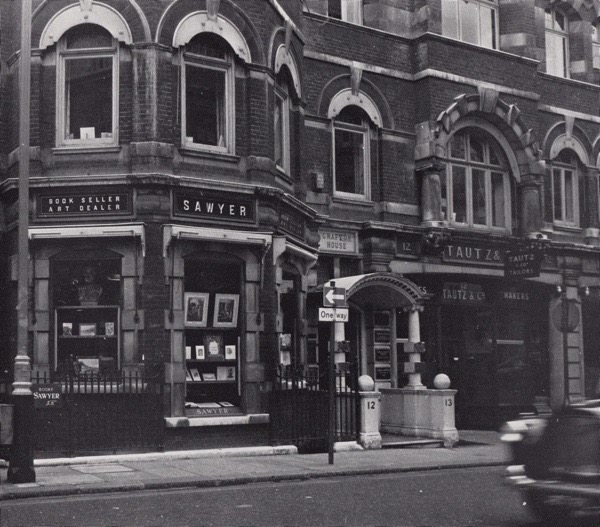
Sawyer, the bookseller in Grafton St where Mike Henbrey once worked


Mr Gibbs, bookshop manager


GLOSSARY
by Spitalfields Life Contributing Slang Lexicographer Jonathon Green


Mike Henbrey, Collector of books, ephemera and tools
Mike Henbrey’s Vinegar Valentines were purchased by Bishopsgate Institute where they are preserved in the archive as the Mike Henbrey Collection
You may like to take a closer look at some of Mike Henbrey’s collections
Mike Henbrey’s Vinegar Valentines
Vinegar Valentines for Bad Tradesmen
The Spitalfields Roman Woman
Meet me this Sunday on the steps of St Paul’s Cathedral and we will spend the afternoon walking eastward together through the square mile to explore the wonders and the wickedness of the ancient City of London.
Click here to book for The Gentle Author’s City of London walk on Sunday 4th June

Curator of Human Osteology, Rebecca Redfern watches over her charge
In his Survey of London 1589, John Stow wrote about the discovery of pots of Roman gold coins buried in Spitalfields and it had long been understood that ancient tombs once lined the road approaching London, just as they did along the Appian Way in Rome. Yet it was only in the nineteen-nineties, when large scale excavations took place prior to the redevelopment of the Spitalfields Market, that the full extent of the Roman cemetery was uncovered.
In March 1999, a Roman stone sarcophagus containing a rare lead coffin decorated with scallop shells came to light, indicating the burial of someone of great wealth and high status. Grave goods of fine glass and jet were buried between the coffin and the sarcophagus. It was the first unopened sarcophagus to be found in London for over a century and when the entire assemblage was removed to the Museum of London, the coffin was opened to reveal the body of a young woman in her early twenties, buried in ceremonial fashion. In the week after the opening of the coffin, ten thousand Londoners came to pay their respects to the Spitalfields Roman woman. She was the most astonishing discovery of the excavations yet, as the years have passed and more has been learnt about her, the enigma of her identity has become the subject of increasing fascination.
Analysis of residue in the coffin revealed that her head lay upon a pillow of bay leaves, her body was embalmed with oils from the Arab world and the Mediterranean, and wrapped in silk which had been interwoven with fine gold thread. Traces of Tyrian purple were also found, perhaps from a blanket laid over the coffin. Such an elaborate presentation suggests she may have been displayed to her family and friends seventeen hundred years ago as part of funeral rites.
The sarcophagus and grave goods are on public exhibition at the Museum but, thanks to Rebecca Redfern, Curator of Human Osteology, Contributing Photographer Sarah Ainslie and I had the privilege to visit the Rotunda where the human remains are stored and view the skeleton of the Spitalfields Roman woman. Deep in a windowless concrete bunker filled with metal shelving stacked with cardboard boxes, containing the remains of thousands of Londoners from the past, lay the bones of the woman. We stood in silent reverence with just the sound of distant traffic echoing.
Rebecca is the informal guardian of the Spitalfields woman and remembers switching on the television to watch news of the discovery as a student. Today, she has a daughter of her own. “The work went on for so many years that a lot of couples met working in Spitalfields,” Rebecca admitted to me, “and there is now a whole generation of ‘Spital babies’ born to those archaeologists.”
“She’s five foot three and delicately built, petite like a ballet dancer,” Rebecca continued, turning her attention swiftly from the living to the dead and gesturing protectively to the bones laid out upon the table. While some might objectify the skeleton as a specimen, Rebecca relates to the Spitalfields Roman woman and all the other twenty thousand remains in her care as human beings. “They’re able to tell us so much about themselves, it’s impossible not to regard them as people,” she assured me.
Recent research into the isotopes present in the teeth of the Spitalfields Roman woman have revealed an exact match with those found in Imperial Rome, which means that her origin can be traced not just to Italy but to Rome itself. “I find it very sad that she came so far and then died so young,” Rebecca confided, recognising the lack of any indication of the cause of death or whether the woman had given birth. Contemplating the presence of the skeleton with its delicate bones dyed brown by lead, it is apparent that the Spitalfields Roman woman holds her secrets and has many stories yet to tell.
More than seventy-five Roman burials were uncovered at the same time as the sarcophagus, many interred within wooden coffins and some only in shrouds. You might say these represented the earliest wave of immigration to arrive in Spitalfields.
“People were so mobile,” Rebecca explained to me, “We found a fourteen-year-old girl from North Africa whose mother was European. A legion from North Africa was sent to guard Hadrian’s Wall and we have found tagine cooking pots that may been theirs. I pity those men – how they must have suffered in the cold.”

The only Roman sarcophagus discovered in London in our time was uncovered in Spitalfields in 1999


Inside the stone sarcophagus an elaborately decorated lead coffin was discovered

At the Museum of London, the debris was removed to uncover the pattern of scallop shells

The lead coffin was opened to reveal the body of a young woman


Photographs of coffin & excavations copyright © Museum of London
Portrait of Rebecca Redfern & photographs of skeletal details copyright © Sarah Ainslie
You may also like to read about
Dan Jones’ East End Portraits
Meet me next Sunday on the steps of St Paul’s Cathedral and we will spend the afternoon walking eastward together through the square mile to explore the wonders and the wickedness of the ancient City of London.
Click here to book for my next City of London walk on Sunday 4th June

In recent years, Dan Jones has painted a magnificent series from different eras for his EAST END PORTRAITS. Many of these are well known but others less familiar, so you can click on any of the names to learn more about the subjects.


Police Constable James Stewart


Portraits copyright © Dan Jones
You may also like to take a look at
Antony Cairns’ Small Shops
Meet me next Sunday on the steps of St Paul’s Cathedral and we will spend the afternoon walking eastward together through the square mile to explore the wonders and the wickedness of the ancient City of London.
Click here to book for my next City of London walk on Sunday 4th June
Today I present Antony Cairns’ ethereal portfolio of small shops, created using nineteenth century Vandyke Brown process, and evoking those commercial premises which exist as receptacles of collective memory for the communities they served.
The first picture is of The Handy Shop, Tony’s first local shop when growing up in Plaistow, and the last picture is W.F.Arber & Co Ltd in Roman Rd, of which my friend Gary Arber was the proprietor.

The Handy Shop, Ruskin Ave, E12

M.J. Evans, Warren St, W1

Unknown shop, Mile End, E1

Unknown shop, Bonsor St, SE5

Unknown shops, unknown street

Unknown shop, Copenhagen St N.1

Unknown shops, Morning Lane, E8

Unknown shop, Oswin St, SE11

Unknown shops, Hackney Rd, E2

Fishmonger, Commercial Rd, E1

Unknown shop, St Pancras Way, NW5

Printworks, Blackfriars Rd, SE1

Gari’s, Northwold Rd, N16

George Harvey, Bougourd Chemist & Droys, Rochester Row, SW1

Gricks Jellied Eels, Rosebery Ave, Manor Park, E12

Arber & Co Ltd, 459 Roman Rd, E3
Photographs copyright © Antony Cairns
You may also like to take a look at
and these other photographs of shops
The First Hundred Penguin Books
Meet me next Sunday on the steps of St Paul’s Cathedral and we will spend the afternoon walking eastward together through the square mile to explore the wonders and the wickedness of the ancient City of London.
Click here to book for my next City of London walk on Sunday 4th June


I came across this set of the first hundred Penguin books in my attic when I was unpacking a box that has been sealed since I moved in. With their faded orange, indigo, green, violet and pink spines they make a fine display and I am fond of this collection that took me so many years to amass.
When I left college, I wrote to companies all over the country seeking work and asking if they would give me an interview if I came to see them. Then I travelled around on the cheap, through a combination of buses, trains and hitchhiking, to visit all these places – the industrial towns of the North and the Cathedral cities of the South – staying in bus stations, youth hostels and seedy B&Bs, and going along filled with hope to interviews that were almost all fruitless. It was the first time I encountered the distinctive regional qualities of Britain and in each city, to ameliorate the day of my interview, I took the opportunity to visit the museums, civic art galleries, cathedrals and castles that distinguish these places. Arriving at each destination, I would consult the directory and make a list of the second-hand booksellers, then mark them on a tourist map and, after the job interview, I would visit every one. There were hundreds of these scruffy dusty old shops with proprietors who were commonly more interested in the book they were reading behind the counter than in any customer. Many were simply junk shops with a few books piled in disorder on some shelves in the back or stacked in cardboard boxes on the pavement outside.
In these shabby old shops, I sometimes came upon Penguin books with a podgy penguin on the cover, quite in contrast to the streamlined bird familiar from modern editions. These early titles, dating from 1935 had a clean bold typography using Eric Gill’s classic sans typeface and could be bought for just twenty or thirty pence. So, in the manner of those cards you get in bubblegum packets, I began to collect any with numbers up to one hundred. In doing so, I discovered a whole library of novelists from the nineteen thirties and reading these copies passed the time pleasantly on my endless journeys. In particular, I liked the work of Eric Linklater whose playful novel “Poet’s Pub” was number two, Compton Mackenzie whose novel of the Edwardian vaudeville “Carnival” was ten, Vita Sackville-West whose novel “The Edwardians” was sixteen, T.F.Powys whose “Mr Weston’s Good Wine” was seventy-three and Sylvia Townsend Warner whose novel “Lolly Willowes” was eighty-four. After these, I read all the other works of these skillful and unjustly neglected novelists.
Eventually I found a job in Perthshire and then subsequently in Inverness, and from here I made frequent trips to Glasgow, which has the best second-hand bookshops in Scotland, to continue my collection. And whenever I made the long rail journey down South, I commonly stopped off to spend a day wandering round Liverpool or Durham or any of the places I had never been, all for the purpose of seeking old Penguins.
The collection was finally completed when I moved back to London and discovered that my next door neighbour Christine was the daughter of Allen Lane who founded Penguin books. She was astonished to see my collection and I was amazed to see the same editions scattered around her house. From Christine, I learnt how her father Allen was bored one day on Exeter St David’s Station (a place familiar to me), changing trains on the way to visit his godmother Agatha Christie. When he searched the bookstall, he could not find anything to read and decided to start his own company publishing cheap editions of good quality books. I presume he did not know that, if he had been there half a century earlier, he could have bought a copy of Thomas Hardy’s first published novel “Desperate Remedies”, because Exeter St David’s was where Hardy experienced that moment no writer can ever forget, of first seeing their book on sale.
I do not think my collection of Penguins is of any great value because they are of highly variable condition and not all are first editions, though every one predates World War II and they are of the uniform early design before the bird slimmed down. While I was collecting these, I thought that I was on a quest to build my career – a fancy that I walked away from, years later. Now these hundred Penguin books are the only evidence of my innocent tenacity to create a life for myself at that time.
Allen Lane’s idealistic conception, to use the mass market to promulgate good writing to the widest readership in cheap editions that anyone could afford, is one that I admire. And these first hundred are a fascinating range of titles, a snapshot of the British public’s reading tastes in the late thirties. Looking back, the search for all these books led me on a wonderful journey through Britain. If you bear in mind that I only found a couple in each city, then you will realise that my complete collection represents a ridiculously large number of failed job interviews in every corner of these islands. It was a job search than became a cultural tour and resulted in a stack of lovely old paperbacks. Now they sit on my shelf here in Spitalfields as souvenirs of all the curious places I never would have visited if it were not my wayward notion to scour the entire country to collect all the first hundred Penguins.


The Trade Cards Of Old London
Meet me on the steps of St Paul’s Cathedral and we will spend an afternoon walking eastward together through the square mile to explore the wonders and the wickedness of the ancient City of London.
Click here to book for my next City of London walk on Sunday 4th June

Was your purse or wallet like mine, bulging with old trade cards? Did you always take a card from people handing them out in the street, just to be friendly? Did you pick up interesting cards in idle moments, intending to look at them later, and find them months afterwards in your pocket and wonder how they got there? So it has been for over three hundred years in London, since the beginning of the seventeenth century when trade cards began to be produced as the first advertising. Here is a selection of cards you might find, rummaging through a drawer in the eighteenth century.


Images courtesy Bishopsgate Institute
You might also like to take a look at


