
Swan Upping Season
Click here to book your ticket for THE GENTLE AUTHOR’S TOUR OF SPITALFIELDS

Since before records began, Swan Upping has taken place on the River Thames in the third week of July – chosen as the ideal moment to make a census of the swans, while the cob (as the male swan is known) is moulting and flightless, and before the cygnets of Spring take flight at the end of Summer. This ancient custom stems from a world when the ownership and husbandry of swans was a matter of consequence, and they were prized as roasting birds for special occasions.
Rights to the swans were granted as privileges by the sovereign and the annual Swan Upping was the opportunity to mark the bills of cygnets with a pattern of lines that indicated their provenance. It is a rare practice from medieval times that has survived into the modern era and I have always been keen to see it for myself – as a vision of an earlier world when the inter-relationship of man and beast was central to society and the handling of our fellow creatures was a important skill.
So it was my good fortune to join the Swan Uppers of the Worshipful Company of Vintners’ for a day on the river from Cookham to Marlow, just one leg of their seventy-nine mile course from Sunbury to Abingdon over five days. The Vintners Company were granted their charter in 1363 and a document of 1509 records the payment of four shillings to James the under-swanherd “for upping the Master’s swans” at the time of the “great frost” – which means the Vintners have been Swan Upping for at least five hundred years.
Swan Upping would have once been a familiar sight in London itself, but the embankment of the Thames makes it an unsympathetic place for breeding swans these days and so the Swan Uppers have moved upriver. Apart from the Crown, today only the Dyers’ and Vintners’ Companies retain the ownership of swans on the Thames and each year they both send a team of Swan Uppers to join Her Majesty’s Swan Keeper for a week in pursuit of their quarry.
It was a heart-stopping moment when I saw the Swan Uppers for the first time, coming round the bend in the river, pulling swiftly upon their oars and with coloured flags flying, as their wooden skiffs slid across the surface of the water toward me. Attended by a flotilla of vessels and with a great backdrop of willow framing the dark water surrounding them, it was as if they had materialized from a dream. Yet as soon as I shook hands with the Swan Uppers at The Ferry in Cookham, I discovered they were men of this world, hardy, practical and experienced on the water. All but one made their living by working on the Thames as captains of pleasure boats and barges – and the one exception was a trader at the Billingsgate Fish Market.
There were seven in each of the teams, consisting of six rowers spread over two boats, and a Swan Marker. Some had begun on the water at seven or eight years old as coxswain, most had distinguished careers as competitive rowers as high as Olympic level, and all had won their Doggett’s coat and badge, earning the right to call themselves Watermen. But I would call them Rivermen, and they were the first of this proud breed that I had met, with weathered skin and eager brightly-coloured eyes, men who had spent their lives on the Thames and were experts in the culture and the nature of the river.
They were a tight knit crew – almost a family – with two pairs of brothers and a pair of cousins among them, but they welcomed me to their lunch table where, in between hungry mouthfuls, Bobby Prentice, the foreman of the uppers, told me tales of his attempts to row the Atlantic Ocean, which succeeded on the third try. “I felt I had to go back and do it,” he confessed to me, shaking his head in determination, “But, the third time, I couldn’t even tell my wife until I was on my way.” Bobby’s brother Paul told me he was apprenticed to his father, as a lighterman on the Thames at fifteen, and Roger Spencer revealed that after a night’s trading at Billingsgate, there was nothing he liked so much as to snatch an hour’s rowing on the river before going home for an hour’s nap. After such admissions, I realised that rowing up the river to count swans was a modest recreation for these noble gentlemen.
There is a certain strategy that is adopted when swans with cygnets are spotted by the uppers. The pattern of the “swan voyage” is well established, of rowing until the cry of “Aaall up!” is given by the first to spot a family of swans, instructing the crews to lift their oars and halt the boats. They move in to surround the swans and then, with expert swiftness, the birds are caught and their feet are tethered. Where once the bills were marked, now the cygnets are ringed. Then they are weighed and their health is checked, and any that need treatment are removed to a swan sanctuary. Today, the purpose of the operation is conservation, to ensure well being of the birds and keep close eye upon their numbers – which have been increasing on the Thames since the lead fishing weights that were lethal to swans were banned, rising from just seven pairs between London and Henley in 1985 to twenty-eight pairs upon this stretch today.
Swan Upping is a popular spectator sport as, all along the route, local people turn out to line the banks. In these river communities of the upper Thames, it has been witnessed for generations, marking the climax of Summer when children are allowed out of school in their last week before the holidays to watch the annual ritual.
Travelling up river from Cookham, between banks heavy with deep green foliage and fields of tall golden corn, it was a sublime way to pass a Summer’s afternoon. Yet before long, we passed through the lock to arrive in Marlow where the Mayor welcomed us by distributing tickets that we could redeem for pints of beer at the Two Brewers. It was timely gesture because – as you can imagine – after a day’s rowing up the Thames, the Swan Uppers had a mighty thirst.


Martin Spencer, Swan Marker


Foreman of the Uppers, Bobby Prentice


The Swan Uppers of the Worshipful Company of Vintners, 2011

The Swan Uppers of 1900


The Swan Uppers of the nineteen twenties.


In the nineteen thirties.


The Swan Uppers of the nineteen forties.


In the nineteen fifties.

Archive photographs copyright © Vintners’ Company
You may also like to read about
Charles Skilton’s London Life

Click here to book for my tours through July, August and September
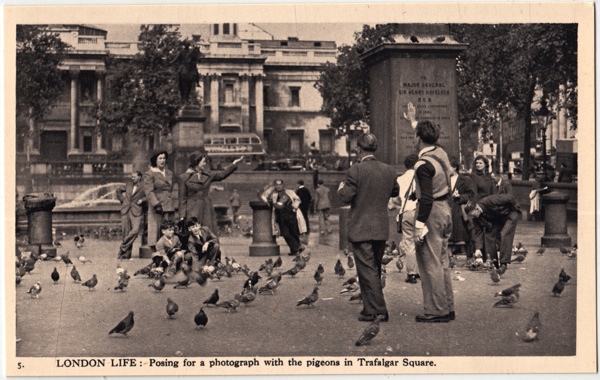
Now that the summer visitors are here and thronging in the capital’s streets and transport systems, I thought I would send you this fine set of postcards published by Charles Skilton, including my special favourites the escapologist and the pavement artist.
Looking at these monochrome images of the threadbare postwar years, you might easily imagine the photographs were earlier – but Margaret Rutherford in ‘Ring Round the Moon’ at The Globe in Shaftesbury Ave in number nine dates them to 1950. Celebrated in his day as publisher of the Billy Bunter stories, Charles Skilton won posthumous notoriety for his underground pornographic publishing empire, Luxor Press.




You may also like to take a look at
The Last Days Of Smithfield Market
Click here to book for my tours through July, August and September
As London’s oldest market prepares to move out of the City, Photographer Orlando Gili has been down at Smithfield, documenting the last generation of butchers to work at this ancient site

Greg Lawrence Junior and Greg Lawrence Junior Junior, Owners of G Lawrence Wholesale Meat
‘I arrived at Smithfield in the dead of night to photograph London’s renowned meat market which is set for permanent closure. The last pubs had long closed and it was a few hours before tube station shutters were wrenched open.
Walking towards the market, you are met by a wave of sound, beeps and wheels dragged over tarmac, bearing the weighty chunks of meat wrapped in plastic. Emitting at a different frequency is the grumble from a line of white lorries and vans, punctuated by shouts and low pitched chatter. Smithfield is very much alive and in full operational mode at this time. Within minutes of arriving, I am dressed in white overalls and deep inside the bowels of the market, photographing blood splattered butchers, and dodging lines of dead animals hanging from hooks.
Experiencing Smithfield at night is to uncover a secret parallel world that operates in the shadows while the rest of London sleeps. There is a sense of frenetic energy and unpredictability. Forklifts whizz past men in long jackets hunched over neatly stacked boxes, punching numbers into calculators and fielding phone calls. Inside the tall Victorian halls, behind large glass windows, carcasses are hacked into pieces at literally breakneck speed. It is a physical analogue space with a masculine atmosphere. There is a strong sense of camaraderie and familial spirit, many of the businesses are family run.
I returned on early mornings in winter to develop a portrait series that celebrates the people behind the market. Night workers provide an under-appreciated role in modern cities. They risk significant damage to their health to meet the demands of the 24/7 city. According to a long-term US study of nurses, night shift workers are up to 11% more likely to die early compared to those who work day shifts.
The historic market will soon relocate to a £1 billion high-tech behemoth in Dagenham. The closure of Smithfield ends over 800 years of trading meat in Central London as part of a wider trend to sanitise inner cities with less palatable aspects of urban life kept out of sight.’
Orlando Gili

Mark, Chicken Salesman

Horatio, Driver

Moro, Butcher

Harry, Shopman

Simon, Salesman

Ian, Chicken Salesman

Greg, Beef Salesman and Sean, Cashier

Jonny, Butcher

Elijah, Salesman

Tony, Retired Boxer, Trader and Restaurant Distributor

Roger, Fork Lift Operator

Dave, Salesman

‘Pig Ear Tony’, Pig Meat Salesman

Charlie, Salesman

Aaron, Butcher, Marcus, Salesman and Mark, Shopman

Luca, Production

Adam, Butcher

Kye, Unloader

Pav, Butcher

Russel, Butcher

James, Sales Manager

Grant, Butcher
Photographs copyright © Orlando Gili
You may also like to read about
Joan Brown, The First Woman at Smithfield Market
Learn How To Write A Blog This November

HOW TO WRITE A BLOG THAT PEOPLE WILL WANT TO READ: 25th-26th November 2023
Spend a weekend in an eighteenth century weaver’s house in Spitalfields and learn how to write a blog with The Gentle Author.
This course is suitable for writers of all levels of experience – from complete beginners to those who already have a blog and want to advance.
We will examine the essential questions which need to be addressed if you wish to write a blog that people will want to read.
“Like those writers in fourteenth century Florence who discovered the sonnet but did not quite know what to do with it, we are presented with the new literary medium of the blog – which has quickly become omnipresent, with many millions writing online. For my own part, I respect this nascent literary form by seeking to explore its own unique qualities and potential.” – The Gentle Author
COURSE STRUCTURE
1. How to find a voice – When you write, who are you writing to and what is your relationship with the reader?
2. How to find a subject – Why is it necessary to write and what do you have to tell?
3. How to find the form – What is the ideal manifestation of your material and how can a good structure give you momentum?
4. The relationship of pictures and words – Which comes first, the pictures or the words? Creating a dynamic relationship between your text and images.
5. How to write a pen portrait – Drawing on The Gentle Author’s experience, different strategies in transforming a conversation into an effective written evocation of a personality.
6. What a blog can do – A consideration of how telling stories on the internet can affect the temporal world.
SALIENT DETAILS
Courses will be held at 5 Fournier St, Spitalfields on 25th-26th November, running from 10am-5pm on Saturday and 11am-5pm on Sunday.
Lunch, tea, coffee & cakes catered by the Townhouse included within the course fee of £350.
Email spitalfieldslife@gmail.com to book a place on a course.
Please note we do not give refunds if you are unable to attend or if the course is postponed for reasons beyond our control.

Comments by students from courses tutored by The Gentle Author
“I highly recommend this creative, challenging and most inspiring course. The Gentle Author gave me the confidence to find my voice and just go for it!”
“Do join The Gentle Author on this Blogging Course in Spitalfields. It’s as much about learning/ appreciating Storytelling as Blogging. About developing how to write or talk to your readers in your own unique way. It’s also an opportunity to “test” your ideas in an encouraging and inspirational environment. Go and enjoy – I’d happily do it all again!”
“The Gentle Author’s writing course strikes the right balance between addressing the creative act of blogging and the practical tips needed to turn a concept into reality. During the course the participants are encouraged to share and develop their ideas in a safe yet stimulating environment. A great course for those who need that final (gentle) push!”
“I haven’t enjoyed a weekend so much for a long time. The disparate participants with different experiences and aspirations rapidly became a coherent group under The Gentle Author’s direction in a gorgeous house in Spitalfields. There was lots of encouragement, constructive criticism, laughter and very good lunches. With not a computer in sight, I found it really enjoyable to draft pieces of written work using pen and paper.Having gone with a very vague idea about what I might do I came away with a clear plan which I think will be achievable and worthwhile.”
“The Gentle Author is a master blogger and, happily for us, prepared to pass on skills. This “How to write a blog” course goes well beyond offering information about how to start blogging – it helps you to see the world in a different light, and inspires you to blog about it. You won’t find a better way to spend your time or money if you’re considering starting a blog.”
“I gladly traveled from the States to Spitalfields for the How to Write a Blog Course. The unique setting and quality of the Gentle Author’s own writing persuaded me and I was not disappointed. The weekend provided ample inspiration, like-minded fellowship, and practical steps to immediately launch a blog that one could be proud of. I’m so thankful to have attended.”
“I took part in The Gentle Author’s blogging course for a variety of reasons: I’ve followed Spitalfields Life for a long time now, and find it one of the most engaging blogs that I know; I also wanted to develop my own personal blog in a way that people will actually read, and that genuinely represents my own voice. The course was wonderful. Challenging, certainly, but I came away with new confidence that I can write in an engaging way, and to a self-imposed schedule. The setting in Fournier St was both lovely and sympathetic to the purpose of the course. A further unexpected pleasure was the variety of other bloggers who attended: each one had a very personal take on where they wanted their blogs to go, and brought with them an amazing range and depth of personal experience. “
“I found this bloggers course was a true revelation as it helped me find my own voice and gave me the courage to express my thoughts without restriction. As a result I launched my professional blog and improved my photography blog. I would highly recommend it.”
“An excellent and enjoyable weekend: informative, encouraging and challenging. The Gentle Author was generous throughout in sharing knowledge, ideas and experience and sensitively ensured we each felt equipped to start out. Thanks again for the weekend. I keep quoting you to myself.”
“My immediate impression was that I wasn’t going to feel intimidated – always a good sign on these occasions. The Gentle Author worked hard to help us to find our true voice, and the contributions from other students were useful too. Importantly, it didn’t feel like a ‘workshop’ and I left looking forward to writing my blog.”
“The Spitafields writing course was a wonderful experience all round. A truly creative teacher as informed and interesting as the blogs would suggest. An added bonus was the eclectic mix of eager students from all walks of life willing to share their passion and life stories. Bloomin’ marvellous grub too boot.”
“An entertaining and creative approach that reduces fears and expands thought”
“The weekend I spent taking your course in Spitalfields was a springboard one for me. I had identified writing a blog as something I could probably do – but actually doing it was something different! Your teaching methods were fascinating, and I learnt a lot about myself as well as gaining very constructive advice on how to write a blog. I lucked into a group of extremely interesting people in our workshop, and to be cocooned in the beautiful old Spitalfields house for a whole weekend, and plied with delicious food at lunchtime made for a weekend as enjoyable as it was satisfying. Your course made the difference between thinking about writing a blog, and actually writing it.”
“After blogging for three years, I attended The Gentle Author’s Blogging Course. What changed was my focus on specific topics, more pictures, more frequency, more fun. In the summer I wrote more than forty blogs, almost daily from my Tuscan villa on village life and I had brilliant feedback from my readers. And it was a fantastic weekend with a bunch of great people and yummy food.”
“An inspirational weekend, digging deep with lots of laughter and emotion, alongside practical insights and learning from across the group – and of course overall a delightfully gentle weekend.”
“The course was great fun and very informative, digging into the nuts and bolts of writing a blog. There was an encouraging and nurturing atmosphere that made me think that I too could learn to write a blog that people might want to read. – There’s a blurb, but of course what I really want to say is that my blog changed my life, without sounding like an idiot. The people that I met in the course were all interesting people, including yourself. So thanks for everything.”
“This is a very person-centred course. By the end of the weekend, everyone had developed their own ideas through a mix of exercises, conversation and one-to-one feedback. The beautiful Hugenot house and high-calibre food contributed to what was an inspiring and memorable weekend.”
“It was very intimate writing course that was based on the skills of writing. The Gentle Author was a superb teacher.”
“It was a surprising course that challenged and provoked the group in a beautiful supportive intimate way and I am so thankful for coming on it.”
“I did not enrol on the course because I had a blog in mind, but because I had bought TGA’s book, “Spitalfields Life”, very much admired the writing style and wanted to find out more and improve my own writing style. By the end of the course, I had a blog in mind, which was an unexpected bonus.”
“This course was what inspired me to dare to blog. Two years on, and blogging has changed the way I look at London.”
John Leighton’s Cries Of London
Click here to book for my tours through July, August and September

John Leighton’s ‘London Cries & Public Edifices’ were published in 1851 under his pseudonym of ‘Luke Limner.’ Today Leighton is remembered primarily for his designs for book bindings but his ingenious Cries of London evoke the long-lost street life of the capital with sympathy and sly humour.
This Turkish rhubarb seller in Leadenhall St fascinates me, especially as fresh rhubarb is sold by the Costard-Monger in another plate, yet since Leighton refers to rhubarb here as a drug and it is being sold in dried form, I conclude that this gentleman is selling rhubarb as a laxative. I leave you to imagine what cry might be appropriate, although I understand the phrase “Fine Turkey Rhubarb!” was sufficient to get the message across. In fact, John Leighton himself was not averse to a little hawking and if you study the hoardings closely, you will see they advertise his other self-published works.
The Cherry Seller, The Milk Maid and The Bay Seller are elegant young women presenting themselves with poise to catch the attention of the viewer, but in engraving of The Match Seller a different sensibility is at work. The nature of the viewer is specified through the shadow of the lady and gentleman approaching the Bank of England – and the anxious expression upon the seller’s face underlines the irony of the lowliest vendor standing in front of the symbol of the greatest wealth.
Each of Leighton’s characters have vivid life, as if they are paying rapt attention – like the Cats’ & Dogs’ Meat Seller in Smithfield, surrounded by dogs and cats, and just waiting for an animal lover to come along with cash to feed the hungry. Some of these engravings appear to be portraits, because who would invent the one-legged Chair Mender or the flamboyant Costard Monger or the crone Watercress Seller who appears to have walked out a fairy tale? The hunched posture of the Umbrella Mender tells you everything about his profession, while the Hot Potato Seller jumping to keep warm in the snow suggests direct observation from life.
It is remarkable how many of the landmarks of 1851 stand unchanged – in the City of London, where John Soane’s Bank of England, the Mansion House and the Royal Exchange face each other today just as they did then, and further west, Charing Cross Station and Trafalgar Square are as we know them. At first, I thought the sellers and the buildings looked as if they were from separate drawings that had been pasted together, until I realised that this disparity is the point – the edifices of wealth and the occupations of the poor.

The Tinker is swinging his fire-pot to make it burn, having placed his soldering iron in it, and is proceeding to some corner to repair the saucepan he carries.

Of all the poor itinerants of London, the Matchsellers are the poorest and subsist as much as on donations as by the sale of their wares

Here is a poor Irish boy endeavouring to dispose of his oranges to some passengers outside an omnibus

These little prisons are principally manufactured by foreigners who have them of all sizes to suit the nature and habits of little captive melodists

This artificer does not necessarily pay much rent for workshops, as he commences operations with his canes or rushes up the nearest court or gateway

As the vendor approaches, the cats and dogs bound out at the well-known cry

The costume of the Dustman bears a string resemblance to that of the Coalheaver, probably through their being connected with the same material, the one before it is burnt, the one after

The blind must gain a livelihood as well as those who are blest with sight. He sells cabbage nets, kettle-holders, and laces, doubtless the work of his own hands in the evenings

During the day, the Umbrella-mender goes his rounds, calling “Umbrellas to mend! Sixpence a piece for your broken umbrellas!” and then he returns home to patch and mend them, after which he hawks them for sale. Here he appears in his glory under the auspices of St Swithin.

Of cherries, there are a great variety and most come from the county of Kent

The Costard Monger is an itinerant vendor of garden produce, in the background is a seller of hearthstones in conversation with a Punch & Judy man

The dealers in these items are mostly Italians, our vendor has some high class items, the Farnese Hercules, Cupid & Psyche, and Chantrey’s bust of Sir Walter Scott.

“How very cold it is!” The Potato-merchant jumps about to warm his feet

Bow Pots! (or Bay Pots!) two a penny!

Wild ducks from the fens of Lincolnshire, Rabbits from Hampshire and Poultry from Norfolk

There is a law that permits of Mackerel being sold on Sundays, and here comes the beadle to warn off the Fish-woman

The old clothesman and bonnet-box seller go their rounds

Of dealers in milk there are two classes – the one keeping cows, and the other purchasing it from dairymen in the outskirts and selling it on their own account

At half past eight, the step is mopped and Betty runs to get the penny for the poor old dame

Knife Grinder at the entrance to Lincoln’s Inn Fields, with a seller of rush, rope and wool mats

This is the evening cry in Winter

John Leighton and his Cries of London
Images courtesy Bishopsgate Institute
You may like to take a look at
Ted Vanner, Model Steamboat Pioneer
Click here to book for my tours through July, August and September

Ted with SS Star
This is the earliest photograph of Ted Vanner, taken when when he was twenty-six years old in 1909, cradling one of his cherished creations with barely-concealed pride. Born in 1883 in Deptford as the second of seven children, Ted began his working life as a blacksmith and apparently gained no formal training as an engineer yet became a legendary innovator in model boat design. An early member of Victoria Model Steamboat Club, founded in 1904, Ted remained prominent in the club for more than sixty years until his death in 1955 when his wife Daisy continued to race his boats in her nineties until her death in 1973.
In later life, Ted Vanner recalled that he, along with other Victoria Model Steamboat Club members, took part in the first ever Model Engineer Regatta at Wembley in 1908. They all met at the Club Boat House in Victoria Park at 5:30am where Mr Blaney was busy cooking eggs and bacon over an oil stove for breakfast, and set out for Wembley in a horsedrawn van carrying boats and owners, ‘stopping at a few hurdles on the way.’
Working with the most rudimentary tools, it was his skill working with sheet metal and tinplate that set Ted Vanner apart from other competitors. According to Boat Club President Norman Phelps, Ted started with a ‘buck’ made from orange boxes and plasterer’s laths, which he would ‘plate’ with sections of cocoa tins. In order to create a joint that could be soldered, each plate overlapped the previous one, starting from the stern and working forward. This was Ted’s method to create elegantly stream-lined hulls that enabled him to produce model boats which were faster than his rivals. The refined shapes were achieved by ‘stroking’ the tin over a flat iron before the plates were soldered together with a large iron, heated either in the living room fire or on a gas ring.
In spite of these primitive construction techniques, Ted became an ambitious innovator. The early boats he built were steam driven tugs, such as he would have seen in the London Docks, but he quickly graduated to speed boats with sophisticated multi-cylinder engines. Ted acquired a reputation, competing at regattas all around the country, carrying his boats on the train and representing Victoria Model Steamboat Club in Paris in 1927, winning first prize with Bon-Ami, second prize with Leda III and third prize with Ledaette.
Today, Victoria Model Steamboat Club is one of only a small handful of surviving model boat clubs but you may still see their vessels on the Victoria Park Boating Lake each Sunday in Summer. Many of the boats in the collection are now over a century old and, if you are lucky, you may even get to see one of Ted Vanner’s creations in action. Seven of his elegant craft remain in working order, carrying his reputation into the future. An inspirational creator, making so much out of so little with such astonishing ingenuity, Ted Vanner is an unsung hero and legend in the civilised world of model boat clubs.

Victoria Model Steamboat Club, 1909

Outside the Club House in Victoria Park

Boats inside the Club House

Ted releases Danube III

Ted is second from left

Ted releases Leda III

Ted stands on the right in this photo in Paris in 1927


Ted is fourth from the right in this line up at St Albans

On the Round Pond Kensington, 1954

Ted wins a trophy for Victoria Park Steamboat Club at Forest Gate Regatta, May 10th 1954


Presenting the prizes at the Victoria Park Model Steamboat Regatta, 1955

At this Model Boat club dinner, Ted & Daisy Vanner sit in the middle of the back row

Daisy Vanner in the fifties

Daisy and Ted on the left

In her nineties, Daisy Vanner continued to compete in regattas with Ted’s boats after his death


Leda III and All Alone, two of seven of Ted’s boats still in working order today
With thanks to Tim Westcott for supplying the photographs accompanying this feature
You may also like to read about
Norman Phelps, Boat Club President
Lucinda Douglas Menzies at Victoria Park Steam Model Boat Club
Nicholas Hawksmoor’s Churches

Click here to book for my tours through July, August and September

St George’s, Bloomsbury 1716 – 1731
In 1711 Nicholas Hawksmoor was fifty years old yet, although he had already worked with Christopher Wren on St Paul’s Cathedral and for John Vanbrugh on Castle Howard, the buildings that were to make his name were still to come. In that year, an Act of Parliament created the Commission for Building Fifty New Churches to serve the growing population on the fringes of the expanding city. Only twelve of these churches were ever built, but Nicholas Hawksmoor designed six of them and – miraculously – they have all survived, displaying his unique architectural talent to subsequent generations and permitting his reputation to rise as time has passed.
Living in the parish of Christ Church and within easy reach of the other five Hawksmoor churches, I realised that sooner or later I should make a pilgrimage to visit them all. And so, taking advantage of some fleeting spells of sunlight and clear skies in recent days, I set out to the west, the south and to the east from Spitalfields to photograph these curious edifices.
In 1710, the roof of the ancient church of St Alfege in Greenwich collapsed and the parishioners petitioned the Commission to rebuild it and Hawksmoor took this on as the first of his London churches. Exceeding any repair, he remodelled the building entirely, although his design was “improved” and the pilasters added to the exterior by fellow architect Thomas Archer, compromising the clean geometric lines that characterise Hawksmoor’s other churches. His vision was further undermined when the Commission refused to fund replacing the medieval tower with an octagonal lantern as he wished, so he retained the motif, employing it at St George-in-the-East a few years later. Latterly, the tower of St Alfege was refaced and reworked by Hawksmoor’s collaborator John James in 1730. Yet in spite of the different hands at work, the structure presents a satisfyingly harmonious continuity of design today, even if the signature of Hawksmoor is less visible than in his other churches.
Before Hawksmoor’s involvement with St Alfege was complete in 1716, he had already begun designs for St George-in-the-East, St Anne’s Limehouse and Christ Church Spitalfields. In each case, he was constructing new churches without any limitation of pre-existing structures or the meddling hands of other architects. These three churches share many characteristics, of arched doorways counterpointed by arched and circular windows, and towers that ascend telescopically, in graduated steps, resolving into a spire at Christ Church, a lantern at St George-in-the-East and a square tower at St Anne’s. This is an energetic forceful mode of architecture, expressed in bold geometric shapes that could easily become overbearing if the different elements of the design were not balanced within the structure, but the success of these churches is that they are always proportionate to themselves. While the outcome of Hawksmoor’s architecture is that they are awe-inspiring buildings to approach, cutting anyone down to size, conversely they grant an increased sense of power to those stepping from the door. These are churches designed to make you feel small when you go in and big when you come out.
In 1716, Hawksmoor began work on what were to be the last two of his solo designs for churches, St Mary Woolnoth and St George’s, Bloomsbury. Moving beyond the vocabulary of his three East End churches, he took both of these designs in equally ambitious but entirely different and original directions. St Mary Woolnoth in the City of London was constructed upon a restricted site and is the smallest of Hawksmoor’s churches, yet the limitation of space resulted in an intense sombre design, as if the energy of his larger buildings were compressed and it is a dynamic structure held in tense equilibrium, like a coiled spring or a bellows camera held shut.
St George’s Bloomsbury was the last of Hawksmoor’s churches and his most eccentric, completed in 1731 when he was seventy as the culmination of twenty extraordinarily creative years. Working again upon a constricted site, he contrived a building with a portico based upon the Temple of Bacchus in Baalbek and a stepped tower based upon the Mausoleum at Halicarnassus which he adorned with a statue of George I upon the top, flanked by the lion and unicorn to celebrate the recent defeat of the Jacobites. Undertaken with such confidence and panache, Hawksmoor’s design is almost convincing and the enclosed location spares exposure, permitting the viewer to see only ever a portion of the building from any of the available angles.
The brooding presence of Hawksmoor’s churches has inspired all manner of mythologies woven around the man and his edifices. Yet the true paradox of Hawksmoor’s work stems from the fact that while he worked in the Classical style, he could never afford the opportunity to undertake the Grand Tour and see the works of the Renaissance masters and ruins of antiquity for himself. Thus, he fashioned his own English interpretation which was an expression of a Gothic imagination working in the language of Classical architecture. It is this curious disconnection that makes his architecture so fascinating and gives it such power. Nicholas Hawksmoor was incapable of the cool emotional restraint implicit in Classicism, he imbued it with a ferocity that was the quintessence of English Baroque.

St Alfege, Greenwich 1712-16

St Mary Woolnoth, Bank 1716-24

St George-in-the-East, Wapping 1714-1729

St Anne’s, Limehouse 1714-1730

Christ Church, Spitalfields 1714-1729
You may also like to take a look at


