
Parkash Kaur, Shopkeeper

We are in the third week of our month’s crowdfund campaign and I am grateful to the 149 people who have contributed so far, and touched by your messages of encouragement. I am hoping that we can reach the target in the next 9 days.
CLICK HERE TO VISIT OUR CROWDFUND PAGE & CONTRIBUTE
WOMEN AT WORK IN THE EAST END OF LONDON 1992-2023
Sarah Ainslie celebrates the contribution of female labour over the past thirty years in exuberant portraits that capture the passion and struggle of the working life. Drawn from Sarah’s personal archive and her work as Spitalfields Life Contributing Photographer, this is a panoramic survey of social change.
“It means so much to me and will be an important recognition of all the women I have photographed over the years for this book to be published by Spitalfields Life Books, a perfect home for it.”
Sarah Ainslie
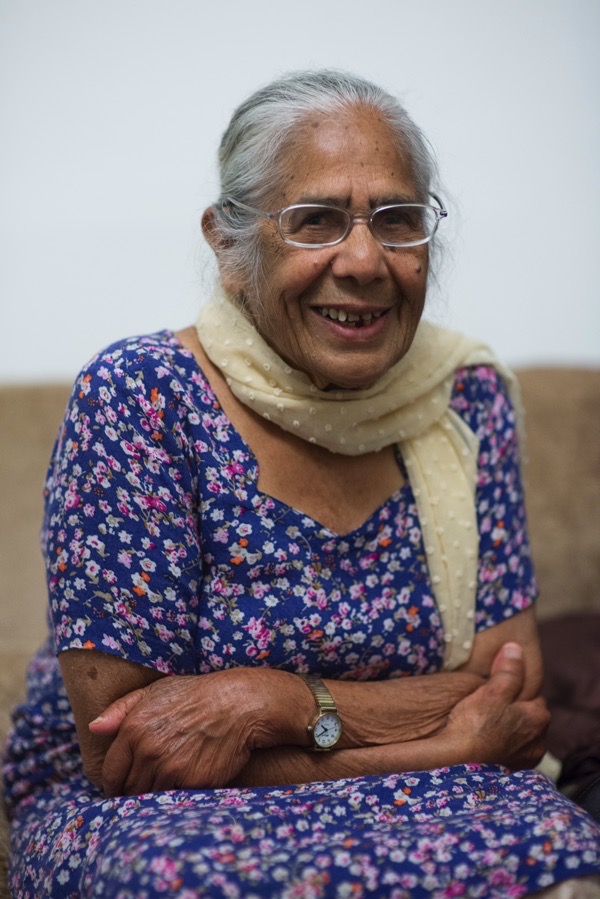
‘We Punjabi girls are strong.’
Contributing Photographer Sarah Ainslie & I first met Parkash Kaur in 2015 when we were making portraits of the residents of the Holland Estate next to Petticoat Lane in Spitalfields. It was evident then that Parkash occupied a revered position among the residents as spiritual mother to the entire estate.
Then Suresh Singh, author of A MODEST LIVING, told me that Parkash famously ran a grocers shop at 5 Artillery Passage with her husband Jarnail Singh. So close were these two Sikh families in Spitalfields that Suresh and his wife Jagir know Parkash as Aunty Ji and, in Suresh’s childhood, he knew Jarnail as Uncle Jarnail.
Jarnail came to London in 1951 from Jundalar in the Punjab to seek a better life and his wife Parkash joined him in 1953. They had been married when they were children. By 1958, they had saved enough money to put a deposit on a shop in Artillery Passage and in 1963 they bought it and moved in, opening the first Sikh grocer in East London.
Around 2000, they closed their shop and retired to live fifty yards away in the Holland Estate. Since Jarnail died in 2010, Parkash lives alone but Suresh & Jagir visit her regularly. Sarah Ainslie & I accompanied them recently and we shared a delicious dinner of Jagir’s homemade rotis and yoghurt while Parkash told her story to Suresh, who has translated it from Punjabi for us to read.
“Your father and my husband made a pact of love and they called themselves the ‘rodda’ Sikhs (the ones without turbans). They had this silent love that they kept dear between them and always knew of each other’s joy and pain, sometimes even without talking.
They sat and talked all day long in our shop at 5 Artillery Passage where me and your Uncle worked day and night. I would shut the heavy shutters in the evening and sleep on the top floor while your Uncle went to do a night shift at the rubber factory in Southall. I walked back the other day to Artillery Passage and I could not even find the door or the number. No one there spoke Hindi or Punjabi any more and I felt a deep loss. It made me very sad.
Our days started at 4am each morning when your Uncle Jarnail would bring boxes of fruit and vegetables from the Spitalfields Market across the road. Big rats would jump out of some of the boxes. I was so scared of the rats, but we had a lovely niece working for us who could catch them by their tails. She would never kill them, but lift the heavy grate from the sewer and send them back. She said they were gods.
Suresh, this was when you were very little. I remember your mother Chinee would always wave and call out ‘Sat Shri Akal’ (blessings to all) to me from far away, if she saw me in Petticoat Lane or in Itchy Park next to the big white church. She was a very observant women who always stuck by your father, Joginder.
I was so happy when your parents invited me and your Uncle Jarnail to your wedding with Jagir in 1984. It was a joyful occasion for Joginder. After his stroke, your father struggled to walk yet he would always come every day from Princelet St to our shop in Artillery Passage and ask your Uncle Jarnail, ‘Do you think we have enough roti flour?’ For a long time, we were the only shop in East London that sold roti flour and people would come from as far away as Mile End and Plaistow.
Your Uncle Jarnail and Joginder helped each other with money, they never wanted to let each other down. People would say ‘Jarnail is a jatt (a farm owner) but Joginder is a chamar (an untouchable).’ Your uncle would reply, ‘Get out of my shop! We do not believe in castes here. He is my brother.’
All the money earned by Punjabis in East London passed through our shop and we sent it over to the Punjab and exchanged it for rupees, so people could build big houses over there. Once I sat on thousands of pounds in cash all on my own while your Uncle was out, before it was sent to the Punjab. I learnt to be a very good counter of money. In those days, people were naive enough to believe that one day they would all take their families back to the Punjab and live there for ever. But in Joginder’s eyes, he knew the truth.
He was happy to spend time with your Uncle Jarnail in the shop. They often spoke of the assassin Udam Singh who lodged in 15 Artillery Passage in the thirties. He shot Michael O’ Dwyer who ordered the massacre of Sikhs in Amritsar when he was Lieutenant Governor of the Punjab.
When me and your Uncle Jarnail needed a break from the hard work of shopkeeping, dealing with customers who never wanted to pay the asking price and always wanted to barter, we would sit on the wall outside Artillery Passage and eat ice cream from another shop – just to have a change. That was our holiday.
Where are all those people who came to our shop now? All gone. The ones that we helped out, where are they? Not to be seen. But you and Jagir are here with me and you know you are always welcome in my home. I am happy that you and Jagir and look after me. Your Uncle Jarnail died and left me alone but I am strong. We Punjabi girls are strong.”
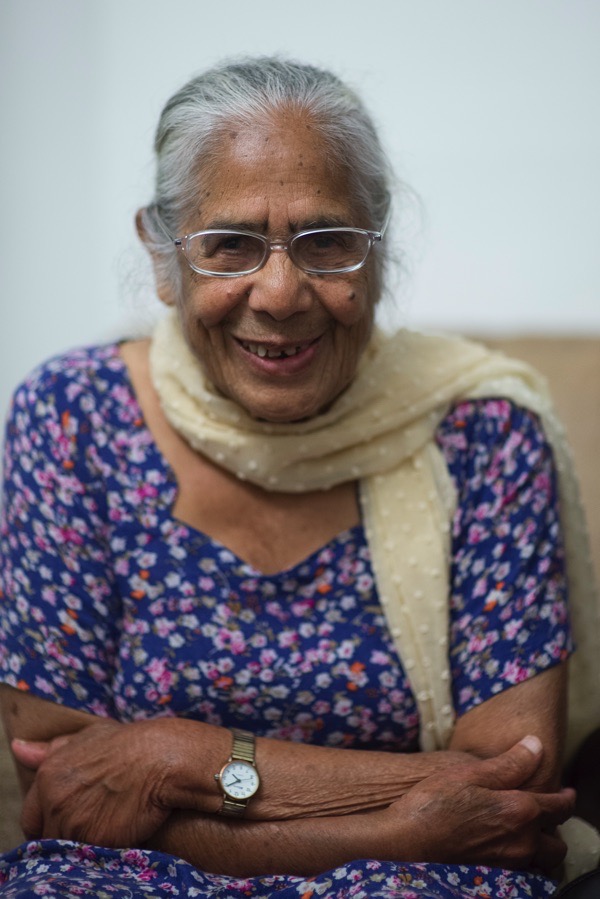
Portraits by Sarah Ainslie
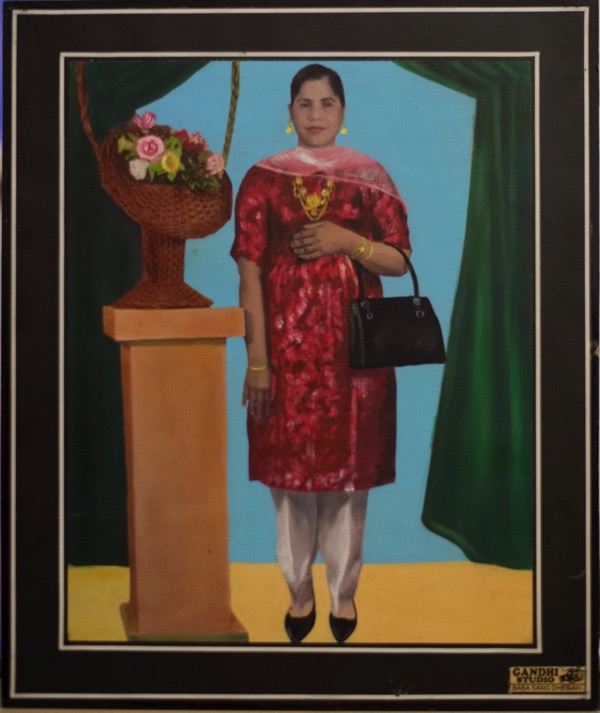
Parkash Kaur
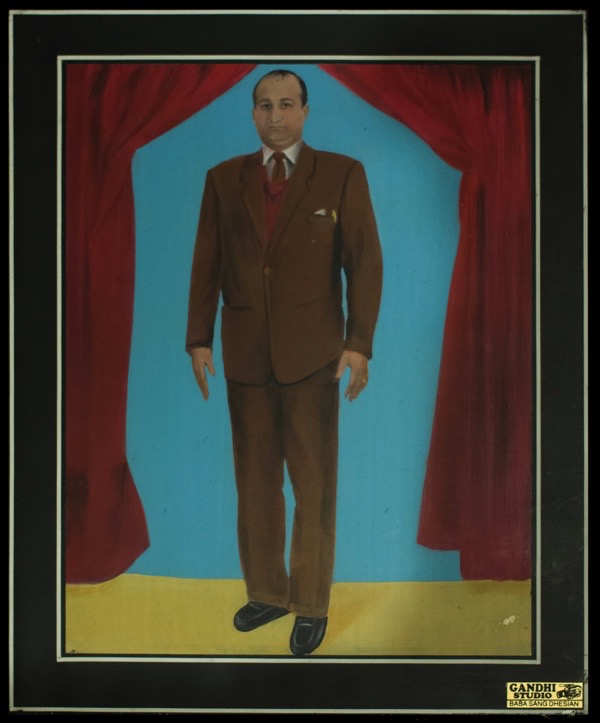
Jarnail Singh
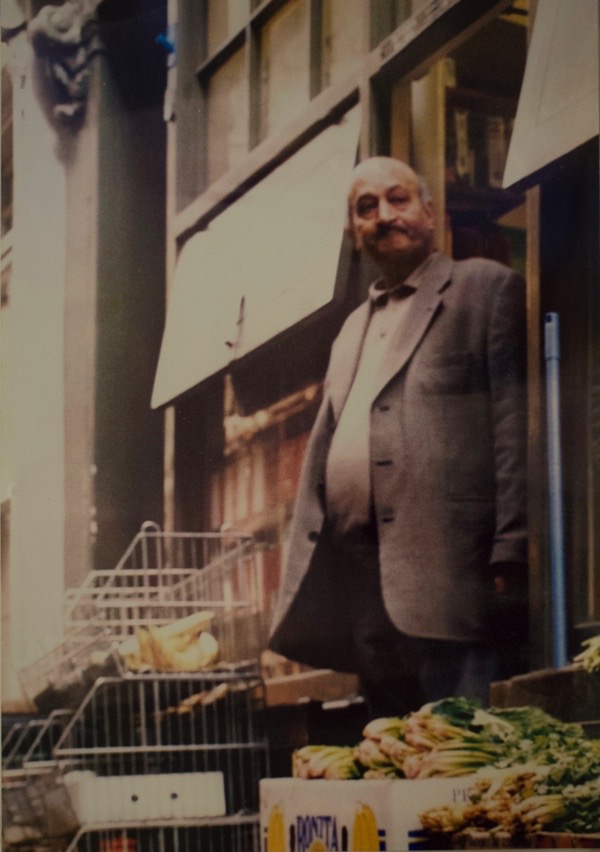
Jarnail ouside the grocery shop he ran with Parkash at 5 Artillery Passage
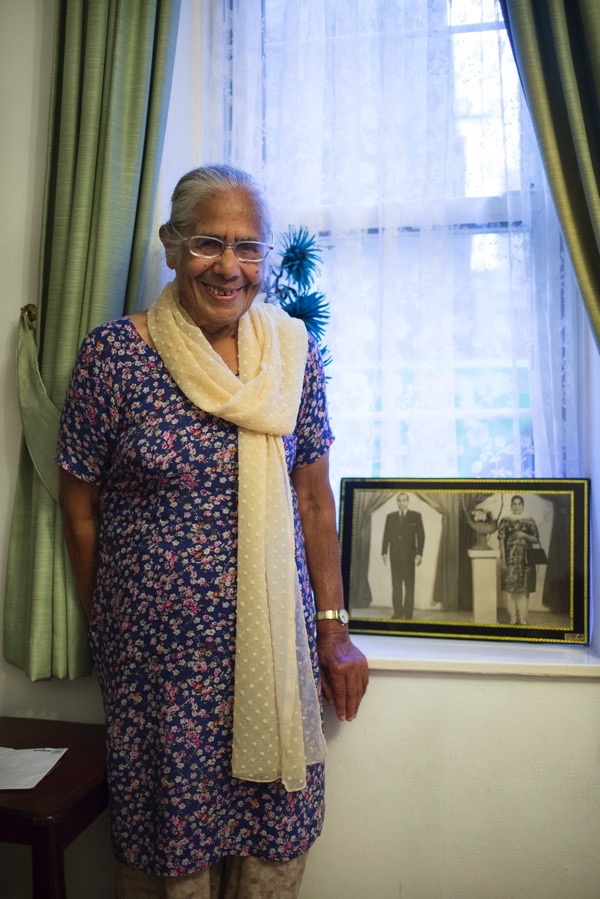
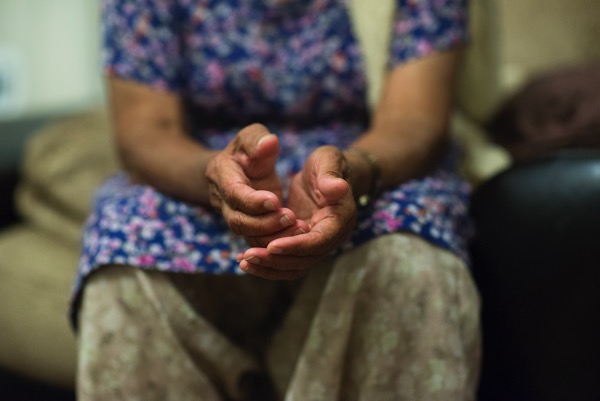
Parkash in her flat the Holland Estate (Photograph by Sarah Ainslie)
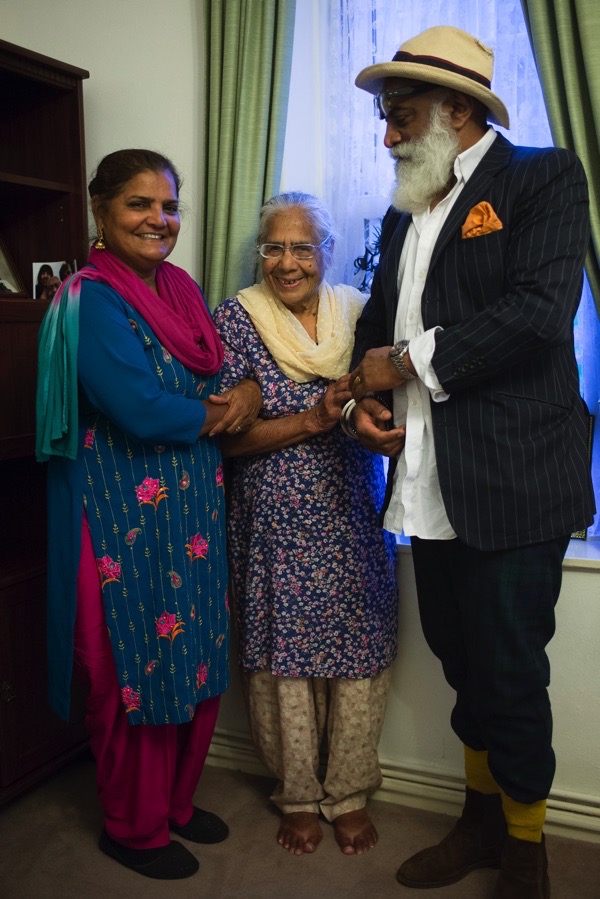
Jagir Kaur, Parkash Kaur & Suresh Singh (Photograph by Sarah Ainslie)
David Hoffman At St Hildas
We are in the third week of our month’s crowdfund campaign and I am grateful to the 139 people who have contributed so far, and touched by your messages of encouragement. I am hoping that we can reach the target in the next 10 days.
CLICK HERE TO VISIT OUR CROWDFUND PAGE & CONTRIBUTE
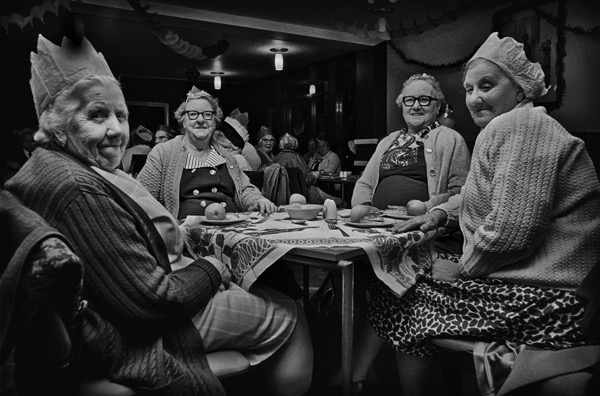
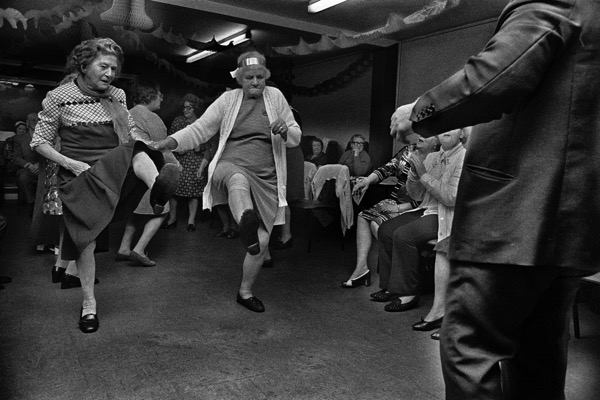
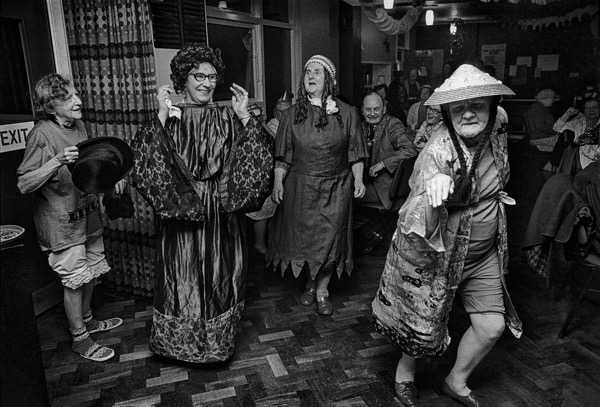
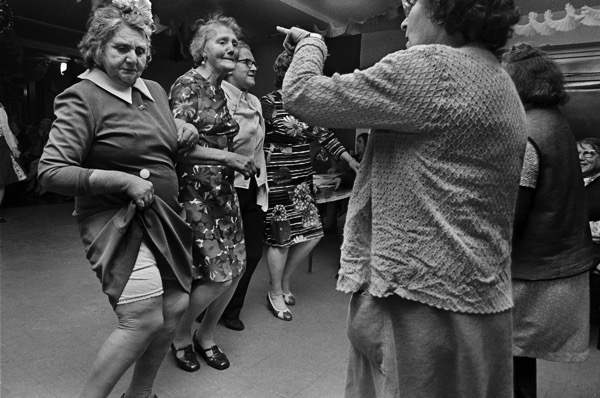
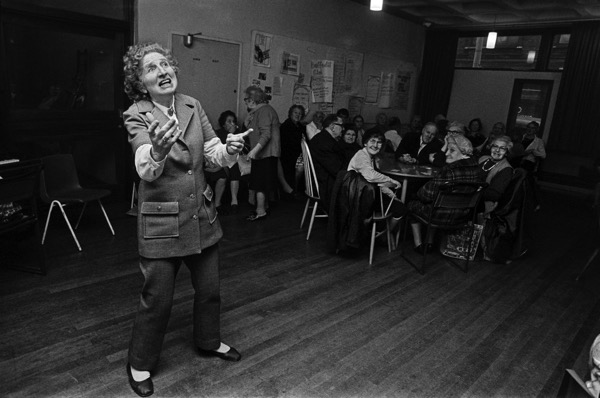
Contributing Photographer David Hoffman sent me these glorious pictures of a party he attended at St Hilda’s Community Centre, Club Row, in 1975.
‘St Hilda’s East was established in 1889 by former pupils of Cheltenham Ladies College as ‘a community of people bound together in the service of the poor’. I came across it by chance in 1975. I was twenty-nine, just starting out as a photographer and this window into an East End from long ago immediately fascinated me.
I just walked in, asked if it would be OK to take some photos and got an immediate easy invitation to help myself. Quickly followed by offers of a cup of tea, a sandwich, a slice of cake… I think this was early December and I saw posters for the Christmas party so I invited myself along.
I found the spirit and the energy of what seemed to me to be such aged pensioners hard to believe. When one of the dancers flashed her knickers and winked at me, I wondered if my tea had been spiked and it was all a delirium. These photos, some unseen since I took them, not only prove that this was no hallucination but, rather disconcertingly, that those seemingly ancient people I photographed were all younger than I am now.’
David Hoffman
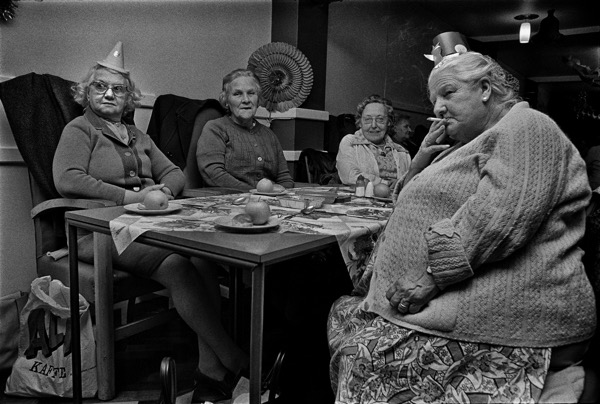
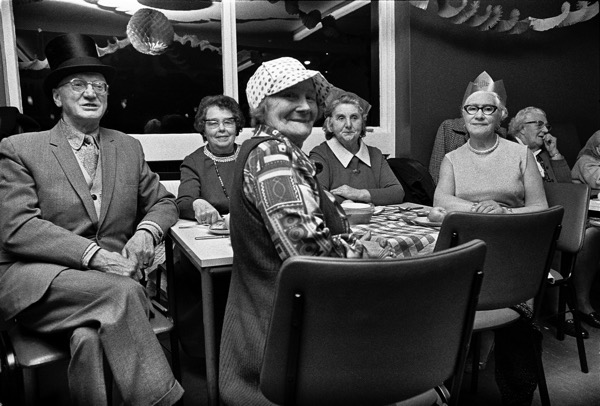
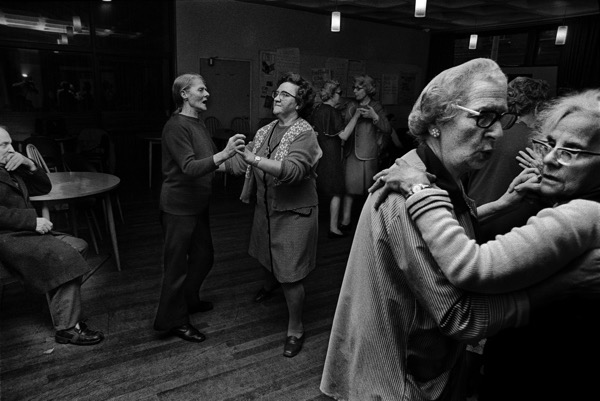
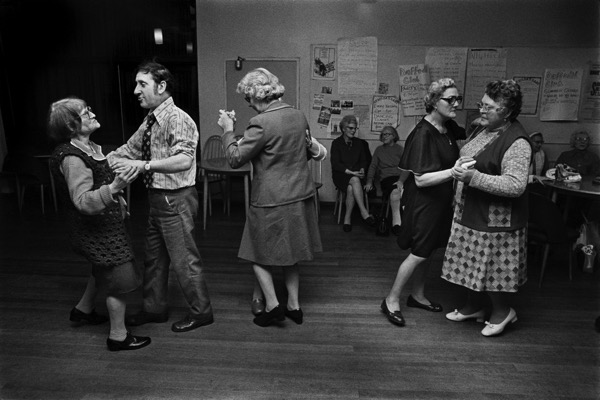
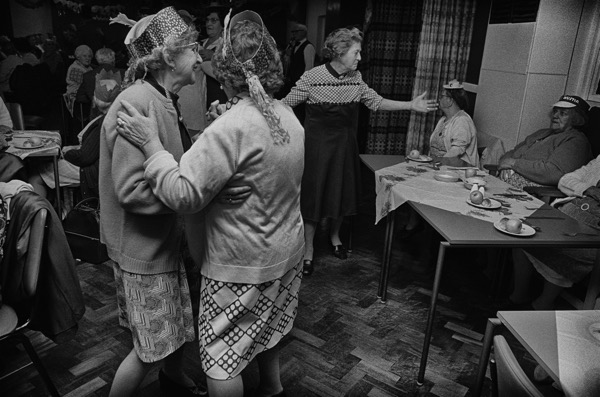
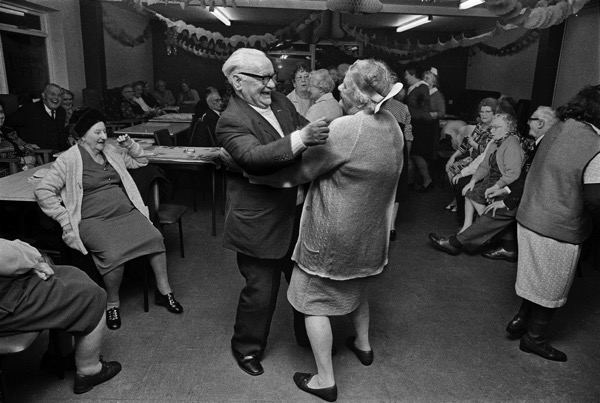
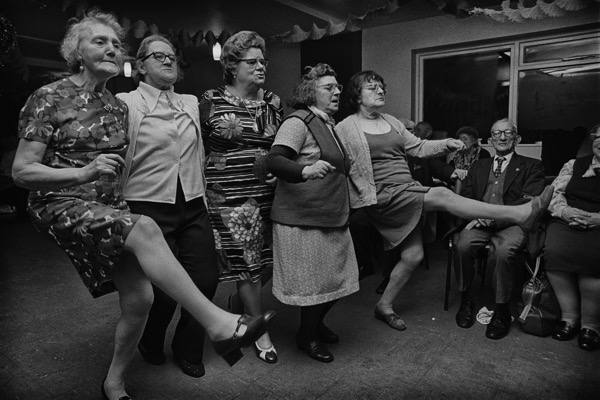
Photographs copyright © David Hoffman
The Hoxton Varieties Mosaic
We are in the third week of our month’s crowdfund campaign and I am grateful to the 132 people who have contributed so far, and touched by your messages of encouragement. I am hoping that we can reach the target in the next 2 weeks.
CLICK HERE TO VISIT OUR CROWDFUND PAGE & CONTRIBUTE
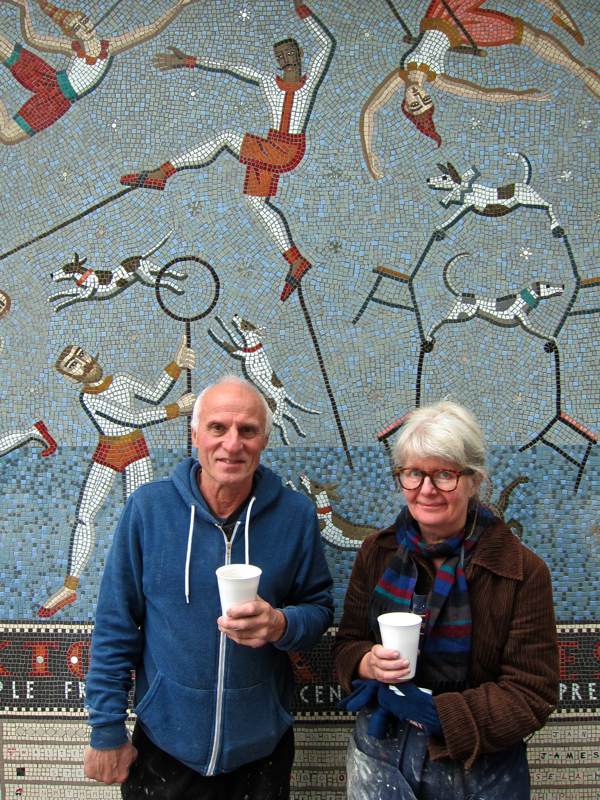
Walter Bernadin, master mosaic fixer & Tessa Hunkin, mosaic designer
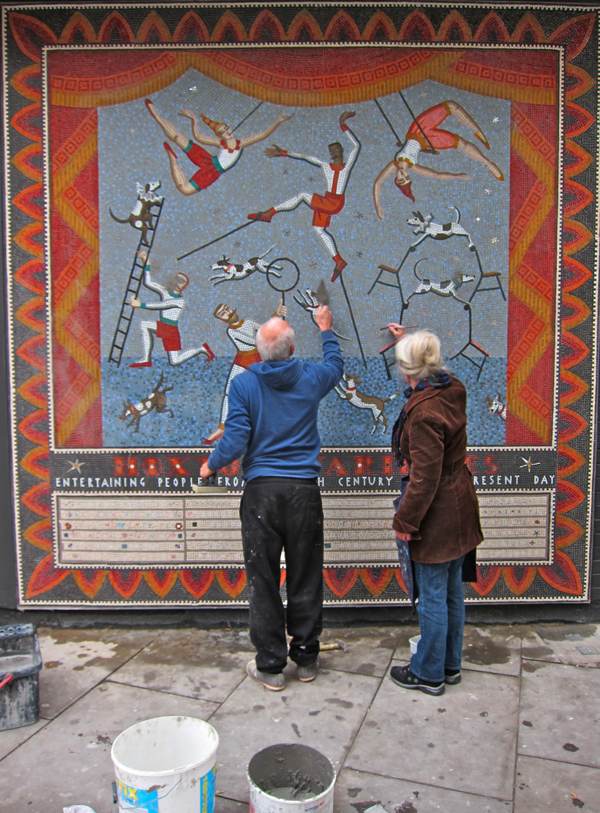
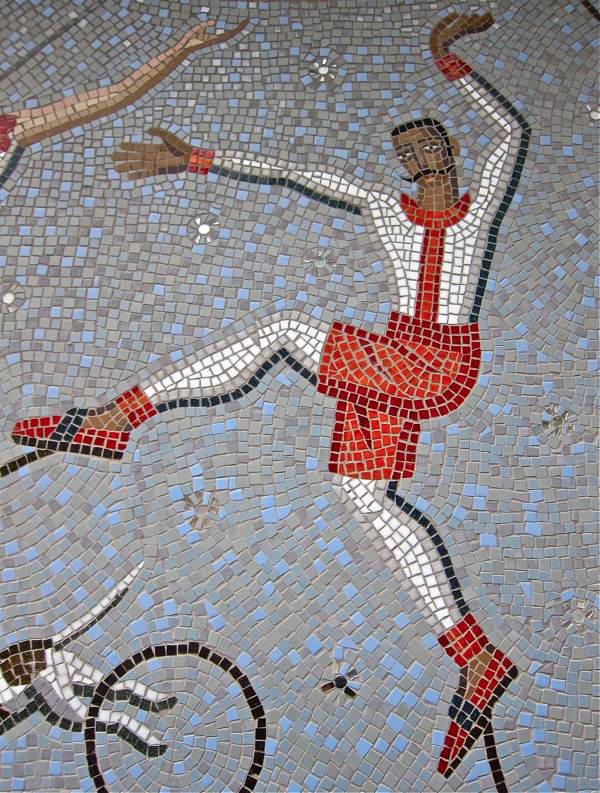
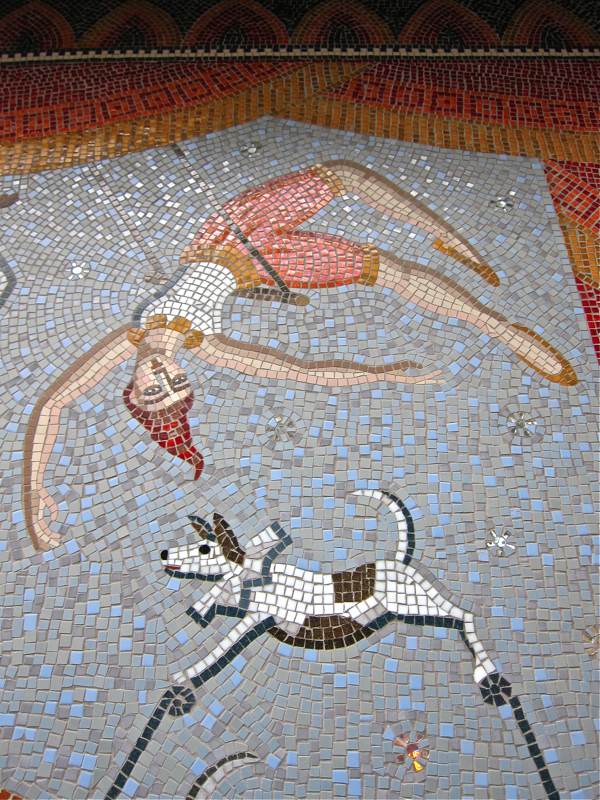
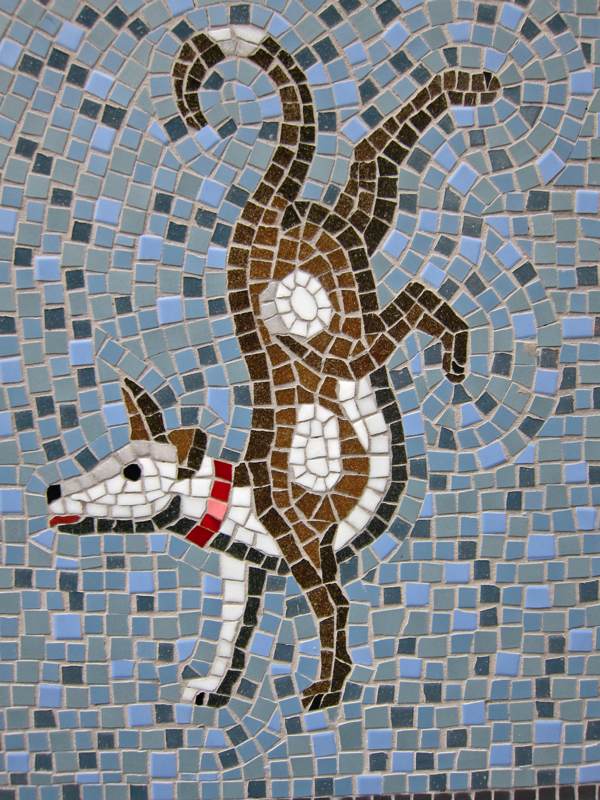
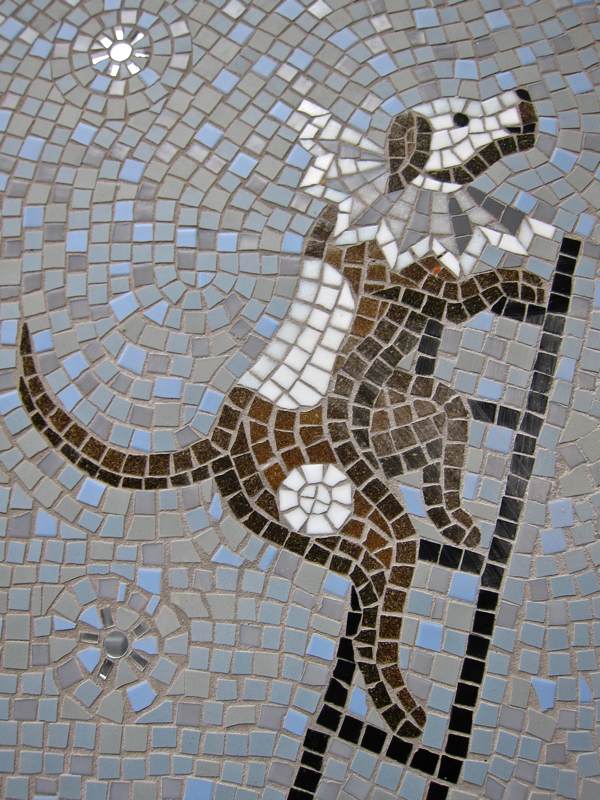
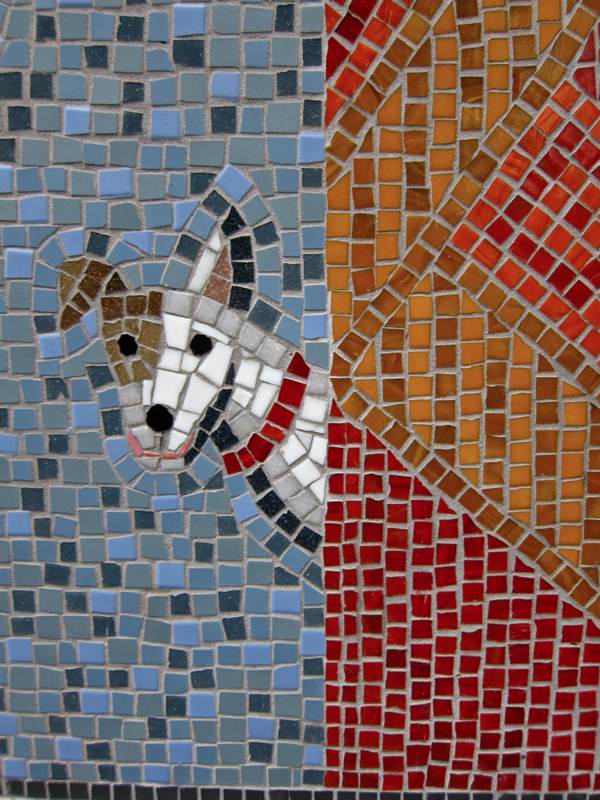
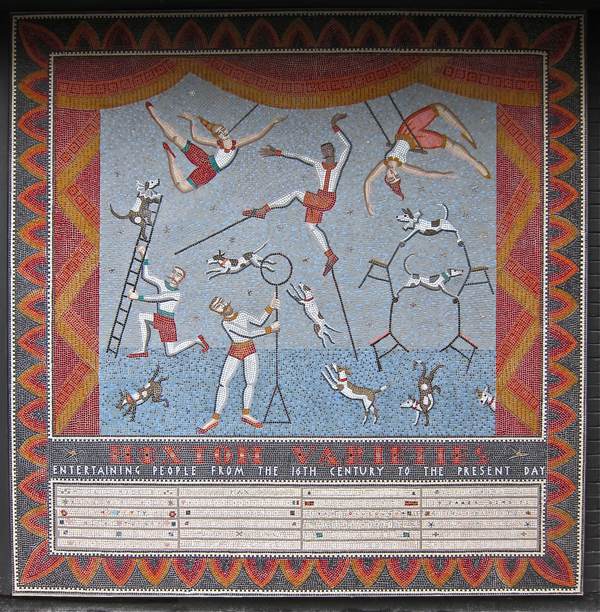
I had the privilege to see the Hoxton Varieties Mosaic by Hackney Mosaic Project unveiled upon the corner of Pitfield St and Old St. Celebrating the former Varieties Music Hall that opened nearby in 1870, the mural designed by Tessa Hunkin and realised by members of the project, illustrates the glory days of live popular entertainment in Hoxton with colourful images of acrobats and performing dogs.
When I arrived, Walter Bernadin, a sprightly white-haired Italian, was up a ladder sponging off the excess grout to reveal Tessa’s lively design in its full glory for the first time. “I am a master mosaic fixing specialist, I’ve been doing it for fifty years,” he admitted to me when I brought him a cup of hot tea to warm his cold hands, “My father Giovanni was a mosaic fixing specialist before me, so I just took on from him. We come from Sequals in Italy, most of the mosiac fixers in London are from there.”
“My father was in espionage and he had been here as a prisoner of war in Mildenhall. Then, in the sixties, there was a lot of terrazzo going on in London, so he came over in 1964. He ran a mosaic gang of forty men and I helped them out on Saturdays from the age of twelve and that’s how I learnt my trade. They put it on bridges and underpasses to cover the concrete. I could take you all over London and show you work my father done.”
The Hoxton Varieties Mosaic was another aesthetic triumph for the Hackney Mosaic Project who have spent the last ten years installing joyful artworks in unloved corners of the neighbourhood and drawing everyone back to consider the meaning of the place. Even on a cloudy day in midweek, a small crowd gathered in delighted excitement to admire the exuberance of the conception as a blank wall acquired a new life in Hoxton.
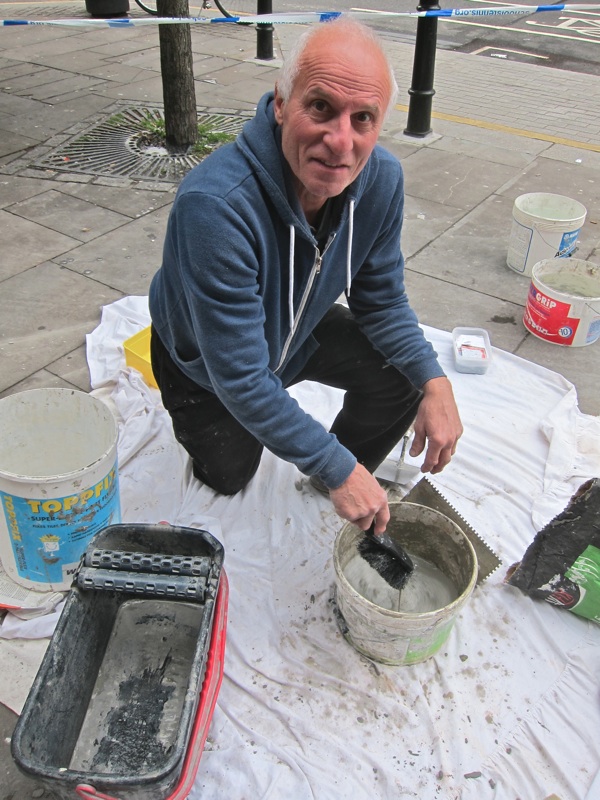
Walter Bernadin, Master Mosaic Fixing Specialist – “I could take you all over London and show you work my father done.”
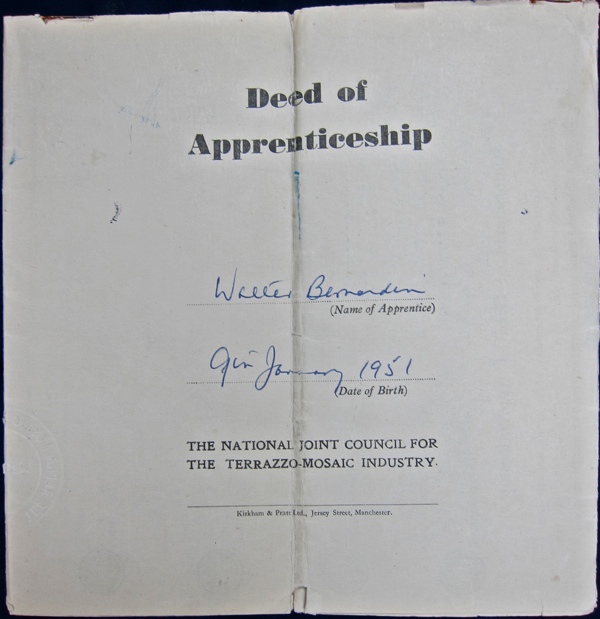
Walter still carries his deed of apprenticeship with him in the van
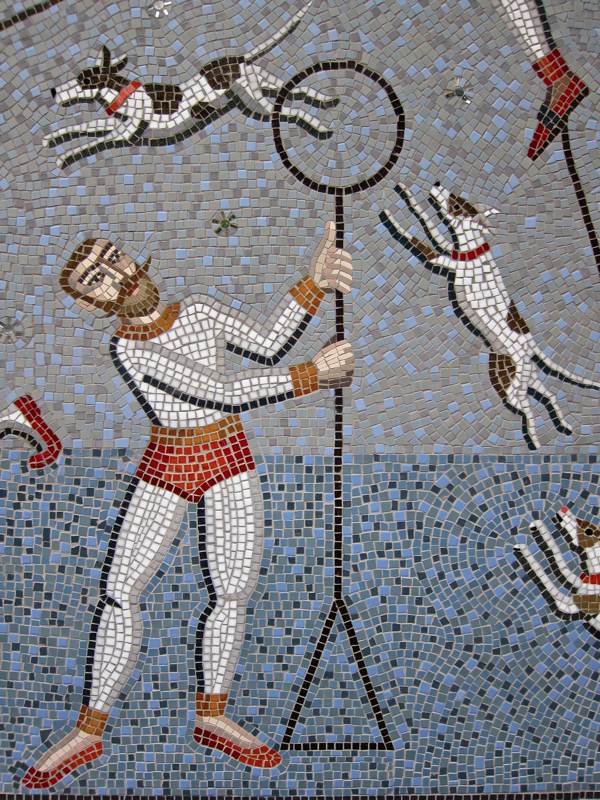
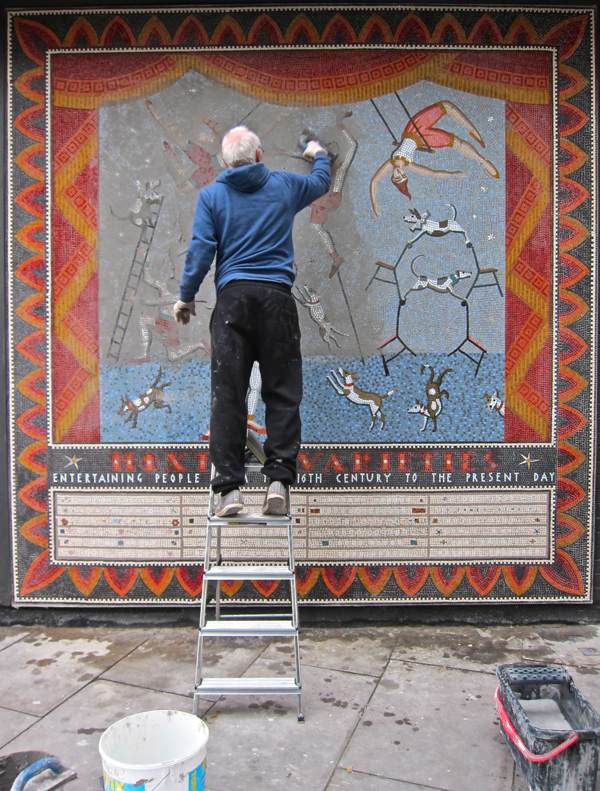
Walter sponges off the surplus grouting to reveal Tessa’s finished design
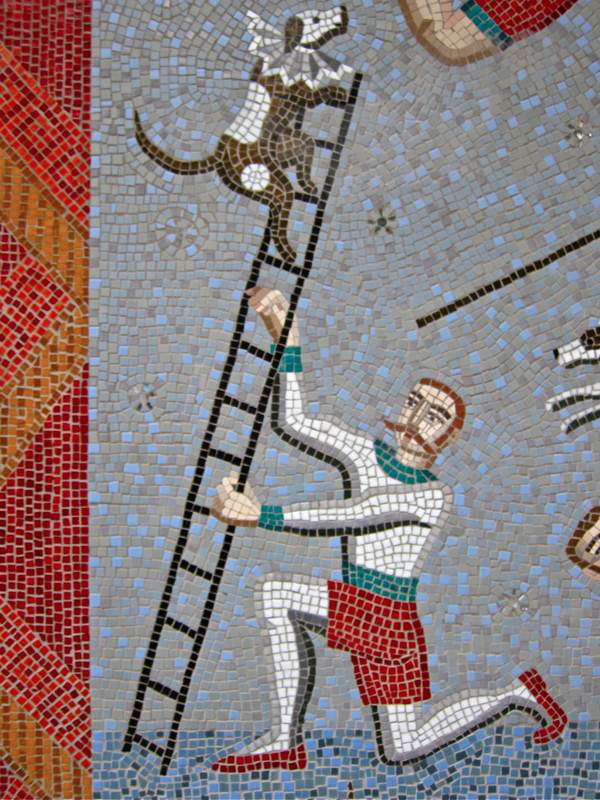
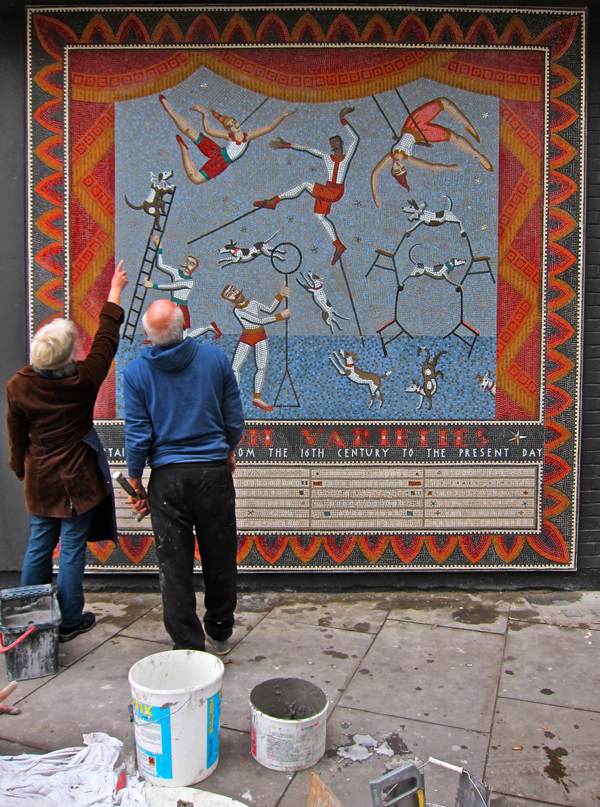
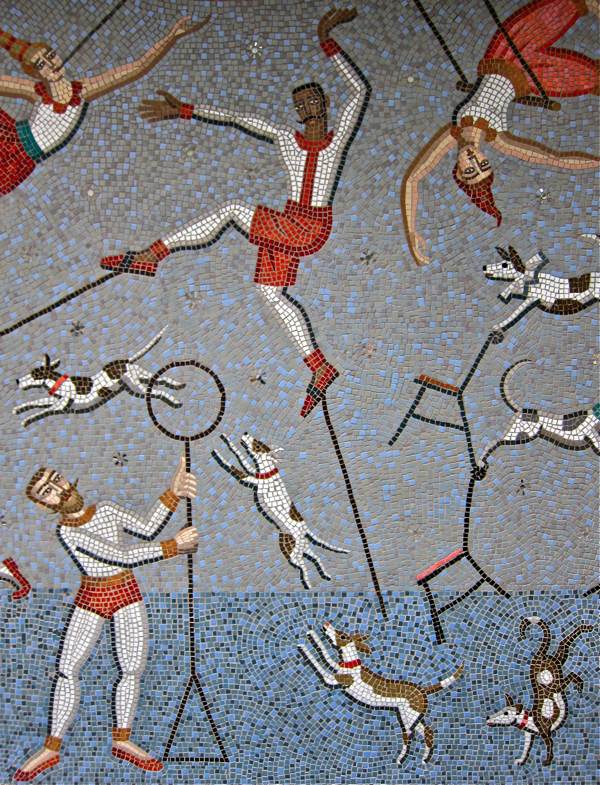
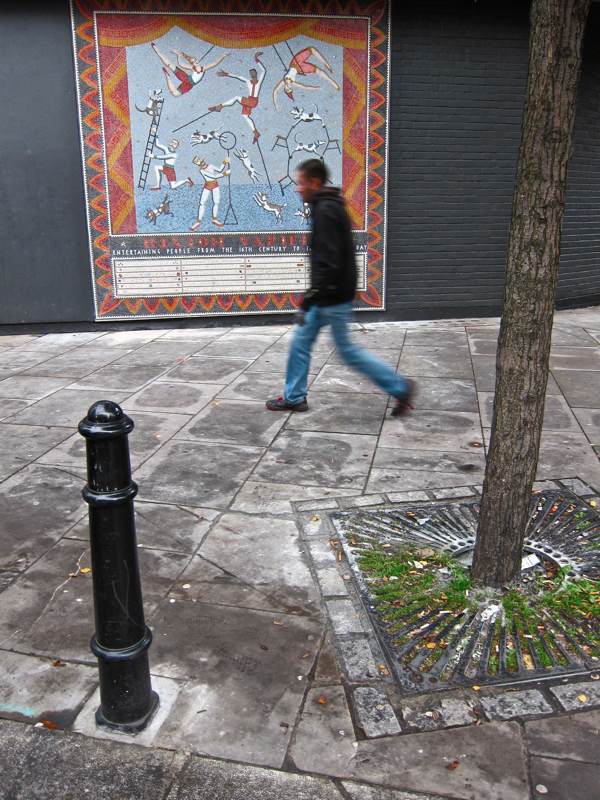
Visit the Hoxton Varieties Mosaic at the corner of Pitfield St & Old St, N1.
You may also like to read about
Gillian Tindall At St Brides
We are in the third week of our month’s crowdfund campaign and I am grateful to the 108 people who have contributed so far, and touched by your messages of encouragement. I am hoping that we can reach the target in the next 2 weeks.
CLICK HERE TO VISIT OUR CROWDFUND PAGE & CONTRIBUTE
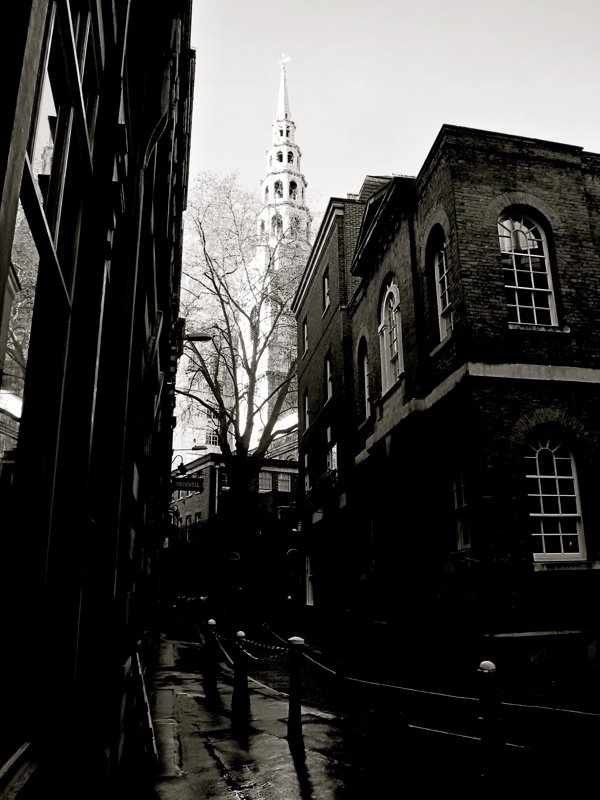
St Brides
Contributing Writer, Gillian Tindall, visits St Brides Church in Fleet St
This year is the three hundredth anniversary of Sir Christopher Wren’s death in 1723 at the age – very advanced for those days – of ninety. This anniversary is being celebrated in many of the City of London churches that he was responsible for redesigning, after eighty-seven of them had been ravaged by the Great Fire of 1666. But he is given special prominence at St Brides which is situated without the old City walls.
Even after suffering another firey destruction in the Blitz of World War II, St Brides still stands today just down the hill from the site of the old Lud Gate, on the west side of the Fleet valley where Fleet St leads towards Charing Cross and Westminster, and to everywhere else that is now Central London.
When the Great Fire took hold on the other side of the City, in Pudding Lane not far from the Tower, on 2nd September 1666, the wind was blowing from the east. So, four days later, when the devastated Londoners returned to survey the blackened wreckage of their homes and businesses, churches and storehouses, they found that much of the Aldgate and Bishopsgate area to the north-east of the walled City had been spared, but – in defiance of all hopes and prayers – the wind-driven blaze had jumped the stream in the Fleet Valley and devoured St Brides.
It just spared St Andrew, Holborn, a little to the north, and was about to consume the buildings of the Temple when fortunately it was quelled. Perhaps the wind dropped or possibly the energies and organisation of King Charles II, who had taken matters over from the desperate City Mayor, had something to do with it.
So Wren’s triumphant rebuilding of St Brides in the 1670s is being celebrated this autumn with a recital and a dramatic performance. But this is not in the actual St Brides, brick for brick, that was built by Wren, but rather, in the careful simulacrum of it that was a post-World-War II rebuilding. The design followed Wren’s faithfully, though leaving out the gallery seating and bits of late-Victorian décor. So what you see today is very much what Wren’s contemporaries, in their periwigs and cumbersome great-coats, would have see in the exciting modernity of the early 1700s. Except that the church is now nicely heated: no thick coats needed.
What the Blitz of 1940 also revealed were not merely extensive graveyards, spreading to the south-east right across where Farringdon Rd now runs, but – beneath everything else – the ruins of Roman mosaics. Evidently this site was a holy place well before an obscure `St Bridget’ lived and died – indeed before the first emissaries of the Christian faith landed on our shores. Relics and fragments of these distant times are now displayed beneath the church in the old crypt. This was sealed up, along with its bodies and coffins, when it came to be understood in the Victorian era that putting rotting remains beneath a church floor is hardly an hygienic method of disposal.
After the War, these and all the other newly-found bones were taken off to the Museum of London, but some of them were later returned to the church for storage in neatly labelled cardboard boxes. A previous Rector once opened a box to show me the tiny fragmented skull bones of Wynken de Worde, the man credited with the invention of print in the late fifteeth century. Though Fleet St is no longer the heart of newspaper production, the association of the church with print flourishes to this day. St Brides is where editors and journalists, including those who lose their lives in foreign wars, are celebrated and commemorated.
Samuel Pepys was baptised here, in the old pre-Great Fire St Brides while the poet John Dryden was a regular attender in the post-Great Fire one. But in recent times more obscure yet equally interesting members of the congregation have featured on wall-plaques on the west porch. Who has heard of Denis Papin? Very few, I guess, although he was a remarkable man, extraordinarily ahead of his time. A Huguenot from the Loire, he came to London in the 1670s and managed to interest several members of the newly-founded Royal Society in his ideas about steam. It could, he argued, be utilised to power devices, and he managed to invent a kind of pressure cooker.
Later, back in France and then on the far side of the Rhine, he created the first model of a piston steam-engine, a whole century before steam-power became the driver of the Industrial Revolution.
But when he returned in 1707 his old acquaintances in London had forgotten him or were dead, and several years later he was destitute. His lonely death in August 1713 went unremarked, and it was not until three hundred years later that a researcher in the Metropolitan Archive came upon the record of his burial in St Brides’ lower ground. Now he is commemorated in stone.
A nearby memorial similarly bestows dignity on a forgotten individual of a different kind. The current Rector of St Brides, Canon Alison Joyce, became interested in one of the victims of the over-publicised Whitechapel murders – one who evidently did not conform to the stereotypical assumption that the women were all sex workers. Mary Ann Nichols, known as Polly, was not only born in St Brides parish, she was also married there in 1864 to a printer. She could read and write, and she had five children. But the marriage broke up and there is evidence that she chose to live instead with the man she would have preferred to marry in her teens but was not allowed to. When this relationship ended too, she seems to have taken to drink and the addresses recorded for her were workhouses and the lowest sort of lodging houses.
A plaque in St Brides reads ‘Remember her life, not its end.’ Given the uncertainties, pains and regrets that accompany too many people’s last days, that might serve as a kindly epitaph for many of us.
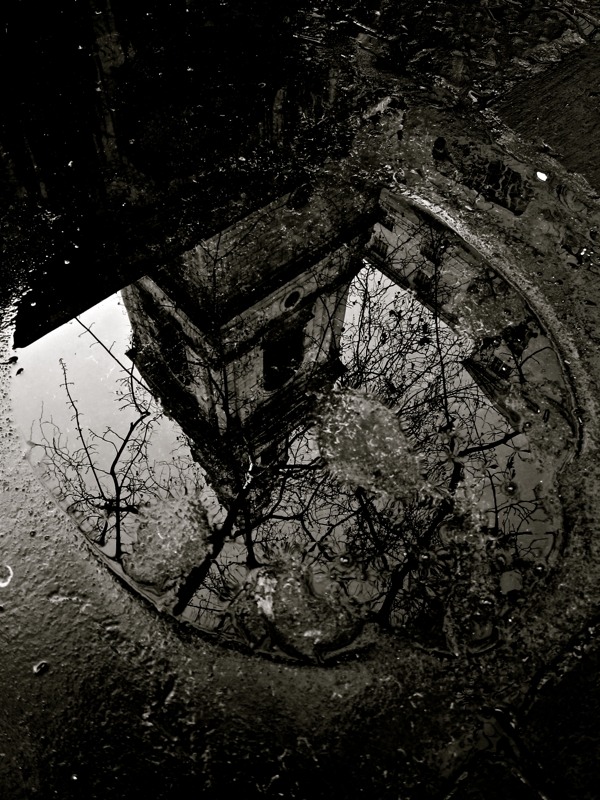
In St Brides Churchyard
Gillian Tindall’s The House by the Thames is available from Pimlico
You may like to read these other stories by Gillian Tindall
Memories of Ship Tavern Passage
At Captain Cook’s House in Mile End
Eleanor Crow’s Everyday
Yesterday, we passed the midway point of our month’s crowdfund campaign and I am grateful to the 99 people who have contributed £10,755, and touched by your messages of encouragement. I am hoping that we can reach the target in the next 2 weeks.
CLICK HERE TO VISIT OUR CROWDFUND PAGE & CONTRIBUTE
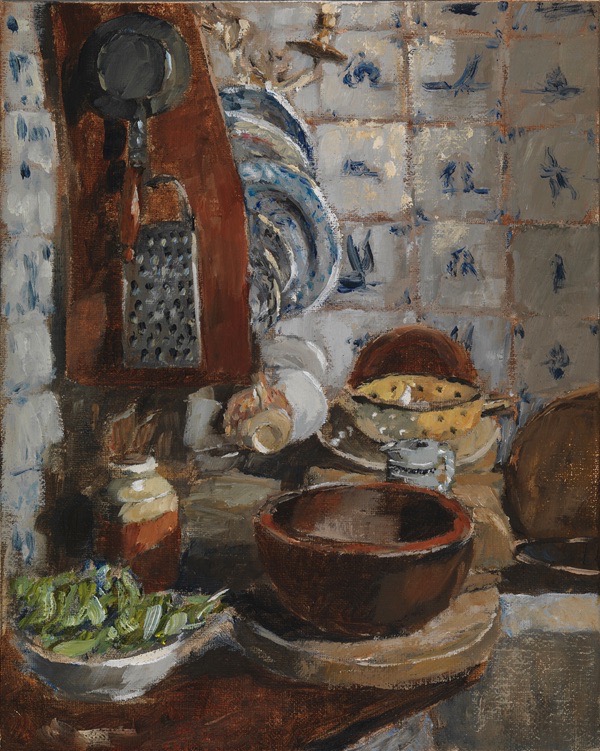
A Corner of the Kitchen at Dennis Severs’ House
I am delighted to publish this gallery of favourites from Contributing Artist Eleanor Crow‘s forthcoming exhibition of paintings entitled EVERYDAY at Townhouse Spitalfields, opening next Saturday 7th and running until 22nd October.
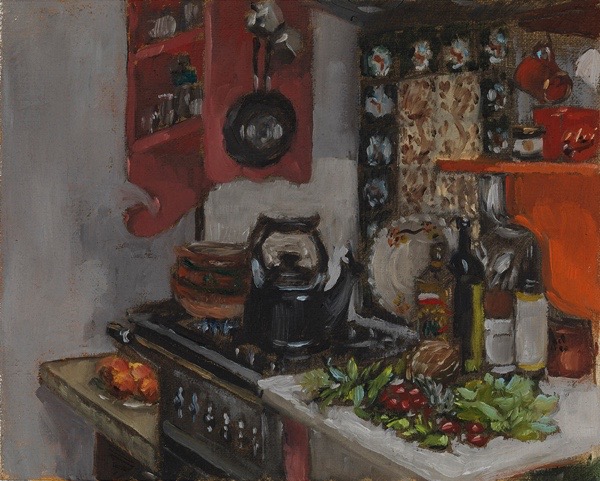
The Kitchen of Jagir Kaur and Suresh Singh
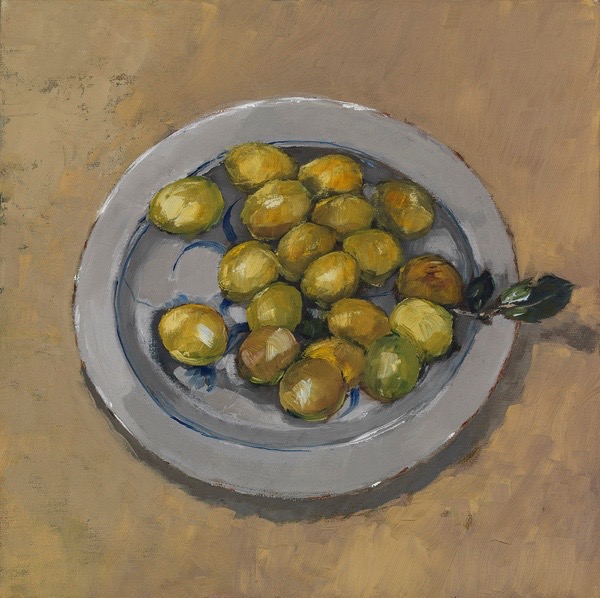
A Plate of Greengages
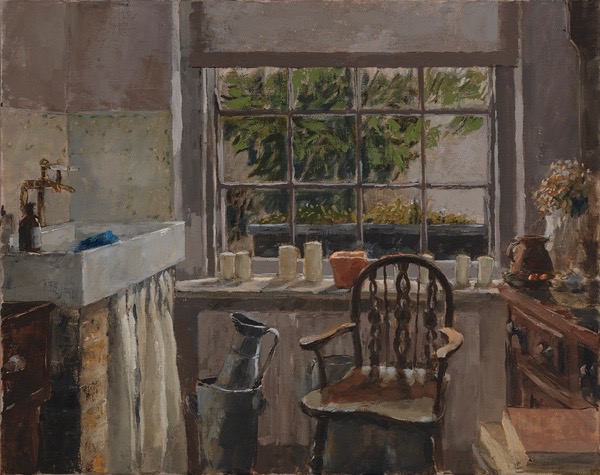
A North London Kitchen, Summer Light
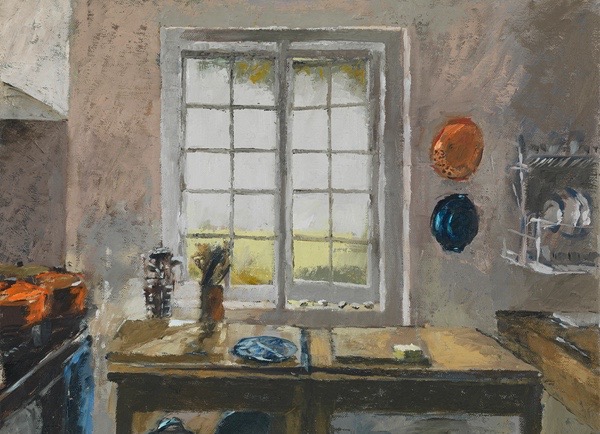
A Dorset Kitchen in Summer
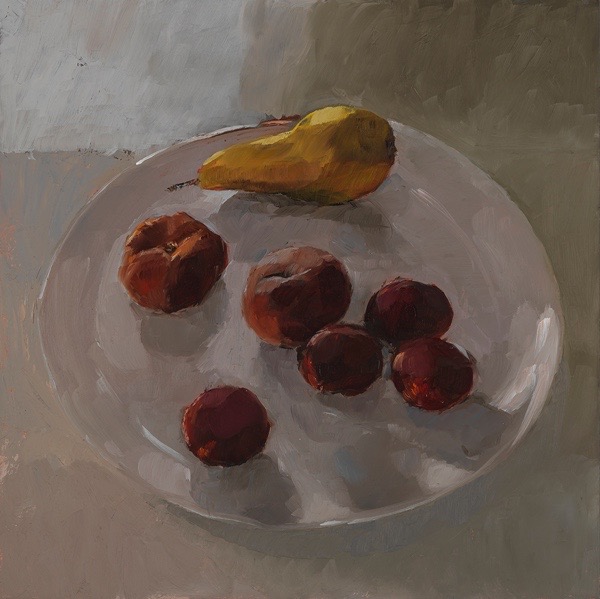
A Plate with Fruit
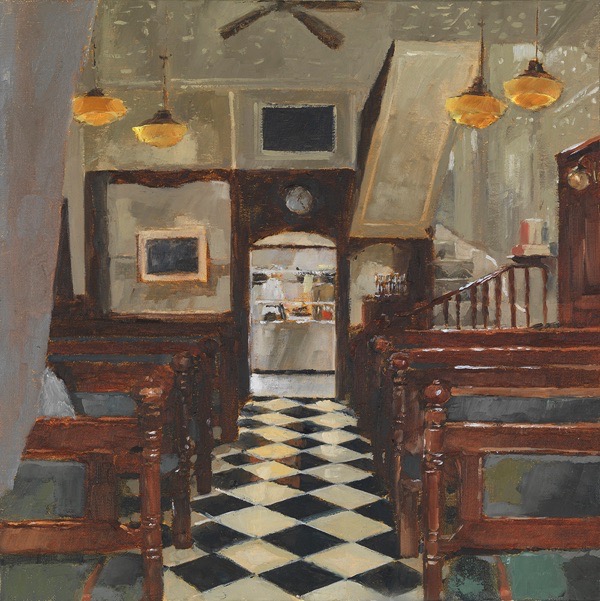
At The Quality Chop House
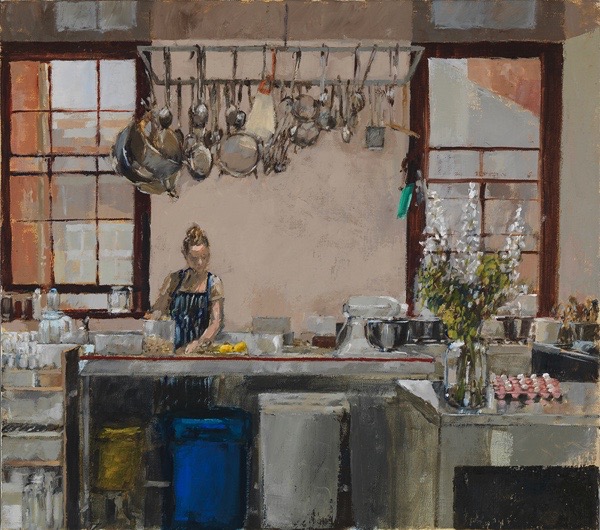
The Kitchen at Leila’s Cafe
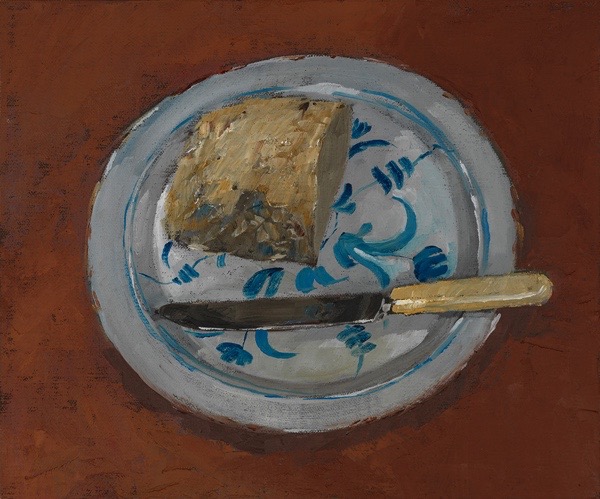
Bread on a Delft Plate
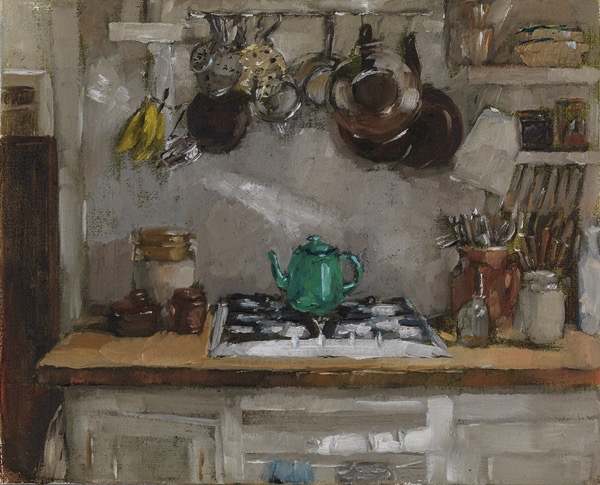
A Corner of a Stockwell Kitchen
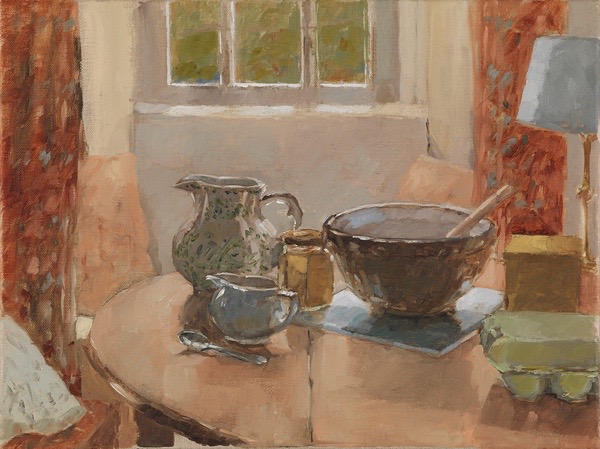
Bird How Still Life
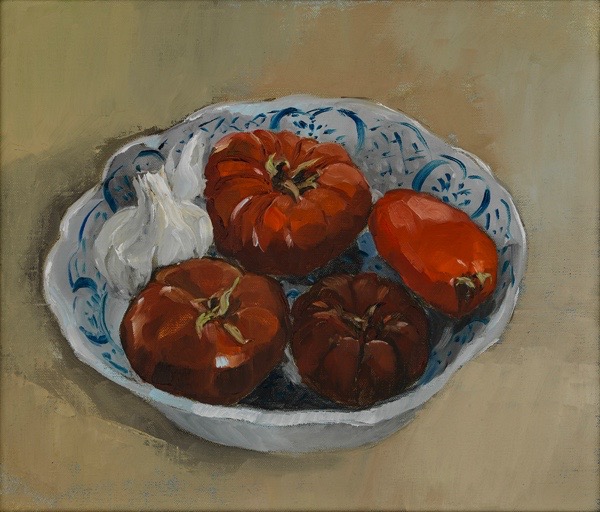
Tomatoes and Garlic
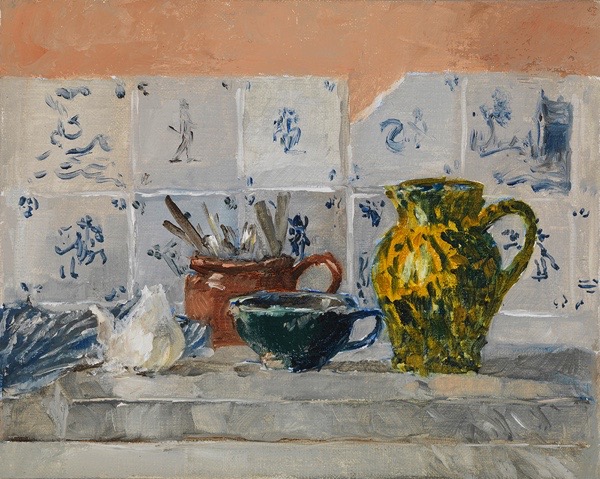
Still Life in Dinah’s Kitchen
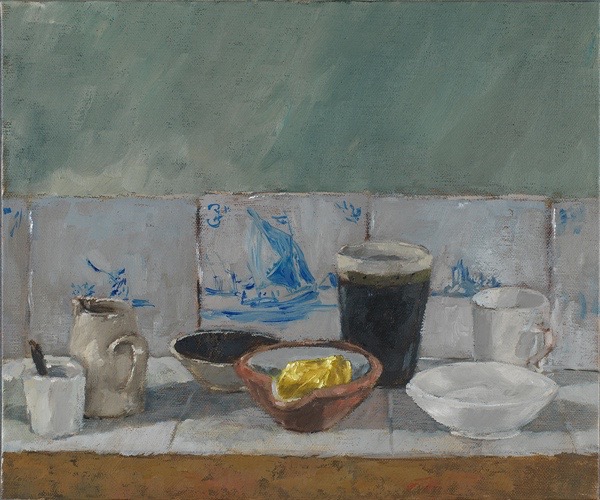
The Little Dutch Kitchen
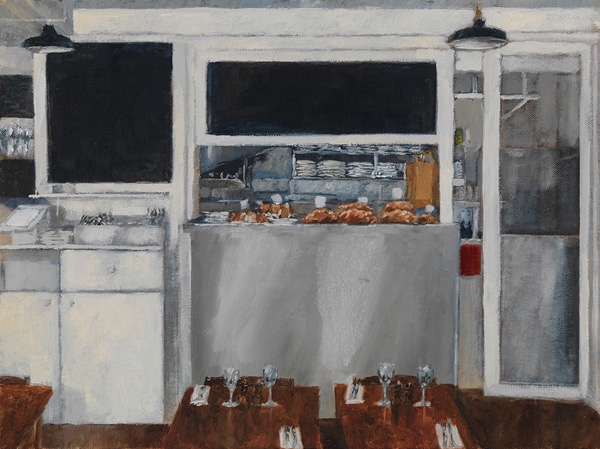
St. John Bread & Wine, Morning Light
Paintings copyright © Eleanor Crow
You may also like to take a look at
The Midway Point

CLICK HERE TO VISIT OUR CROWDFUND PAGE & CONTRIBUTE
After two weeks, we have now reached the midway point of our month’s crowdfund campaign and I am grateful to the 84 people who have contributed a total of £10,405, and touched by your messages of encouragement. I am hoping that we can reach the target in the next two weeks, by 14th October.
Please consider helping us take a big step by becoming a patron and receiving a signed fine art print by Doreen Fletcher, signed photographic prints by David Hoffman and Sarah Ainslie, plus an inscribed copy of my forthcoming book.
Although I write on the internet, I still believe in the primacy of books. The world wide web could get wiped out tomorrow but history teaches us that books endure. Publishing books is not an easy task, yet I am passionate to do it when I find stories that I want to cherish, that I know people will love, and that I believe deserve to be dignified in our time and for posterity.
A good example of such a story is Suresh Singh’s ‘A Modest Living, Memoirs of a Cockney Sikh.’ But equally, a collection of photography such as Horace Warner’s ‘Spitalfields Nippers’ or a collection of artworks such Doreen Fletcher’s ‘Paintings’ comprise incredibly important stories that needed to be published.
In different ways, each of the three new books I want to publish is a witness of our times and I am committed to publish them so you can have copies and we can share them with everyone, and they can be a legacy and record of our era.
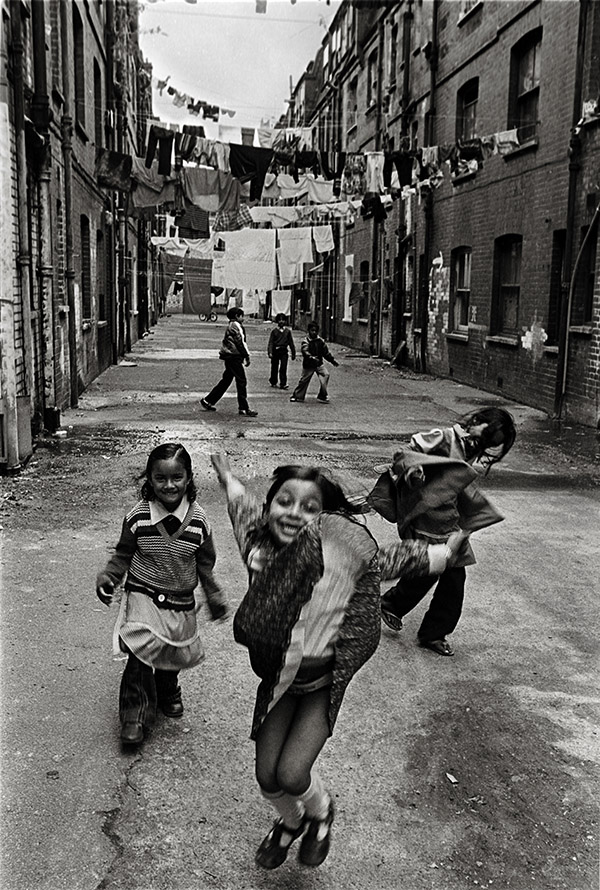 Fieldgate Mansions, Whitechapel, 1981
David Hoffman’s A Place to Live, Endurance & Joy in the East End 1971-87 is the outcome of more than ten years work in which he photographed the lives of the people around him in Whitechapel. No-other photographer did this with such candour and compassion as David. We have already worked for more than three years to organise this brilliant photography with David’s testimony to create the best possible book. I am publishing David’s work because I believe it is an invaluable social record.
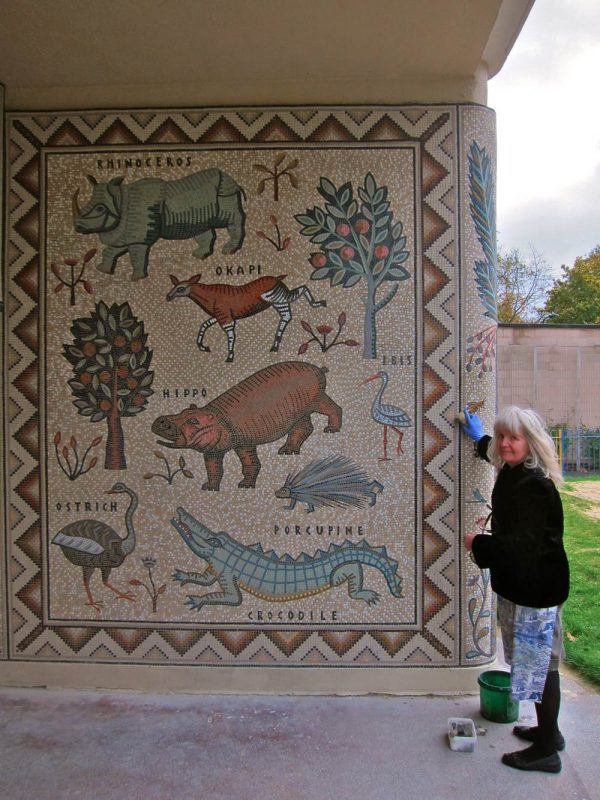
For over ten years now, Hackney Mosaic Project led by Tessa Hunkin has created breathtakingly beautiful and witty public mosaics across the East End. People are astonished when they come upon one, but once they are all collected into a book the monumental scale of the achievement will become evident. I want this to be celebrated and I want people in the future to know that – even in a time of austerity – local people worked together as volunteers to create artworks of enduring beauty to enhance their neighbourhoods.
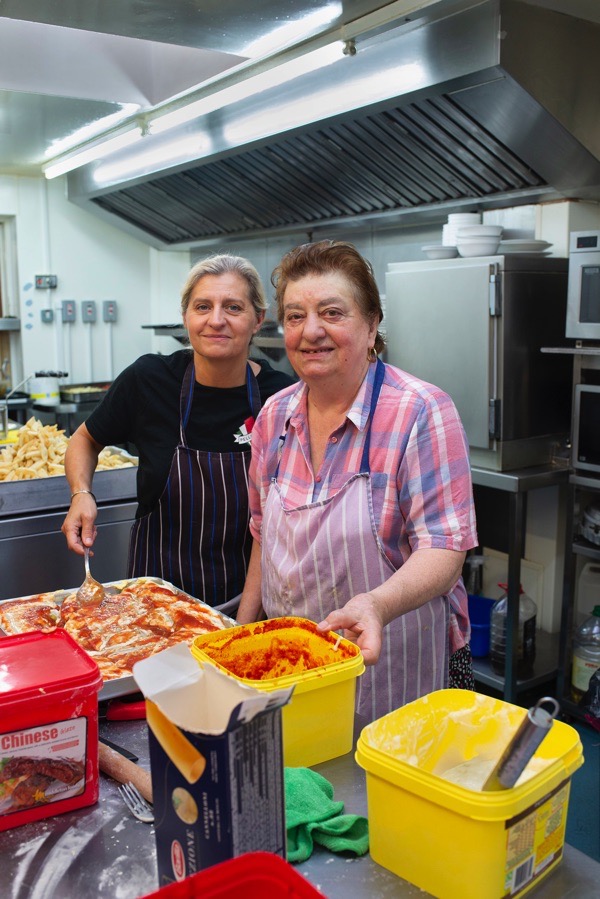
Anna & Maria Pellicci at their restaurant founded by Elide Pellicci in 1900
Sarah Ainslie’s Women at Work in the East End, 1992 – 2023, collects a unique gallery of exuberant portraits that capture the passion and struggle of the working life. What began as Sarah’s personal project drawing on her archive over thirty years and her work as Spitalfields Life Contributing Photographer, has become a panoramic survey of social change and is destined to be the historic record of women’s working lives in London through the past three decades.
CLICK HERE TO VISIT OUR CROWDFUND PAGE & CONTRIBUTE
Best wishes for getting the publishing going again! I lived in Fieldgate Mansions in the early 80’s, towards the end of David Hoffman’s time there. I don’t think I ever met him, but it was very moving to see his photos and I look forward to the book being published.
Garth Maeer
Your blog is the first thing I read every morning. It is a joy. I admire all that you do in the community. Thank you.
Christine Chinnery
Best of luck Gentle Author! From your biggest Nuevo México fan!
Melissa Delano
The three publications look fantastic. Particularly looking forward to reading Sarah Ainslie’s Women at Work in the East End
Madeleine Ruggi
Good luck!
Simon Costin
In honour of Tessa Hunkin and her team and their magical work.
Michael Zilkha
Good luck, wish you success
Vivienne Ritchie
Delighted owner of many of your titles and looking forward to buying the Mosaics book. Your blog a constant source of delight for many years now. Thank you
Raymond Golland
Supporting because we’d love to see Sarah Ainslie’s book published, alongside all the other great projects
Maya Corry
Brilliant projects! Amie and Jason x
Amie Corry
Living in Wisconsin, USA, your words and images transport me to a different time and place that need to be known and are impossible to see without you. Thank you for your dedication to history.
Maria Rogers
David Hoffman’s East End

Starting in 2013, Spitalfields Life Books published 15 books over 6 years until the pandemic shut us down. Now we are ready to begin again and are crowdfunding to raise enough money to cover production of our next 3 books. We have raised £10,005 so far.
CLICK HERE TO VISIT OUR CROWDFUND PAGE AND CONTRIBUTE
Thank you for all you do to document and celebrate the human history of the East End. Hugh Valentine
I am so looking forward to the publication of these books – I always read your blog and really enjoy your writing. Good luck! Sarah Lewington
All the very best of luck with this venture. Dina Fawcett
To support GA, the authors, artists, illustrators & photographers in the production of more beautiful books. Hellen Martin
May you and Spitalfields life, blog, community and books continue to inspire, flourish, stir and resist..thank you. Silvervanwoman
Good luck. I’ve got quite a few of your books and will look forward to more. Alison Pilkington
I have great admiration for The Gentle Author. TGA works incredibly hard and deserves all the support that we can give. Tim Sayer
Valuable historically and personally memorable for different aspects of the East End to be recorded, visually and orally so the streetscape, cultural vitality and diversity of voices are not lost. Jude Bloomfield
The daily blog from Spitalfields Life is life affirming. Best wishes with the publishing venture. Kate Amis
The Gentle Author brings great enjoyment to me every morning. Lynn MacKay
Looking forward to all three books – especially the mosaics, scattered like stardust, and free for all to enjoy…as all great art should be. Josephine Eglin
Dear Gentle Author, I am a great admirer of Tessa Hunkin’s work and would like to support the publication of your book about her and her mosaics. Many thanks for the work you do for so many and the interesting stories you share with all of us readers. Best of luck with this and warm crispy autumn wishes, Matilda Moreton
Good luck with the publication fund raiser. I loved working with Sarah Ainslie on various Spitalfields Life pieces, and I’m excited for her work, and the others, to be published in book form. Rosie Dastgir
I love the books! Good luck! Mary Winch
Love the books – hope the funding project succeeds. Edward Gillman
Good luck with your worthy venture. Keith Brennan
Amazing books … keep going. Sophie Alderson
Precious publications from a very special place … Oh here’s to Spitalfields lives ! Sophie Thompson
I am a great-granddaughter of man born in Bethnal Green. Proud to be an East Ender! Pamela Henning
Wonderful projects. Sensorinet
Cracking beautiful relevant stuff !! Bonne chance xx Oliver Lazarus
I love your books, which would not be published anywhere else. Long may you continue. Melanie McGrath
Books open worlds, make great companions, are lovely gifts, and keep our minds from growing stale. And they ask for little in return! Long live books! Jennifer Newbold
So pleased you’re re-launching SL Books, which are all beautifully produced and feature the work of such excellent photographers, artists and writers. Julia Meadows
Good luck – your books are brilliant. Joan Isaac
Today we preview David Hoffman’s book:
A PLACE TO LIVE: ENDURANCE & JOY IN THE EAST END 1971-87
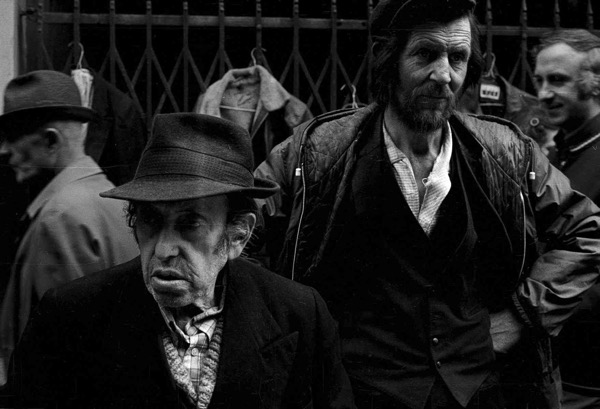
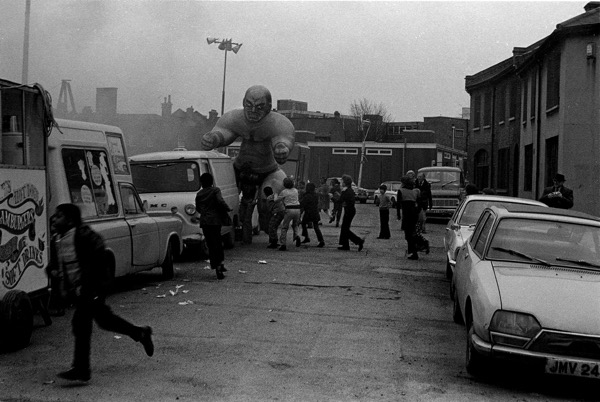
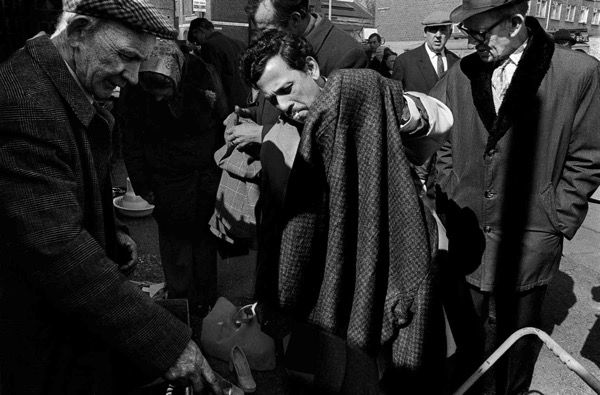
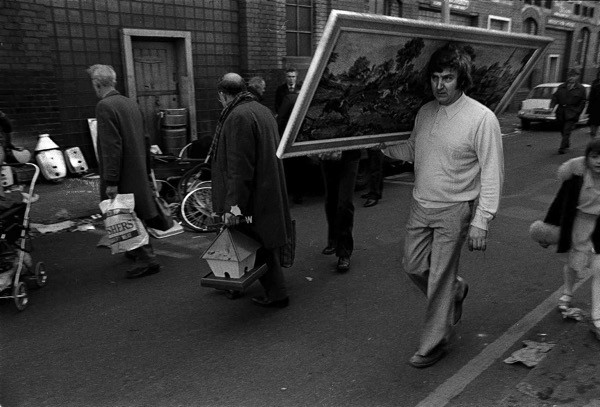
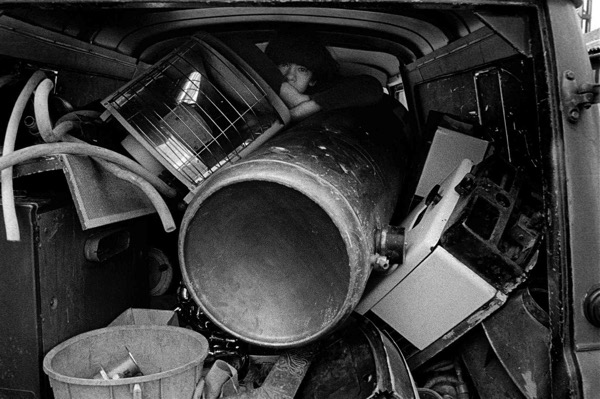
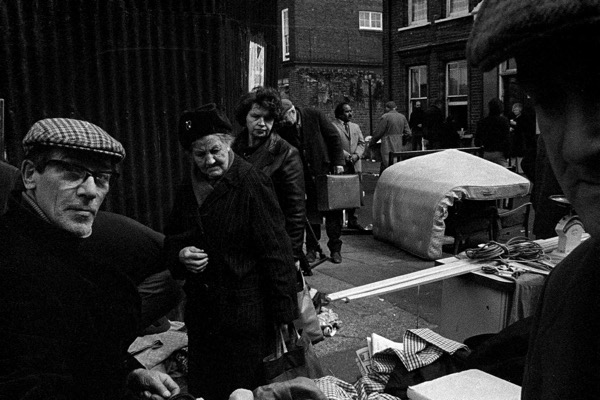
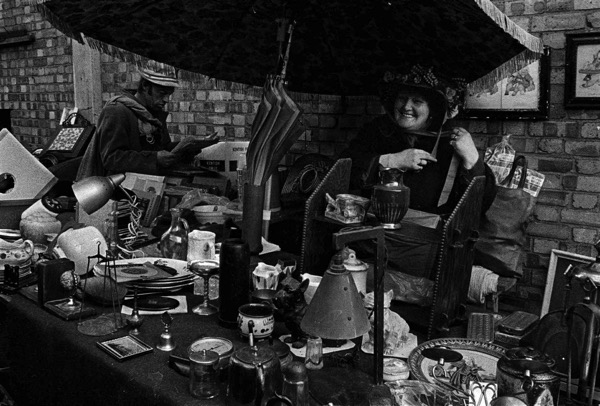
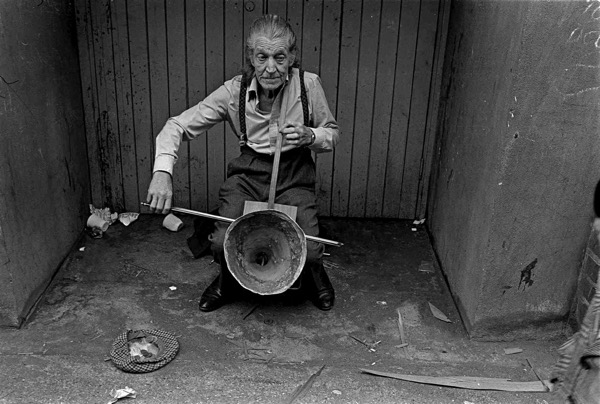
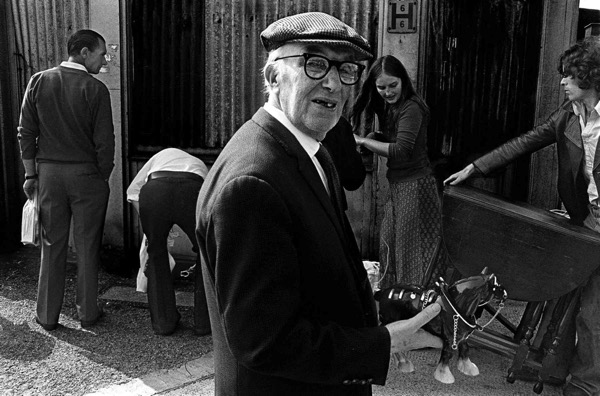
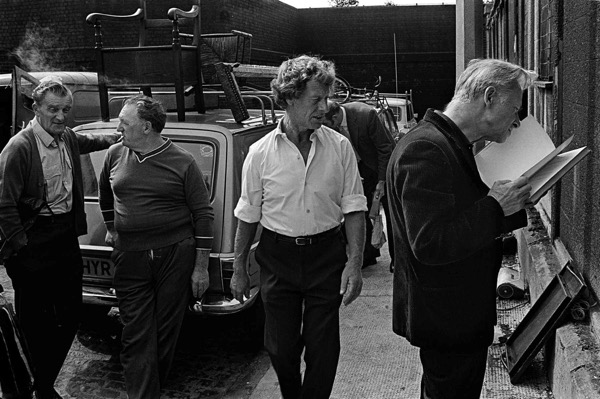
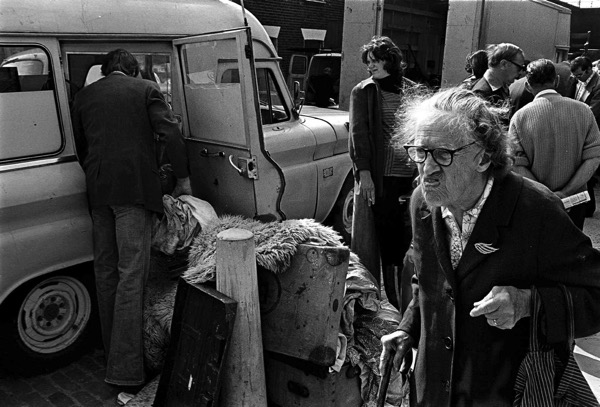
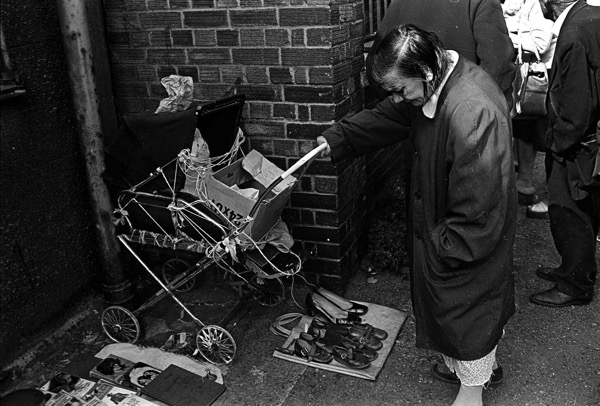
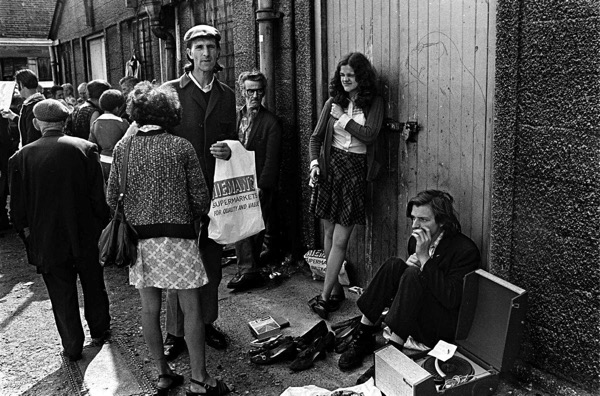
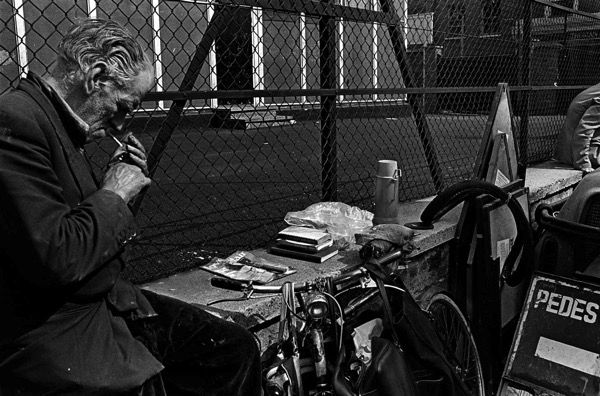
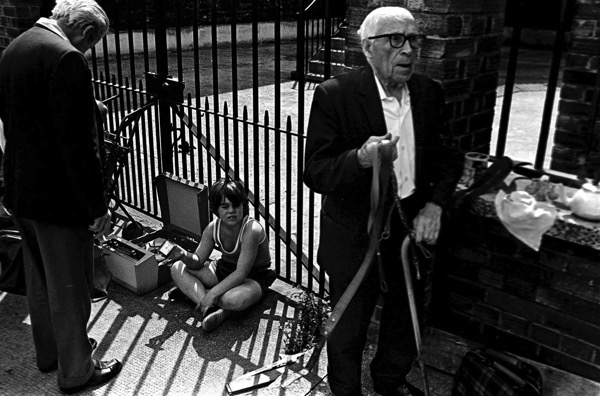
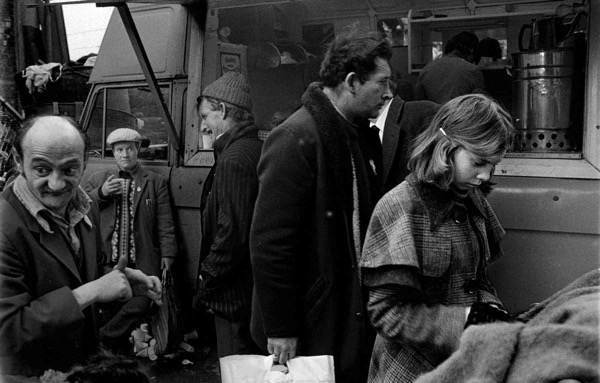
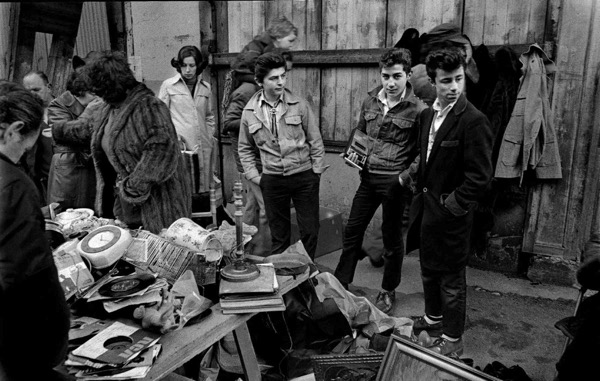
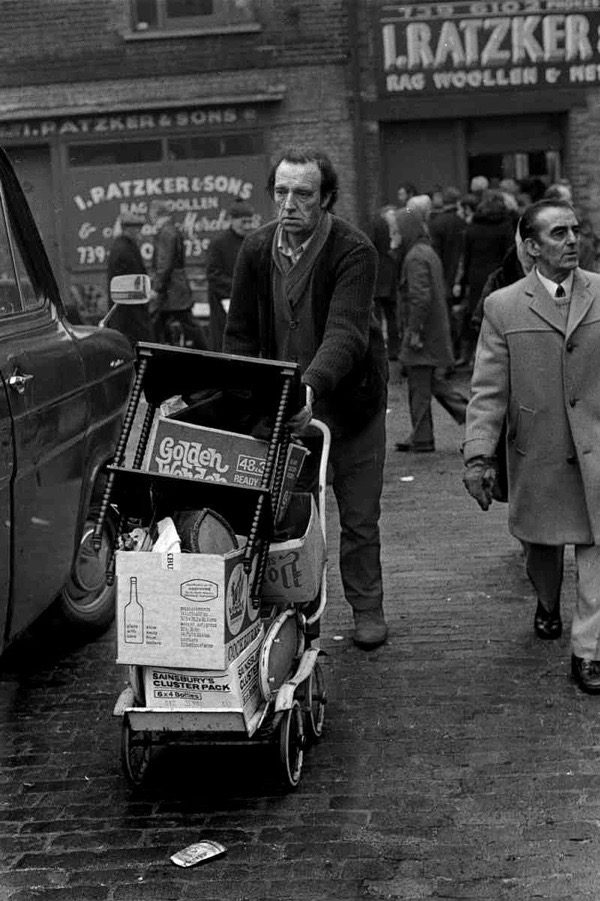
David Hoffman’s bold, humane photography records a lost decade, speaking vividly to our own times. Living in Whitechapel through the 70s, David documented homelessness, racism, the incursion of developers and the rise of protest in startlingly intimate and compassionate pictures to compose a vital photographic testimony of resilience.
“The old East End was disappearing as I took these photographs, being able to bring back a glimpse of its spirit in this book means a lot to me.”
David Hoffman
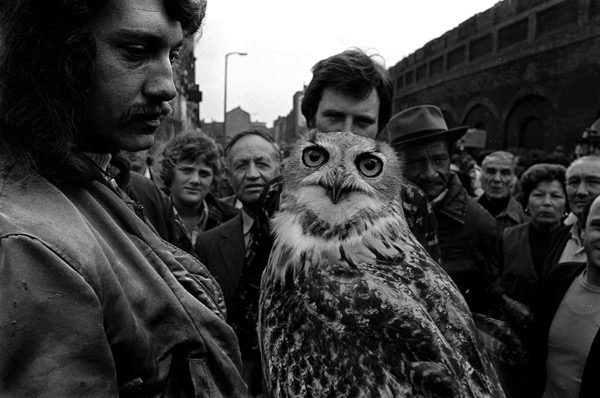
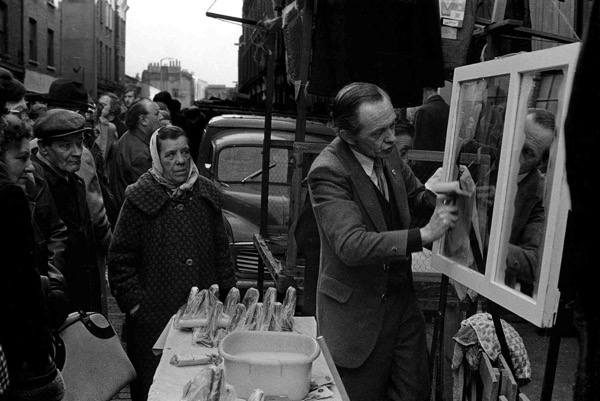
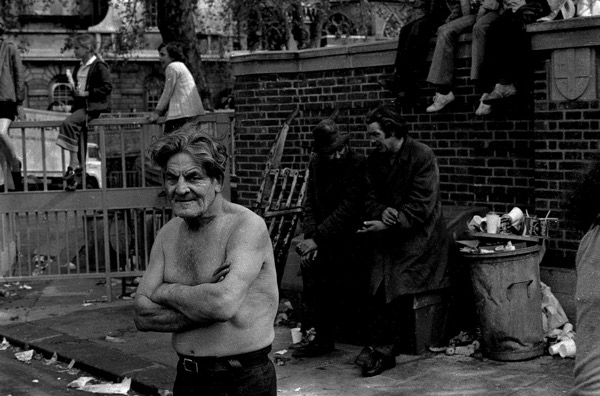
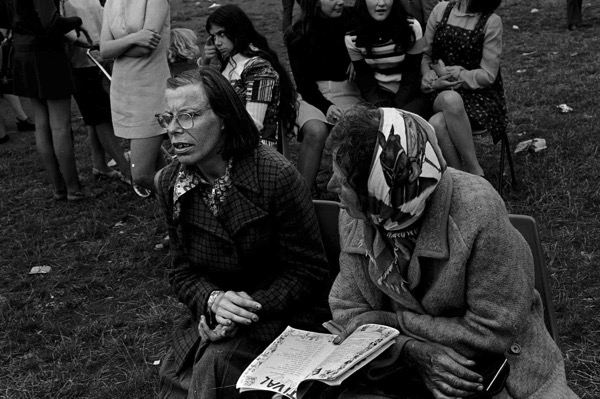
“I moved to the dilapidated slums of Whitechapel from the dilapidated slums of North Kensington in 1970. First to 19a Chicksand St which was soon demolished, then to 17 Black Lion Yard. When that was predictably demolished in 1973, I squatted one of the tinned-up tenement flats in Fieldgate Mansions, replacing the council concrete-filled loo and building a darkroom.
With a Nikon F and 35mm lens hanging from my wrist, I wandered the strange, chaotic time-slipped streets trying to work out what photography was about. I never did find out. These photos ended up as contact sheets buried and forgotten beneath the protest photography that became my specialism in the late seventies.
As I now digitise forty years’ work, they’ve floated back into sight. I think they’ve matured nicely over the decades.”


Photographs copyright © David Hoffman












