
Paul Sandby’s Cries Of London, 1760
Click here to book your ticket for THE GENTLE AUTHOR’S TOUR OF SPITALFIELDS

I am giving an illustrated lecture about the CRIES OF LONDON as a prologue to Berio’s CRIES OF LONDON performed by the Carice Singers at St Botolph’s Without Bishopsgate on Tuesday 2nd July at 6:30pm as part of SPITALFIELDS MUSIC FESTIVAL. Click here to book your ticket

Frontispiece to Paul Sandby’s ‘Cries Of London Done From The Life’
Observe this young woman displaying her raree box containing the views of Paul Sandby’s ‘Cries of London Done From Life’ while, in the background, the artist is seen carrying packets of his prints back to his house in Carnaby Market, Soho, where he sold them directly to customers from the door – becoming a hawker in his own right.
Celebrated with his brother Thomas as a landscape watercolourist, Paul’s hundred or so sketches of London street traders – of which just twelve were issued as engravings – proved to be a misdirection in his career, yet they are distinguished by a greater social reality than any artist had brought to prints of the Cries of London before.
Both Paul and Thomas trained in military drawing at the Tower of London. Then Paul assisted in the surveying of the Highlands of Scotland after the defeat of the Jacobite Rebellion and began to paint landscapes in his spare time, before moving to live with Thomas in Windsor Great Park where his brother had been appointed Deputy Ranger. Over a decade there, Paul established himself as a consummate landscape painter with his views of Windsor, winning the admiration of Thomas Gainsborough for his accomplished work.
In 1760, Paul moved to London and set up house in Soho upon his marriage, and his set of Cries may be understood as his response to the city after years in Windsor. He saw with the eyes of an outsider to London and, perhaps, his military training encouraged a certain objectivity and lack of sentiment regarding hawkers. In Scotland, he mapped the land as part of the subjugation of the rebels and, now in London, he mapped the underclass of street traders with new realism.
These are the first set of the Cries in which the traders as portrayed as filthy and there is no doubt that the mackerel seller would have smelled foul too. Each of these sellers is a portrait of an individual, not just a social type as was the case in earlier series but, more than this, we have characters placed in a dramatic relationship to the world and, in many cases, stories that tell us of their circumstance.
Far from merely picturesque, these hawkers confront us in ways that we might choose to avoid. The ballad seller proffering two parts of ‘Kitty Fisher’ was known to work with a pickpocket, while the seller of switches for the distribution of domestic punishment raises his arm as if he is about to lash out at us. The provocation offered by the low-bodiced woman offering nosegays and notebooks is overtly sexual, and her expectant posture turns the use of ‘Your honour’ into a challenge.
Yet the lack of sentiment does not ever reduce Paul’s subjects but, rather, grants them power and independent existence beyond his portrayal. No longer rendered as the amusing curiosities of earlier Cries, these hawkers are the first to demand our respect. While, in life, we might take detours or do almost anything to avoid them, these prints offer a more complex and troubling political relationship between sellers and buyers than had been described before.
Unsurprisingly, Paul found that the public did not warm to his realistic portrayal of this urban social landscape with the same enthusiasm which they responded to his naturalistic rural landscapes. Beyond the set of twelve engravings, none other of the hundred sketches were ever turned into prints.
In 1760, Paul displayed his rural landscapes as part of the Society of Artists which became the Royal Academy when it was incorporated by George III in 1765, with Paul chosen to be one of the twenty-eight founder members in 1768. For the rest of his career, Paul sublimated his figures to landscapes, existing as polite adornments to add scale to the majesty of scenes which established his reputation as the father of English Landscape Painting – but he never did better figure drawings than in his characterful and raggedy Cries of London.

“Turn your copper into silver before your eyes”

Hawker with donkey and panniers

Flower Seller

Seller of pots and pans

Fishmonger

“Lights for the cats, liver for the dogs”

Shoe cleaner

Seller of laces

“Do you want any spoons?”

“All fire and no smoke”

Black-hearted cherries

Man with a bottle

“Throws for a ha’penny. Have you a ha’penny?”

“Any kitchen stuff”

Muffin Man

Tinker and his wife

“Small coal or brushes”

“Last dying speech and confession”

Mountebank

Orange Seller

Old Clothes Seller

Milk Maid

“Fun upon fun!”

“My Pretty Little Ginny Tarters for a Ha’penny a Stick or a Penny a Stick, or a Stick to Beat your Wives or Dust your Clothes”

Paul Sandby (1731 – 1809) by Francis Coates

Paul Sandby’s design for his trade card
Images courtesy of Yale Centre for British Art
Joan Naylor Of Bellevue Place
Tickets are available for my walking tour on Saturday 29th June.
Click here to book your ticket for THE GENTLE AUTHOR’S TOUR OF SPITALFIELDS

This is Joan Naylor, photographed in the garden of her house in Bellevue Place, the hidden terrace of nineteenth century cottages secluded at the rear of the former Wickhams’ department store in the Mile End Rd.
Joan moved into Bellevue Place with her husband Bill in 1956 when they were first married and they brought up their family there. “When we first moved in it was known as ‘Bunghole Alley’ and no-one wanted to live there,” she recalled with a shrug. Originally built as a crescent of cottages around a green which served in the Victorian era as tea gardens, Charringtons built a brewery on the site, lopping the terrace in half, constructing a wall round it and using the cottages for their key workers. Enclosed on all sides, there is a door in one wall that led directly into the brewery, which remains locked today, now the brewery is gone.
Joan’s husband, Bill, was a load clerk whose job it was to devise the most efficient delivery routes and loads for the draymen on the rounds of all the Charringtons pubs in the East End. When Joan arrived, the brewery workers started early, commencing each day with a few pints in the tap-room before beginning work, and Bill was able to pop home through the door in the wall at nine o’clock to enjoy breakfast with Joan.
“If you looked out of the bedroom window, you could see a pile of wooden barrels a hundred foot high, and the smell of stale beer permeated the air.” said Joan, recalling her first impressions.“Nothing had been changed in the house. The brewery brought in the decorators but we still had a tiny bathroom off the kitchen and an outside loo. It didn’t bother me. When you think we brought up six of us in that house – I remember the ice on the inside of the window! We used to cut up old barrels to light the fire and they’d burn really well because they had pitch in them.”
With pure joy, Joan remembered the days when there were around a dozen children, including her own, living in Bellevue Place. They all played together, chasing up and down the gardens, an ideal environment for games of hide and seek, and there were frequent parties when everyone celebrated together on birthdays, Christmas and Bonfire Night. “There was always a party coming up, always something to look forward to,” explained Joan, because it was not only the children who enjoyed a high old time in the secret enclave of Bellevue Place.
Although unassuming by nature, Joan became enraptured with delight as she explained that, since everyone knew each other on account of working together at the brewery, there was a constant round of parties for adults too. It was the arrival of Stan, the refrigeration engineer and famous practical joker, to live in the end cottage, that Joan ascribes as the catalyst for the Golden Age of parties in Bellevue Place. You can see Stan in the pith helmet in the photo below. When all the children were safely tucked up asleep (“We had children, we couldn’t go out“), the residents of Bellevue Place enjoyed lively fancy dress parties, in and out of the gardens, and each other’s houses too. “The word would go around from Stan and we would go round the charity shops to see what we could find, but no-one would tell anyone what their outfit was going to be. It was lovely. Everybody had fun and nobody carried on with each other’s wives.” Joan assured me.
Let us not discount the proximity of the brewery in our estimation of the party years at Bellevue Place because I doubt there was ever any shortage of drinks. Also, number one Bellevue Place, the large house at the beginning of the terrace, was empty and disused for many years, and the brewery even gave the residents a key, so it became the social venue and youth club for the terrace, with a snooker table, and a roof top that was ideal for firework parties. With all these elements at their disposal, the enterprising party animals of Bellevue Place became expert at making their own entertainment.
There is a bizarre twist to Joan’s account of the legendary parties at Bellevue Place, because she was born on the twenty-ninth of February, which means she only had a birthday every leap year. So, when she did have a birthday, Joan’s neighbours organised parties appropriate to the birthday in question. In the photo below you can see her reading a Yogi Bear annual as a present for her seventh birthday, when she was twenty-eight years old. I hope it is not indiscreet to reveal that Joan did reach her twenty-first birthday.
It is apparent that the mutual support Joan enjoyed amongst the women in her terrace, who became her close friends, and the camaraderie shared by the men, who worked together in the brewery – all surrounded by the host of children that played together – created an exceptionally warm and close-knit community in Bellevue Place, that became in effect an extended family. Even though they did not have much money and lived together in a house that many would consider small for six, Joan’s memories of her own family life were framed by this rare experience of the place and its people in this particular circumstance, and it is an experience that many would envy.
Eventually, Joan moved out of Bellevue Place for good, but she had become the resident who had lived there the longest and became the living repository of its history. I visited her in sheltered housing in Bethnal Green where she told me her beautiful stories of the vibrant social life of this modest brewery terrace, while her son John, who was a regular visitor, worked on his handheld computer in the corner of the room.
“We were very lucky to have lived down there to bring up the family,” said Joan, her eyes glistening with happiness, as she spread out her collection of affectionate and playful photographs, cherishing the events which incarnate the highlights of her existence in Bellevue Place. She may have first known it as “Bunghole Alley,” but for Joan Naylor “Bellevue Place” lived up to the promise of its name.

Joan, as flapper, with her neighbour Harry

Joan (holding the glass) and her neighbours as hippies
 Lil, Teddy and Tilly, Joan’s neighbours in Bellevue Place
 Joan with her husband Bill, and Mrs Boxall who had lived the longest in Bellevue Place at that time
 One of Joan’s birthday parties, with presents appropriate to her seventh birthday

Joan Naylor (1928-2016)
You may like to take a look at these Charringtons pubs
The Markets Of Old London
Tickets are available for my walking tour this Saturday!
Click here to book your ticket for THE GENTLE AUTHOR’S TOUR OF SPITALFIELDS

Clare Market c.1900
I never knew there was a picture of the legendary and long-vanished Clare Market – where Joseph Grimaldi was born – until I came upon this old glass slide among many thousands in the collection of the London & Middlesex Archaeological Society, housed at the Bishopsgate Institute. Scrutinising this picture, the market does not feel remote at all, as if I could take a stroll over there to Holborn in person as easily as I can browse the details of the photograph. Yet the Clare Market slum, as it became known, was swept away in 1905 to create the grand civic gestures of Kingsway and Aldwych.
Searching through this curious collection of glass slides, left-overs from the days of educational magic lantern shows – comprising many multiple shots of famous landmarks and grim old church interiors – I was able to piece together this set of evocative photographs portraying the markets of old London. Of those included here only Smithfield, London’s oldest wholesale market, continues trading from the same building, though Leather Lane, Hoxton Market and East St Market still operate as street markets, but Clare Market, Whitechapel Hay Market and the Caledonian Rd Market have gone forever. Meanwhile, Billingsgate, Covent Garden and Spitalfields Fruit & Vegetable Market have moved to new premises, and Leadenhall retains just one butcher selling fowl, once the stock-in-trade of all the shops in this former cathedral of poultry.
Markets fascinate me as theatres of commercial and cultural endeavour in which a myriad strands of human activity meet. If you are seeking life, there is no better place to look than in a market. Wherever I travelled, I always visited the markets, the black-markets of Moscow in 1991, the junk markets of Beijing in 1999, the Chelsea Market in Manhattan, the central market in Havana, the street markets of Rio, the farmers’ markets of Transylvania and the flea market in Tblisi – where, memorably, I bought a sixteenth century silver Dutch sixpence and then absent-mindedly gave it away to a beggar by mistake ten minutes later. I often wonder if he cast the rare coin away in disgust or not.
Similarly in London, I cannot resist markets as places where society becomes public performance, each one with its own social code, language, and collective personality – depending upon the nature of the merchandise, the location, the time of day and the amount of money changing hands. Living in Spitalfields, the presence of the markets defines the quickening atmosphere through the week, from the Thursday antiques market to the Brick Lane traders, fly-pitchers and flower market in Bethnal Green every Sunday. I am always seduced by the sense of infinite possibility when I enter a market, which makes it a great delight to live surrounded by markets.
These old glass slides, many of a hundred years ago, capture the mass spectacle of purposeful activity that markets offer and the sense of self-respect of those – especially porters – for whom the market was their life, winning status within an elaborate hierarchy that had evolved over centuries. Nowadays, the term “marketplace” is sometimes reduced to mean mere economic transaction, but these photographs reveal that in London it has always meant so much more.

Billingsgate Market, c.1910
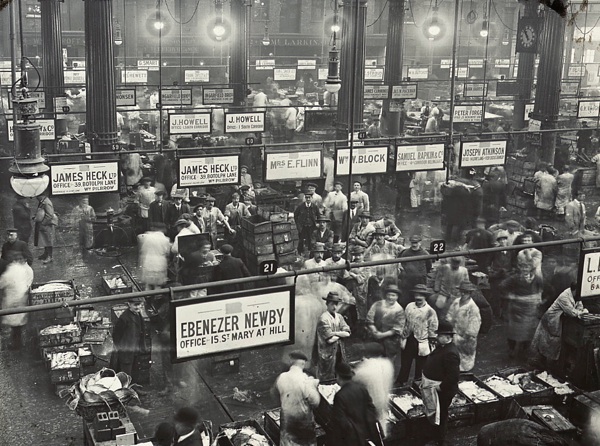
Billingsgate Market, c.1910

Whitechapel Hay Market c.1920 (looking towards Aldgate)

Whitechapel Hay Market, c.1920 (looking east towards Whitechapel)

Porters at Smithfield Market, c.1910

Caledonian Rd Market, c.1910

Book sale at Caledonian Rd Market, c.1910

Caledonian Rd Market, c.1910

Caledonian Rd Market, c.1910

Covent Garden Market, c.1920

Covent Garden Market, c.1910

Covent Garden, c.1910

Covent Garden Market, 1925

Covent Garden Market, Floral Hall, c.1910

Leadenhall Market, Christmas 1935

Leadenhall Market, c.1910

East St Market, c.1910

Leather Lane Market, 1936
 Hoxton Market, Shoreditch, 1910

Spitalfields Market, c.1930
Images courtesy Bishopsgate Institute
You may like to look at these old photographs of the Spitalfields Market by Mark Jackson & Huw Davies
Night at the Spitalfields Market
Other stories of Old London
A Walk With Suresh Singh
Tickets are available for my walking tour this Saturday!
Click here to book your ticket for THE GENTLE AUTHOR’S TOUR OF SPITALFIELDS
I am very proud to be the publisher of A MODEST LIVING, Memoirs of a Cockney Sikh, London’s first Sikh biography, telling the story of one family in Spitalfields over seventy years. Suresh and I enjoyed a ramble round Spitalfields one day and he showed me some of the places that hold most meaning for him.

“I love Whitechapel Library, Aldgate East. It was the library I used to go to every Friday when I was at primary school. You could sit and read. It was just lovely. Upstairs was the art and music library. They had big oversize books of Michelangelo, Leonardo da Vinci, the Impressionists, Matisse, Degas and Le Corbusier’s book about Chandigarh.
It was amazing to have this in Brick Lane, at the end of my street. You were given freedom to look at the books and could borrow twelve books and five records at a time. The librarian in the music library would order whatever you requested. Even if you asked for ‘Yes’ album, he would get it by next week. My dad had a record player and I learnt to be really careful with a record because when you returned it they would meticulously check it.
The library was a whole world. It taught me to read quietly. It exposed me to books that I might never have found. My mum and dad could not read or write. We had no books at home. I liked the art section because the books had pictures and I learnt that pictures told stories as well as words. The librarians always helped me and I could spend hours there. It was a sanctuary from the mayhem outside, a kind of university of the ghetto.”

“Christ Church School, Brick Lane, was my primary school. I loved it when I came back after a long visit to India at six years old. I have frightening memories of it too, as the place I had to go to after the freedom I had experienced in our village. My mum used to walk me here every day and I would walk home for dinner at Princelet St and come back again. School dinners were so bland but my mum gave me dal and roti.
The water fountain used to work and we could drink from it. I remember it as so high, my friends had to give me a lift up so I could drink from it. You pressed the button and it worked. There were little fish that lived in there.
Later on, Eric Elstob – a friend whom I worked for in the renovation of his house in Fournier St – was treasurer of the school and he restored the railings, which was lovely. A couple of years ago, they were repainting them blue and I asked them to paint a bit of my bike with the same colour to remind me of the great memories I have of this school. We used to have great jumble sales at Christmas. You could climb through the school and out through the back, past the gardens of the houses in Fournier St and Nicholas Hawksmoor’s Christ Church into Itchy Park, and out into Commercial St and Spitalfields Market. I loved it because it was a backstreet school.”

“I have fond memories of the rectory at 2 Fournier St when Eddie Stride was Rector. It is one of the few Hawksmoor houses. I helped Eddie wash the steps with Vim when the tramps pissed all over them. There used to be queues outside and Irene Stride made sandwiches for them.
It was a place where Eddie made me feel very welcome. I rang the bell or knocked on the door, and he would always open it to me. The door was never closed. I could always go in and play in the garden. Later on, there were big power meetings at the rectory when Eddie became the chairman of the Festival of Light. So you would meet people like Malcolm Muggeridge, Mary Whitehouse, Cliff Richard and Lord Longford coming and going. It was always an open house.
I was brought up as a Sikh but there were no gurdwaras in Spitalfields, and my dad said ‘You need some moral purpose,’ so he send us to Sunday school and that was how I became friends with Eddie Stride. He was a great friend to our family. He helped me get grants for further education from the Sir John Cass Foundation which led me to study architecture. I loved that time and these steps mean a lot to me. It is amazing how Vim can clean Portland stone. ”

“I always knew the Hanbury Hall as 22a Hanbury St. In those days, Christ Church was closed because it was unsafe and this was used for services instead. There was a youth club at the top of the building on Thursdays and Fridays and we had our Sunday school in the hall.
Because it was built as a Huguenot chapel, everyone used to say that this hall is older than the church and sometimes that used to scare me late at night. There were these big wooden doors that closed with a hasp and I always feared someone might come down the winding stone staircase. Later, when I was doing carpentry work, Eddie gave me the task of housing the remains of the smallpox victims that they found when they were cleaning out the crypt.
When I started a group, we were allowed to rehearse in the vestry at the back. This place was a playground for me but also a church where services were held until the eighties. Then I helped move the furniture from here back to Christ Church. I remember we put the communion table on casters and I had to clear out all the copies of Lord Longford’s pornography report which were being stored in the church.
This hall was a treasure because it had a lovely atmosphere but also a haunted atmosphere too. It was the main meeting point for all of us in Spitalfields at that time.”

“Once, the Truman Brewery in Brick Lane was a dark scary corridor for me. It was my route from my home in Princelet St to my secondary school, Daneford in Bethnal Green. At that time, it used to smell of hops and it was dark and dirty. I got beaten up by a bunch of fascist skinheads at the corner of the brewery where it meets Buxton St. I still try to avoid this route but like a magnet it draws me through. I used to run through or cycle because to go round the other way was much longer and sometimes more scary- you would have to cut past Shoreditch Station and round the back to Cheshire St.
So this was the quickest route but it was like going through a factory. The brewery was always there in my childhood. The smell and the noise were twenty-four hours, and it was always dark beneath the brewery walls. The brewery was a landmark and I remember smoke coming out of that chimney. It was a place that you had no choice but to pass through. At the other end of the brewery was where the skinheads hung out but at this end was the Bengali area where I felt safer. Every day I hoped I would not get my head kicked in as I went to school.
As a kid, I found these long brewery walls interminable. I walked and walked and thought, ‘Will I ever get through to the end?’ It still scares me in a way.”

“I used to pass Franta Belsky’s sculpture in Bethnal Green every day when I walked along the little passageway to Daneford Secondary School. Today, I am wearing the tank top my mum knitted when I was eleven and I remember wearing it to a non-school uniform day all those years ago.
I always used to see this sculpture out of the side of my eye. My friends would say, ‘You go on Singhey, I dare you to touch her breasts and come back down again.’ But slowly I began to appreciate the beauty of it and began looking at books of Henry Moore and David Smith. It was a lovely thing to see before you went to school every day. It comforted me to see a woman and her baby because I thought, ‘That’s how my mum cares for me.’ It gave me a sense of security. I thought, ‘How amazing that we have a piece of sculpture outside our school.’ It made me feel proud because of the sculpture. My dad used to take me to Hyde Park where there were Henry Moores next to the Serpentine. I thought, ‘We’re on a par with the West End here in Bethnal Green.’
I slowly started loving it. I loved her plait and it reminded me of when I had a topknot. I appreciated it in different types of light and I still love it today.”

Suresh Singh & Jagir Kaur at 38 Princelet St (Photograph by Patricia Niven)
You may also like to read about

So Long, Chris Georgiou
Tickets are available for my walking tour this Saturday
Click here to book your ticket for THE GENTLE AUTHOR’S TOUR OF SPITALFIELDS
Tailor Chris Georgiou (1945-2024) died on 28th May aged seventy-nine. A funeral will be held at the Greek Orthodox Church of St Sophia, Moscow Rd, W2 4LQ this Friday 21st June at 2pm.

“I’ve worked seven days a week for forty-five years – each morning I come in about half eight and stay until seven o’clock,” tailor Chris Georgiou assured me, “If I didn’t like it, I wouldn’t do it.”
I was standing in his tiny tailoring shop situated in one of the last quiet stretches of the Kings Cross Rd. “You don’t want to retire,” Chris advised me, thinking out loud and wielding his enormous shears enthusiastically, “The bank manager round the corner retired and he’s had three heart attacks in three years and he now he takes thirty-five pills a day. He came to see me. ‘Chris, never retire!’ he said. A friend of mine, a tailor who worked from home, he retired but after a couple of years he came to see me, ‘Chris,’ he said, ‘Can I come and help you for a couple of days each week? I don’t want any money, I just need a reason to walk down the road.'”
Chris shook his head at the foolishness of the world as he resumed cutting the cloth and thus I was assured of the unlikelihood of Chris ever retiring. And why should when he had so many devoted long-term customers who appreciate his work? As I discovered, when a distinguished-looking gentleman came in clutching an armful of striped shirts that matched the one he was wearing and readily admitted he was a customer of fourteen years standing. Thus it was only a brief interview that Chris was able to grant me but, like all his work, it was perfectly tailored.
“I started out to be tailor at twelve years old, to learn this job you have to start early and you need a lot of patience to hold a needle. My mother was a very good dressmaker and she made shirts, that’s where I got it from. In Cyprus, when you finish school at twelve years old, you must choose a trade. I always liked to dress smart, so I said, ‘I’m going to be a tailor.’ I came from a poor family and I couldn’t have gone to college.
So learnt from a tailor in our village of Zodia. First, I learnt to make trousers and then I learnt to make a jacket, and then it was time to change. After that, I went to another place and said, ‘I know how to make jackets.’ I told lies and I got the job, and I started to learn the art of tailoring. Then I came here in 1968, under contract to a maker of leather wear in Farringdon Rd but, after a year, I told my boss I was going off to do tailoring. And I went to several tailors to see how they do it in England and I bought this shop from one of them in 1969, just a year after I arrived. At first, I used to get jobs from other tailors doing alterations and then I acquired my own customers. 95% of them are barristers and I have never advertised, all my customers have come through recommendations.
When I make a suit, it’s not for the customer, it’s for the people who see the suit. That’s my secret. They wear their suits in chambers and the others ask them where they get their suits. My customers come from the City. It pleases me when you do something good, satisfy your customer and they leave happy. You can’t get rich by tailoring but you can make a good living. I’ve made a lot of suits for famous people whom I’m not at liberty to mention but I can tell you I made a dinner suit for Roger Daltrey, when he got an award for charity work from George Bush, and I made a suit for Lord Mayhew. He brought two security guards who stood outside the shop. I made suits for both his sons and he asked them where they got their suits. He used to go to Savile Row but now he comes here.
I don’t go out for lunch, I eat food prepared by my wife that I bring with each day from East Finchley. She doesn’t see too much of me, that must be why my marriage has lasted forty years.”


“When I make a suit, it’s not for the customer, it’s for the people who see the suit”


“To learn this job you have to start early and you need a lot of patience to hold a needle”


“It pleases me when you do something good, satisfy your customer and they leave happy”

Photographs copyright © Estate of Colin O’Brien
You may also like to read about
The Alteration Tailors Of The East End
James Boswell’s East End


A few years ago, I visited a leafy North London suburb to meet Ruth Boswell – an elegant woman with an appealing sense of levity – and we sat in her beautiful garden surrounded by raspberries and lilies, while she told me about her visits to the East End with her late husband James Boswell who died in 1971. She pulled pictures off the wall and books off the shelf to show me his drawings, and then we went round to visit his daughter Sal who lives in the next street and she pulled more works out of her wardrobe for me to see. And when I left with two books of drawings by James Boswell under my arm as a gift, I realised it had been an unforgettable introduction to an artist who deserves to be better remembered.
From the vast range of work that James Boswell undertook, I have selected these lively drawings of the East End done over a thirty year period between the nineteen thirties and the fifties.There is a relaxed intimate quality to these – delighting in the human detail – which invites your empathy with the inhabitants of the street, who seem so completely at home it is as if the people and cityscape are merged into one. Yet, “He didn’t draw them on the spot,” Ruth revealed as I pored over the line drawings trying to identify the locations, “he worked on them when he got back to his studio. He had a photographic memory, although he always carried a little black notebook and he’d just make few scribbles in there for reference.”
“He was in the Communist Party, that’s what took him to the East End originally,” she continued, “And he liked the liveliness, the life and the look of the streets, and and it inspired him.” In fact, James Boswell joined the Communist Party in 1932 after graduating from the Royal College of Art and his lifelong involvement with socialism informed his art, from drawing anti-German cartoons in style of George Grosz during the nineteen thirties to designing the posters for the successful Labour Party campaign of 1964.
During World War II, James Boswell served as a radiographer yet he continued to make innumerable humane and compassionate drawings throughout postings to Scotland and Iraq – and his work was acquired by the War Artists’ Committee even though his Communism prevented him from becoming an official war artist. After the war, as an ex-Communist, Boswell became art editor of Lilliput influencing younger artists such as Ronald Searle and Paul Hogarth – and he was described by critic William Feaver in 1978 as “one of the finest English graphic artists of this century.”
Ruth met James in the nineteen-sixties and he introduced her to the East End. “We spent quite a bit of time going to Blooms in Whitechapel in the sixties. We went regularly to visit the Whitechapel when Robert Rauschenberg and the new Americans were being shown, and then we went for a walk afterwards,” she recalled fondly, “James had been going for years, and I was trying to make my way as a journalist and was looking at the housing, so we just wandered around together. It was a treat to go the East End for a day.”
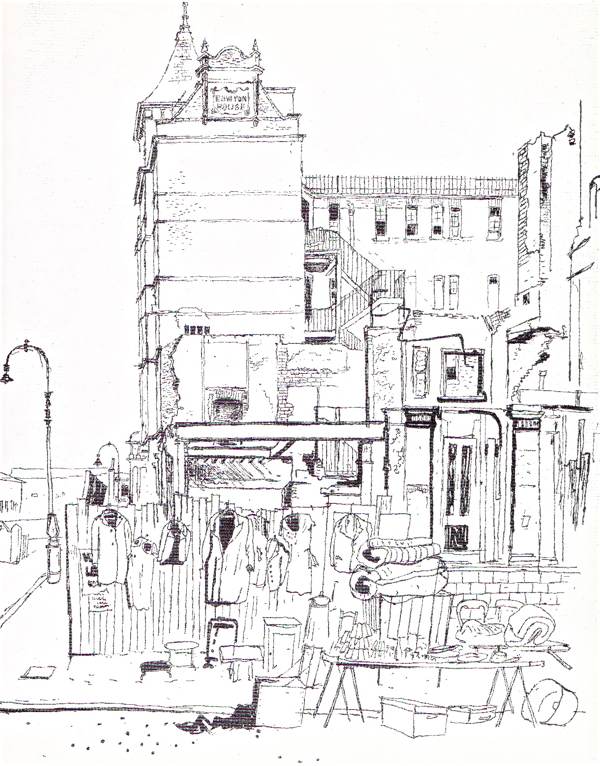
Rowton House

Old Montague St, Whitechapel

Gravel Lane, Wapping

Brushfield St, Spitalfields


Wentworth St, Spitalfields


Brick Lane


Fashion St, illustration by James Boswell from “A Kid for Two Farthings” by Wolf Mankowitz, 1953.

Russian Vapour Baths in Brick Lane from “A Kid for Two Farthings.”

James Boswell (1905-1971)


Leather Lane Market, 1937
Images copyright © Estate of James Boswell
You might also like to take a look at
In the footsteps of Geoffrey Fletcher
In Old Holborn

Next tickets for THE GENTLE AUTHOR’S TOUR OF SPITALFIELDS are available for Saturday 22nd June

Holborn Bars
Even before I knew Holborn, I knew Old Holborn from the drawing of half-timbered houses upon the tobacco tins in which my father used to store his rusty nails. These days, I walk through Holborn once a week on my way between Spitalfields and the West End, and I always cast my eyes up in wonder at this familiar fragment of old London.
Yet, apart from Leather Lane and the International Magic Shop on Clerkenwell Rd, I rarely have reason to pause in Holborn. It is a mysterious, implacable district of offices, administrative headquarters and professional institutions that you might never visit, unless you have business with a lawyer, or seek a magic trick or a diamond ring. So this week I resolved to wander in Holborn with my camera and present you with some of the under-appreciated sights to be discovered there.
Crossing the bed of the Fleet River at Holborn Viaduct, I took a detour into Shoe Lane. A curious ravine of a street traversed by a bridge and overshadowed between tall edifices, where the cycle-taxis have their garage in the cavernous vaults receding deep into the brick wall. John Stow attributed the name of Holborn to the ‘Old Bourne’ or stream that ran through this narrow valley into the Fleet here and, even today, it is not hard to envisage Shoe Lane with a river flowing through.
Up above sits Christopher Wren’s St Andrew’s, Holborn, that was founded upon the bank of the Fleet and stood opposite the entrance to the Bishop of Ely’s London residence, latterly refashioned as Christopher Hatton’s mansion. A stone mitre upon the front of the Mitre Tavern in Hatton Garden, dated 1546, is the most visible reminder of the former medieval palace that existed here, of which the thirteenth century Church of St Etheldreda’s in Ely Place was formerly the chapel. It presents a modest frontage to the street, but you enter through a stone passage way and climb a staircase to discover an unexpectedly large church where richly-coloured stained glass glows in the liturgical gloom.
Outside in Ely Place, inebriate lawyers in well-cut suits knock upon a wooden door in a blank wall at the end of the street and brayed in delight to be admitted by this secret entrance to Bleeding Heart Yard, where they might discreetly pass the afternoon in further indulgence. Barely a hundred yards away across Hatton Garden where wistful loners eyed engagement rings, Leather Lane Market was winding down. The line at Boom Burger was petering out and the shoe seller was resting his feet, while the cheap dresses and imported fancy goods were packed away for another day.
Just across the road, both Staple Inn and Gray’s Inn offer a respite from the clamour of Holborn, with magnificent tranquil squares and well-kept gardens, where they were already raking autumn leaves from immaculate lawns yesterday. But the casual visitor may not relax within these precincts and, when the Gray’s Inn Garden shuts at two-thirty precisely, you are reminded that your presence is that of an interloper, at the gracious discretion of the residents of these grand old buildings.
Beyond lies Red Lion Sq, laid out in 1684 by the notorious Nicholas Barbon who, at the same time, was putting up cheap speculative housing in Spitalfields and outpaced the rapacious developers of our own day by commencing construction in disregard of any restriction. Quiet benches and a tea stall in this leafy yet amiably scruffy square offer an ideal place to contemplate the afternoon’s stroll.
Then you join the crowds milling outside Holborn tube station, which is situated at the centre of a such a chaotic series of junctions, it prompted Virginia Woolf to suggest that only the condition of marriage has more turnings than are to be found in Holborn.

The One Tun in Saffron Hill. reputed to be the origin of the Three Tuns in ‘Oliver Twist’

In Shoe Lane

St Andrew Holborn seen from Shoe Lane

On Holborn Viaduct

Christopher Wren’s St Andrew Holborn

In St Etheldreda’s, Ely Place

Staircase at St Etheldreda’s

The Mitre, Hatton Garden

Charity School of 1696 In Hatton Garden by Christopher Wren

Choosing a ring in Hatton Garden

In Leather Lane

Seeking sustenance in Leather Lane

Shoe Seller, Leather Lane

Barber in Lamb’s Conduit Passage

Staple Inn, 1900


In Staple Inn


In Staple Inn

In Gray’s Inn

In Gray’s Inn Gardens


In Gray’s Inn

Chaos at Holborn Station

Rush hour at Holborn Station

Fusiliers memorial in High Holborn
You may also like to take a look at


