
In The Orchards Of Kent

BOOKING NOW THROUGHOUT THE SUMMER

When the green shoots are sprouting and the leaves unfurling, who can resist an excursion to view the cherry blossom at the National Collection of Fruit Trees at Brogdale in Kent? This is the largest collection of fruit in the world – as the guides proudly remind you – with two hundred and eighty-five types of cherry among over two thousand varieties of fruit, including apples, pears, plums, currants, quinces and medlars.
As if this were not remarkable enough, I was informed that this particular corner of Kent – at the edge of Faversham – offers the very best conditions in the world for growing cherries. They may have originated in the forests of Central Asia, travelling east and west along the Silk Road before they were introduced by order of Henry VIII nearby at Sittingbourne, but here – I was assured – they have found their ultimate home.
The constitution of the soil in Kent is ideal for cherries and the temperate climate, in which the tender saplings are sheltered from the wind by long hedges of hornbeam, produces a delicacy of flavour in the ripe fruit which cannot by matched by the climactic extremes of the Mediterranean.
It was with these thoughts in mind that I advanced up the track, lined with decorative blossom in those livid pink tones so beloved of mid-twentieth century town planners, before turning the corner of a long hedge to confront the orchard of cherries. There are two specimens of each variety regimented in lines that stretch into the distance. The cherry trees are upon parade, awaiting your inspection and eager to display their flamboyant regalia.


You may also like to take a look at
John Claridge’s East End Portraits

Boy, E7 1961 – “He was the son of a friend of my father’s – Peter, an electrician who worked down the docks. To find out if anything was live, he’d stick his finger in the socket!”
Eaten up by the consumption of chocolate, this lad is entirely unaware of the close proximity of photographer John Claridge‘s lens. And, judging from the enthusiasm with which he is sticking the chocolate in his mouth, it looks like he took after his father when it came to poking fingers into holes.
These vibrant photographs reveal the range of John’s approaches to portraiture. “Most of the time I ask,” he admitted to me, “and sometimes people ask me to take their pictures, but at other times you just see something and grab it. I’ve no single way of doing it.”
“I talk to them and it is through talking that you can open a door,” he continued, ” if you’ve known someone for a while, it is very different from if they only have ten minutes to give me their soul. So I never set people up to look foolish, I treat them with dignity because I need to win their trust.”
Offering a variety of moods and contrasted energies, these portraits share a common humanity and tenderness for their subjects. In particular, John’s self-portrait fascinates me. He says he took it in a semi-derelict toilet “for the hell of it,” but, in retrospect, it is emblematic of his extraordinary project – he was a photographer in a world that was spiralling down.
The body of work from which these photos have been selected – of which I have published hundreds in weekly instalments over the last few years – is believed to be the largest collection of images by any single photographer covering this period in the East End. In their quality, their number, and their range, they will come to represent the eye of history – but it makes them especially interesting that they were taken by an insider. When he took these photographs, John Claridge was an East Ender looking at the East End. John was taking portraits of his own people.

Clocking Off, Wapping 1968 – “He was a neighbour and I arranged to meet him down at the warehouse after work.”

Boxer, E16 1969 – “A chap putting on his wraps at Terry Lawless’ gym in Canning Town. I walked in and I was talking to the guys – and I just took the picture.”

Man at Booth House Salvation Army, Whitechapel 1982 – “I printed this picture for the first time the other day. They guy is somewhere else, but I didn’t notice until this week the man with the camera taking the picture on the television.”

Children at the Salvation Army Care Centre, Whitechapel 1970s – “Some children were permanently in care and others were just there for the day. I can’t tell which these were. People only came in these places if there was a problem, if their dad was in the nick or their mum couldn’t take care of them.”

Worker at the Bell Foundry, Whitechapel 1982 – “You expect a man who works lugging bells around to be brawnier than this, but he’s got his cardigan on and he looks like a watchmaker.”

Antiques Dealer, E6 1962 – “He sold everything, penny farthings, paintings, cigarette cards … everything. I used to go down there and see him, and have cup of tea and poke around.”

My Dad in the Back Yard, E13 1961 – “He had a deck chair and he sat in the garden with a cup of tea. I said to him, ‘Just sit and don’t do anything,’ and he’d just laugh. Great times! There isn’t a day that goes by when I don’t think about him.”

Mates in Wapping, 1961 – “I think we were going down to the Prospect for a drink. I was seventeen years old, so everyone’s seventeen. It was Sunday and everyone’s got polished shoes. I haven’t been in touch, but they’re still around – I haven’t seen them for years.”

Man and Mannequin, Spitalfields 1965 – “This was just off the market. He’s listening to a portable radio on earphones. It looks like he has a mate with him and their bellies are almost touching.”

Edward and Mrs Simpson, Spitalfields 1967 – “Another kind of portrait. I love the military jackets for sale and Edward’s got one on, while Wallace is hiding and pointing him out.”

Caretaker at Wilton’s Music Hall, Wapping 1964 – “It said, ‘Please ring for caretaker.’ So I rang for the caretaker. I said, ‘Are you the caretaker?’ He said, ‘Yes.’ So I said, ‘May I take a photo of you?’ and he gave me this lovely smile.”

Self-Portrait, E14 1982 – “It was an old toilet in Poplar, in use but at the end of its day. The mirror was still there. People asked me if I ‘d done self-portraits, so I thought I’d do one down there for the hell of it.”

My Mates, 1961 – “We all went out from the East End for the day somewhere. It might have been Southend, Brighton or Clacton, but I remember it was freezing.”

Man in a Knitted Hat, E17 1964 – “This was at Walthamstow Town Hall. He’d finished his fight, had a shower, put his hat on to keep warm, and we were chatting over a cup of tea. He was a visiting fighter from the States and his shirt says, ‘The Big Apple.'”

Woman in Her Kitchen, E12 1969 – “She had no home and a young family, and was staying in a building that was derelict. The council didn’t want people to use it, so there was barbed wire outside. It was a shelter, and they asked me to go down and take pictures to show how people were living there.”

Tony Moore and Joe Gallagher, Wapping 1970 – “Tony was an ex-heavyweight boxer and Joe was my ex-father-in-law. They look like they’re about to sort somebody out.”

My Friend JB, E14 1972 – “We met when we were both fifteen years old and working at McCann Erickson. We were both Eastenders. He was an incredible designer. He had a wonderful sense of humour. He died of a heart attack. He looked like a villain, and one day we went to New York together, and were in Little Italy in a restaurant, and this guy came in and said, ‘I remember you!’ I said, ‘We’d better get out of this place.'”

My Son, Spitalfields, 1982 – “I went along on a home visit with the Salvation Army and I saw this picture on the sideboard. I said, ‘Is that your son?’ and she said, ‘Yes, he was killed in the war.'”

Headless Bear, E2 1964 – “I just came across it. He had his head burnt off. He was lying there at the edge of a bomb site.”
Photographs copyright © John Claridge
You may also like to take a look at
The Inescapable Melancholy Of Phone Boxes

Click here to book for The Gentle Author’s Tours

Red phone boxes are a cherished feature of my personal landscape because, in my childhood, we never had a telephone at home and, when I first made a phone call at the age of fifteen, it was from a box. In fact, for the major part of my life, all my calls were made from boxes – thus telephone calls and phone boxes were synonymous for me. I grew up with the understanding that you went out to make a phone call just as you went out to post a letter.
Yet the culture of mobile phones is now so pervasive I was shocked to discover I had hardly noticed as the red telephone boxes have vanished from our streets and those few that remain stand redundant and unused. So I set out with my camera to photograph the last of them, lest they should disappear without anybody noticing. It was a curious and lonely pilgrimage because, whereas they were once on every street, they have now almost all gone and I had to walk miles to find enough specimens to photograph.
Reluctantly, I must reveal that on my pitiful quest in search of phone boxes, I never saw anyone use one though I did witnessed the absurd spectacle of callers standing beside boxes to make calls on their mobiles several times. The door has fallen off the one in Spitalfields, which is perhaps for the best as it has been co-opted into service as a public toilet while the actual public toilet nearby is shut.
Although I must confess I have not used one myself for years, I still appreciate phone boxes as fond locations of emotional memory where I once experienced joy and grief at life-changing news delivered down the line. But like the horse troughs that accompany them on Clerkenwell Green and outside Christ Church, Spitalfields, phone boxes are now vestiges of a time that has passed forever. I imagine children must ask their mothers what these quaint red boxes are for.
The last phone boxes still stand proud in their red livery but like sad clowns they are weeping inside. Along with pumps, milestones, mounting blocks and porters’ rests these redundant pieces of street furniture serve now merely as arcane reminders of a lost age – except that era was the greater part of my life. This is the inescapable melancholy of phone boxes.

Ignored in Whitechapel

Abandoned in Whitechapel

Rejected in Bow

Abused in Spitalfields

Irrelevant in Bethnal Green

Shunned in Bethnal Green

Empty outside York Hall
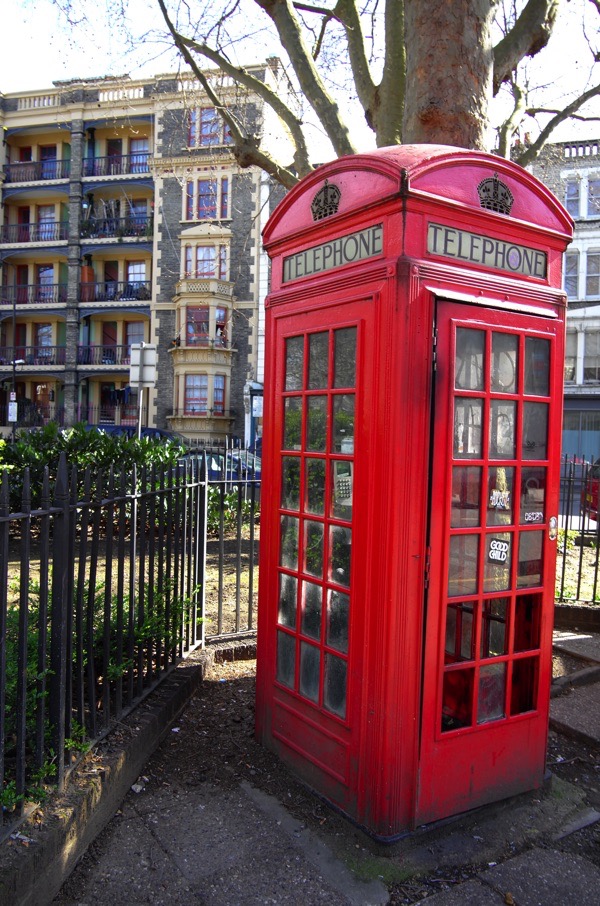
Desolate in Hackney Rd

Pointless in St John’s Sq

Irrelevant on Clerkenwell Green

Invisible in Smithfield

Forgotten outside St Bartholomew’s Hospital

In service outside St Paul’s as a quaint location for tourist shots
You may also like to take a look at
The Silent Traveller
When I encountered the work of Chiang Yee (1903-77) writing as ‘The Silent Traveller’ I knew I had discovered a kindred spirit in self-effacement. These fine illustrations are from his book ‘The Silent Traveller in London’ published in 1938 and I am fascinated by his distinctive vision which renders familiar subjects anew.
‘This book is to be a sort of record of all the things I have talked over to myself during these five years in London, where I have been so silent,’ he wrote, ‘I am bound to look at things from a different angle, but I have never agreed with people who hold that the various nationalities differ greatly from each other. They may be different superficially, but they eat, drink, sleep, dress, and shelter themselves from the wind and rain in the same way.’

Summer afternoon in Kew Gardens

Morning mist in St James’s Park

Snow on Hampstead Heath

Early Autumn in Kenwood

Fog in Trafalgar Sq

Coalman in the rain

Umbrellas Under Big Ben

Deer in Richmond Park

Seagulls in Regent’s Park

At the Whitechapel Gallery

London faces in a public bar

London faces in winter

Coronation night in the Underground

Jubilee night in Trafalgar Sq

London faces at a Punch & Judy show
Images copyright © Estate of Chiang Yee
You may also like to take a look at
The Return Of Lorna Brunstein

Click here to book for THE GENTLE AUTHOR’S TOUR OF SPITALFIELDS

Lorna with her mother Esther in Whitechapel, 1950
In this photograph, Lorna Brunstein is held by her mother outside Fishberg’s jewellers on the corner of Black Lion Yard and Whitechapel Rd. It is a captivating image of maternal pride and affection that carries an astonishing story. The tale this tender photograph carries is one of how this might never have happened and yet, by the grace of fortune, it did.
I met Lorna upon her return visit to Whitechapel where she grew up the early fifties. Although she left Black Lion Yard at the age of six, it is a place that still carries great meaning for her even though it was demolished forty years ago.
We sat together in a crowded cafe in Whitechapel but, as Lorna told me her story, the sounds of the other diners faded out and I understood why she carries such affection for a place that no longer exists beyond the realm of memory.
“My relationship with the East End goes back to when I was born. I have scant memories, it was the early years of my childhood, but this was the area where I spent the first six years of my life. I was born in Mile End maternity hospital in December 1950.
Esther, my mother came to London in 1947. She was liberated from Belsen in April 1945 and she stayed in their makeshift hospital to recuperate for a few months. She had been through Auschwitz and lost all her family, apart from one brother who survived (though she did not know it at the time).
In the summer of 1945 she was taken to Sweden, to a place she said was beautiful – in the forest – where she and many others were looked after. It was while she was in Sweden that she and her brother Perec discovered via the Bund ( Polish Jewish workers Socialist party) that they had both survived. Esther was the youngest of three and Perec was the middle child. Their surname was Zylberberg, which means silver mountain. He was one of the boys who was taken to Windermere from Theresienstadt at the end of the War. They each wrote letters and confirmed that the other had survived. Esther had last seen Perec in March 1944.
After a few months in Windermere, he went to London and his sole mission was to get Esther over. That was all she wanted to do too, but it took two years from 1945 to 1947 for a visa to be granted. So not much has changed really. She was seventeen years old, had lost her mother at Auschwitz and her teenage years yet she was not allowed to come into the country unless she had a job, an address, and the name of a British citizen to be her guarantor and sponsor.
Maurice Regen (Uncle Moishe as I knew him) was an eccentric yet kind man. He came to London in the twenties from Lodz, which was my mother’s hometown. He and his wife were elderly, they had no children and lived in Romford. He said, ‘She can live in our house, so she will have an address, and she can be our housekeeper, that will be her job, and she won’t be dependent on the state.’ That was how my mother came over. My Uncle Perec met her and I think Uncle Moishe was probably there at Tilbury too.
She lived in Romford but she met Stan, my father, at the Grand Palais Yiddish Theatre in Whitechapel where she was acting — her Yiddish was brilliant – and he was the scenic designer. He was an artist from Warsaw. He fled at the beginning of the War and was put in a labour camp in Siberia after spending fourteen months of solitary confinement in a prison in the Soviet Union. His story was pretty horrific too. He was an only child, and he lost everyone, his entire family. He was thirteen years older than my mother.
Stan also came to London in 1947. At the end of the War, he ended up in Italy. The Hitler/Stalin pact was broken while he was in Siberia and he was freed when the political amnesty was declared, so he joined up with the Polish Free Army under General Anders — as many of them did — and fought at the Battle of Monte Casino. Afterwards, he was in Rome for two years, studying scenic design at the Rome Academy of Fine Arts.
So my mother and father met in 1947 or 1948. I do not know exactly when. They got married in 1949 and I was born in 1950. They lived in a little flat in Black Lion Yard in Whitechapel until they moved to Ilford.
Rachel Fishberg – known as Ray – was really significant in my life and my parents’ life, my mother in particular. Ray was an old lady who became a surrogate grandma to my sister – who is four years younger – and me. We remember her with such affection. The Fishbergs were jewellers and were reasonably wealthy among Jewish people in the East End at that time. Ray ran her husband’s and his father’s jewellery shop, on the corner of Whitechapel Road and Black Lion Yard. I remember going back and visiting it when I was six, after we moved out.
My parents had no money, so grandma Ray Fishberg said they could live in the flat above the shop. At the time, they had nothing. My father could not live on his art and he took a diploma in design, tailoring and cutting at Sir John Cass School of Art in Aldgate. He designed and made children’s clothes on a sewing machine in the room we lived in and sold them in the market, and that was how we got by. Grandma Ray let them live there – probably for nothing – and, in fact, she paid for their wedding. When they got married in 1949 in Willesden Green, she paid for the wedding dress.
In 1957, when I was six, we moved to Ilford because my parents did not want to stay in the East End. She gave them the deposit for their first house. She was a lovely lady and she enabled them to have a start a life. This is why I feel so connected to this place, even though my memories of actually living here are scant.
I have this one memory of being in a pram, or maybe a pushchair, and feeling the sensation of the wheels on the cobbles in Black Lion Yard, going to the dairy — my mother said it was Evans the Dairy at the end of the Yard — to get milk.
Apparently, I went Montefiore School in Hanbury Street and I remember my mother talking about Toynbee Hall, where there were meetings, and taking me in the pram to Lyons Corner House in Aldgate where there was this chap, Shtencl, the poet of the East End.
He was quite an eccentric person who wandered around the streets and my mother told me he called into Lyons Corner House when she was sitting there with me as a baby. She said he stroked my head and said, ‘Sheyne, sheyne,’ which in Yiddish is ‘beautiful.’ My mother was in awe of him because his Yiddish was so brilliant and Yiddish was the language so dear to her heart. I was anointed by him even though I have no memory of him.
My mother and father talked a lot about Black Lion Yard. They said, on Sunday mornings at the entrance to Black Lion Yard where the pavement was quite deep, employers and potential employees in the tailoring ‘shmatte’ trade would gather and connect. That was what my father was doing then. He would stand there on a Sunday morning to get work.
Those were the founding years of my life. I have a deep affection for this place because for my parents – even though they wanted to leave for a better life – it was where they found sanctuary. My father used to say, ‘Thank goodness I’m here, I’ve finally found a place where I am able to walk down the street without having to look over my shoulder.”

Black Lion Yard, early seventies, by David Granick

Steps down to Black Lion Yard by Ron McCormick

Lorna aged eight

Esther & Stan Brunstein in the seventies

Esther Brunstein

Stan Brunstein
You may also like to read about
Bluebells At Bow

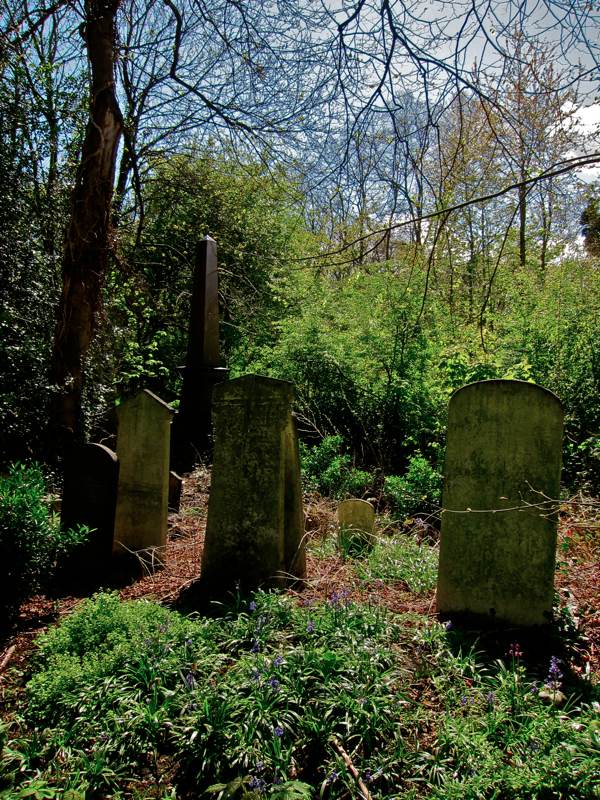
With a few bluebells in flower in my garden in Spitalfields, I was inspired make a visit to Bow Cemetery and view the display of bluebells sprouting under the tall forest canopy that has grown over the graves of the numberless East Enders buried there. In each season of the the year, this hallowed ground offers me an arcadian refuge from the city streets and my spirits always lift as I pass between the ancient brick walls that enclose it, setting out to lose myself among the winding paths, lined by tombstones and overarched with trees.
Equivocal weather rendered the timing of my trip as a gamble, and I was at the mercy of chance whether I should get there and back in sunshine. Yet I tried to hedge my bets by setting out after a shower and walking quickly down the Whitechapel Rd beneath a blue sky of small fast-moving clouds – though, even as I reached Mile End, a dark thunderhead came eastwards from the City casting gloom upon the land. It was too late to retrace my steps and instead I unfurled my umbrella in the cemetery as the first raindrops fell, taking shelter under a horse chestnut, newly in leaf, as the shower became a downpour.
Standing beneath the dripping tree in the half-light of the storm, I took a survey of the wildflowers around me, primroses spangling the green, the white star-like stitchwort adorning graves, a scattering of palest pink ladies smock highlighting the ground cover, yellow celandines sharp and bright against the dark green leaves, violets and wild strawberries nestling close to the earth and may blossom and cherry blossom up above – and, of course, the bluebells’ hazy azure mist shimmering between the lines of stones tilting at irregular angles. Alone beneath the umbrella under the tree in the heart of the vast graveyard, I waited. It was the place of death, but all around me there was new growth.
Once the rain relented sufficiently for me to leave my shelter, I turned towards the entrance in acceptance that my visit was curtailed. The pungent aroma of wild garlic filled the damp air. But then – demonstrating the quick-changing weather that is characteristic of April – the clouds were gone and dazzling sunshine descended in shafts through the forest canopy turning the wet leaves into a million tiny mirrors, reflecting light in a vision of phantasmagoric luminosity. Each fresh leaf and petal and branch glowed with intense colour after the rain. I stood still and cast my eyes around to absorb every detail in this sacred place. It was a moment of recognition that has recurred throughout my life, the awe-inspiring rush of growth of plant life in England in spring.




You may also like to read about
Find out more at Friends of Tower Hamlets Cemetery Park
Viscount Boudica’s Easter

Last call for The Gentle Author’s Tour of the City of London: Meet me at 2pm on EASTER MONDAY on the steps of St Paul’s Cathedral for a tour of sightseeing and storytelling, rambling through the alleys and byways of the Square Mile in search of the wonders and the wickedness of the City. (Also booking for Spring Bank Holiday Monday 4th May)
On Easter Sunday, we celebrate our dearly beloved Viscountess Boudica of Bethnal Green who once entertained us with her seasonal frolics and capers but now is exiled to Uttoxeter

She may be no spring chicken but that never stopped the indefatigable Viscountess Boudica of Bethnal Green from dressing up as an Easter chick!
As is her custom at each of the festivals which mark our passage through the year, she embraced the spirit of the occasion wholeheartedly – festooning her tiny flat with seasonal decor and contriving a special outfit for herself that suited the tenor of the day. “Easter’s about renewal – birth, life and death – the end of one thing and the beginning of another,” she assured me when I arrived, getting right to the heart of it at once with characteristic forthrightness.
I felt like a child visiting a beloved grandmother or favourite aunt whenever I call round to see Viscountess Boudica because, although I never knew what treats lie in store, I was never disappointed. Even as I walked in the door, I knew that days of preparation preceded my visit. Naturally for Easter there were a great many fluffy creatures in evidence, ducks and rabbits recalling her rural childhood. “When my uncle had his farm, I used to put the little chicks in my pocket and carry them round with me,” she confided with a nostalgic grin, as she led me over to admire the wonder of her Easter garden where yellow creatures of varying sizes were gathering upon a small mat of greengrocer’s grass, around a tree hung with glass eggs, as if in expectation of a sacred ritual.
I cast my eyes around at the plethora of Easter cards, testifying to the popularity of the Viscountess, and her Easter bunting and Easter fairy lights that adorned the walls. There could be no question that the festival was anything other than Easter in this place. “As a child, I used to get a twig and spray it with paint and hang eggs from it,” she explained, recalling the modest origin of the current extravaganza and adding, “I hope this will inspire others to decorate their homes.”
“Cadbury’s Dairy Milk is my favourite,” she confessed to me, chuckling in excited anticipation and patting her waistline warily, “I probably will eat a lot of chocolate on Easter Monday – once I start eating chocolate, I can’t stop.” And then, just like that beloved grandmother or favourite aunt, Viscountess Boudica kindly slipped a chocolate egg into my hands, as I said my farewell and carried it off under my arm back to Spitalfields as a proud trophy of the day.


Viscountess Boudica writes her Easter cards


“yellow creatures of varying sizes were gathering upon a small mat of greengrocer’s grass, around a tree hung with glass eggs, as if in expectation of a sacred ritual”

Viscountess Boudica turns Weather Girl to present the forecast for the Easter Bank Holiday – “I predict a dull start with a few patches of sunshine and some isolated showers. In the West Country, it will be nice all day with temperatures between sixty and eighty degrees Farenheit. There will be a small breeze on the coast and sea temperature of around fifty-nine degrees Farenheit.”


Easter blessings to you from Viscountess Boudica!

Viscountess Boudica and her fluffy friends
Take a look at
The Departure of Viscountess Boudica
Viscountess Boudica’s Domestic Appliances
Viscountess Boudica’s Halloween
Viscountess Boudica’s Christmas
Viscountess Boudica’s Valentine’s Day
Viscountess Boudica’s St Patrick’s Day
Read my original profile of Mark Petty, Trendsetter
and take a look at Mark Petty’s Multicoloured Coats


