So Long, Charlie Caisey
Charlie Caisey died on 17th November Tuesday aged ninety-six

Charlie Caisey (1930-2026)
Even twenty years after he retired from Billingsgate, Charlie Caisey could not keep away from the fish market for long, so I was delighted to give him an excuse for a nocturnal visit – showing me around and introducing me to his pals. In those days, Charlie maintained his relationship with the fish business through involvement with the school at Billingsgate, where he taught young people training as fishmongers and welcomed school parties visiting to learn about fish.
Universally respected for his personal integrity and generosity of spirit, Charlie turned out to be the ideal guide to the fish market. Thanks to him, I had the opportunity to shake the hand and take the portraits of many of Billingsgate’s most celebrated characters. Looking back with impunity upon his sixty years of experience in the business, Charlie told me his story candidly. He did not always enjoy the high regard that he won, Charlie forged his reputation in an arena fraught with moral challenges.
“In 1950, when I joined Macfisheries and started in a shop at Ilford, I was told, “You’ll never make a fishmonger,” and they moved me to another shop in Leytonstone. I was honest and in those days fishmongers always added coppers to the scale but I wouldn’t do that. Later, when I ran my shop, it was always sixteen ounces to the pound.
In Leytonstone, it was an open-fronted shop with sawdust on the floor. You had a blocksman who did the fishmongering, a frontsman who served the customers and a boy who ran around. At twenty-one, I was a boy fishmonger and then the frontsman decided to leave, so I moved up when he left. And I found I had an uncanny ability at arranging fish in shows! I made quite a little progress there, even though I was never taught – just three weeks at Macfisheries’ school.
I got my first management of a fish shop within three years, I was sent out to a poor LCC estate at Hainault. It was a fabulous shop but it was losing money, this was where I learnt to run a business and I worked up a bit of a storm there, working eighty hours a week and accounting the stock to a farthing. As a consequence, I was offered a first hand job in a shop behind Selfridges where all the customers were lords and ladies, but I refused because, if I was manager in my own shop, it would have been a step down. So then they sent me to run a shop in Bayswater. It was a lovely shop, when I arrived I had never seen many of the fish that were on display there, and I became wrapped up in it. We had a great cosmopolitan public including ladies of the oldest profession in the world.
Within a couple of years, Macfisheries moved me to Notting Hill Gate at the top of Holland Park Avenue – absolutely fabulous. I served most of the embassies and the early stars of television. The likes of Max Wall, Dickie Henderson and the scriptwriter of The Good Life were customers of mine. I built up quite a reputation and I was the first London manager to earn £1000 a year. From there I went to Knightsbridge running the largest fish shop in London, opposite Harrods. In 1965, I had thirty-five staff working under me and I worked fourteen hours a day.
My dream was to go into business on my own but I had no money. When I started my own shop, the sad part was how poor it was. It had holes in the floor, no proper drainage and no refrigeration. I’d never been to Billingsgate Market in my thirteen years at Macfisheries and when I went with my small orders, it was a different ball game. The dealers treated me like an idiot, the odd shilling was going on the prices and I was given short measures. Yet I never took it personally and I started to earn their respect because I always paid my bills every week. And, in twenty years, my turnover went from twelve thousand pounds to over half a million a year.
Most of my experience and knowledge has come from the customers. My experience of life came from the other side of the counter. They showed me that if you go out and look, there is a better life. When I think of Stratford while I was growing up, it was a stinky place because of the smell from the soap factories. My family were all railway people, my father was an uneducated labourer and what that man used to do for such a small amount of money and bad working conditions. We were poor because my marvellous parents were underpaid for their labours. I didn’t leave London during the war and I witnessed all the horrors. I missed lots of school because I was in the East End all through the bombing, so I’ve always been conscious of my poor education. Basically, I’m a shy man and I’m always amazed that I can stand up in front of people and speak, but I can do it because it comes from the heart.
Don’t ever do what I did. I went eighteen years without a holiday. It was a little crazy, I was forty before I had time to learn to drive.”
Dawn came up as Charlie told me his story and we walked out to the back of the fish market where the dealers throw fish to the seals from the wharf. Through his tenacity, Charlie proved his virtue as a human being and won respect as a fishmonger too. Yet although he may have regretted the inordinate struggle and hard work that kept him away from his family growing up, Charlie was still in thrall to his lifelong passion for this age-old endeavour of distributing and selling the strange harvest of the deep.

Clearing away after a night’s trading at Billingsgate, 7:40am.

Tom Burchell, forty-nine years in the fish business.

Alan Cook, lobster specialist for fifty-two years.

Simon Chilcott, twenty-four years at Bard Shellfish.

Mick Jenn, fifty-four years in eels – “Me dad was an empty boy and I started off in an eel factory.”

Terry Howard, sixty-three years in shellfish – “I played football in the 1960 Olympics.”

Anwar Kureeman, twelve years at Billingsgate – “I am a newcomer.”

Paul Webber, seventeen years at J.Bennett, Billingsgate’s largest salmon dealers.

Andres Slips came from Lithuania eleven years ago – “I couldn’t speak English when I arrived, now my mother would blush to hear my language.”

Geoff Steadman, fourth generation fish dealer, thirty-three years at Chamberlain & Thelwell.

Charlie in his first suit at fifteen –“From Willoughbys, I paid for it myself at half a crown a week.”

Charlie at the Macfisheries School of Fishmongery (He is third from right in back row).


Charlie in his fish shop in the seventies.
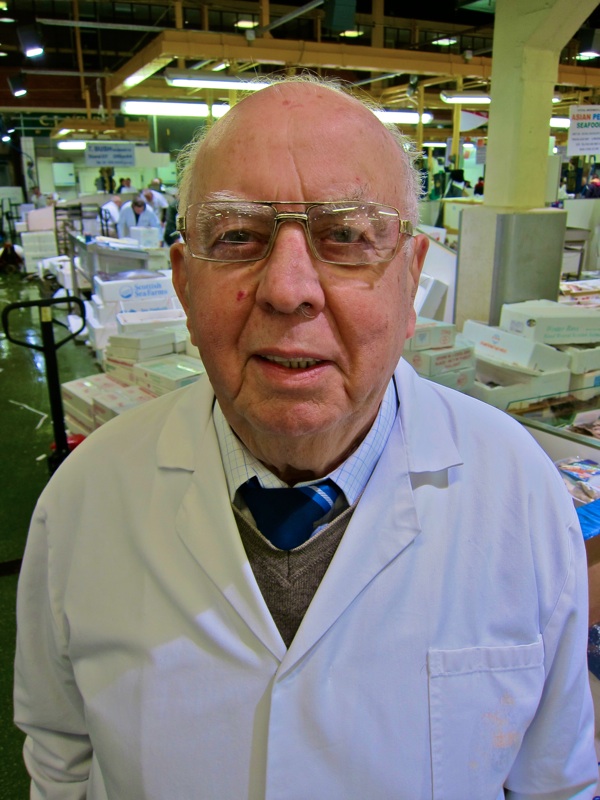
Charlie Caisey – the little fish that became a big fish.
You may recall I met Charlie Caisey at The Fish Harvest Festival
You may also like to take a look at
Boiling the Eels at Barney’s Seafood