
John Claridge In His Own Words
Remembering photographer John Claridge who died on Sunday aged eighty-one. In 2016, over lunch at The French House in Dean St, John told his story to The Gentle Author (Extract from the introduction to East End).
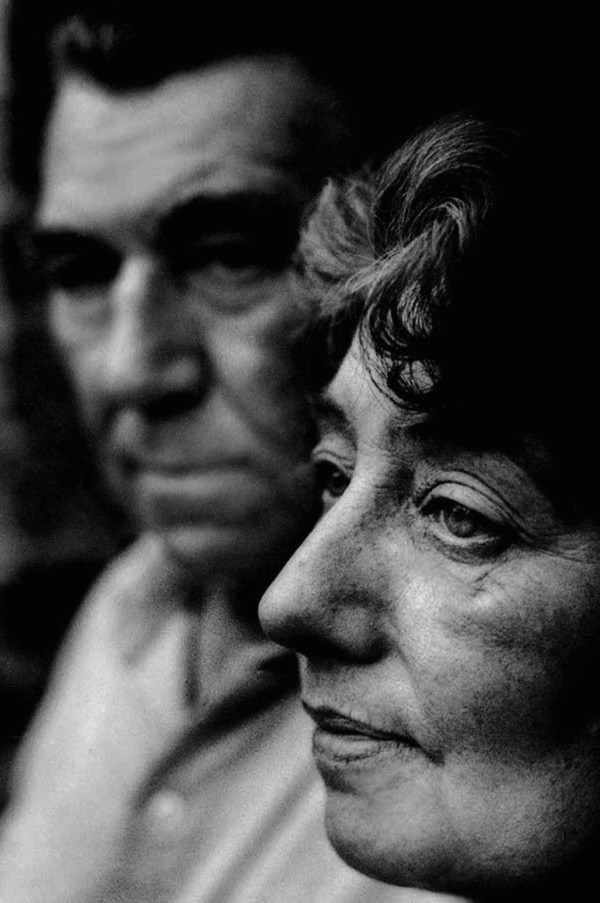
Len & Doll Claridge, 1964
“I was an only child so I asked my mum, ‘Will I have a sister or a brother?’ but she said ‘You’re enough.’ I was never quite sure if that was a compliment.
My father went to sea when he was thirteen and he was invited to go on the Scott expedition. He was a bare-knuckle fighter in the East End and sold booze in the States in the thirties during Prohibition. But my mum, she stayed a machinist most of her life in the Roman Road, Bow. On school holidays I used to go in the van, delivering shirts around the East End. By the time I was growing up, my father had stopped going to sea and was working down the docks as a rigger, testing the cranes and that type of stuff. When he took me down there, it was sheer wonderment.
I used to get up with my dad, before he went down the docks at five o’clock in the morning and I did my paper round. We got up an hour early so we so could talk over a bit of toast and a cup of tea, and he would tell me stories about the sea. That was my education in wonderment. I really wanted to go to sea and see the world, but I did it through people sending me around the world to take photographs, so that ambition was fulfilled in another way.
I used to go to the shops with my mum every Saturday morning, and she would meet people she knew and they would be chatting for maybe an hour, while I went off and played on a bomb site. We would go into these shops and markets and they all smelled different. They each had their distinctive character, it was wonderful. People had a pride in what they were selling or what they were doing.
As a child, from my bedroom in Plaistow, I could see the lights of the docks at night and I used to go to sleep listening to the sound of the horns on the Thames whenever there was fog, which was quite often. You could smell the river if the wind was blowing in the right direction. A lot of the men in my family worked down the docks. When my father worked for the New Zealand Shipping Company, he took me down to the dock gate and onto the wharves – and I used to go out with my camera at weekends, or any spare time I had, to take pictures. I went out to see what was going on, I reacted to what was there and, if I saw something, I photographed it. It was instinctive, I never thought I was documenting. I had a need to take pictures, it was as natural as breathing.
Bomb sites were my playground and I was very aware of the war because a lot of my family were in it, and they showed me the medals they came back with. At that age, what you understand is limited but you are aware. We had rationing yet people had faith that things were going to get better. The only luxury would be something that was knocked off from the docks, be it a lump of liver or a bit of cake or whatever. I remember the end of food rationing, we got more bananas.
When I was eleven, I started boxing at school. South West Ham Tech in Canning Town was an all-boys school and it was mandatory for all the kids to get into the ring. It was a big old gym and they were big on sport, but my mum did not want me to do it because she did not want me to spoil my face. All the family were boxing, and they said, ‘You should do it because you have the ability to do it,’ and I quite enjoyed it actually. It was good fun. If you met someone you had been in a ring with, you always bought them a drink or they bought you a drink. I had reasonable success but I have small hands. I have got my mum’s hands not my dad’s hands.
One day when I was eight or nine, I was at at fair on Wanstead Flats and there was this stall, throwing rings for prizes, and I wanted this plastic camera. I did not know why I wanted it, except I wanted to capture everything and take the memories back with me. You know, I already understood that if you have a camera, you can take it all back with you. But I did not win it. Instead, I did a paper round, saved up and bought an Ilford Sportsman. I do not really know why I needed a camera and I needed to take pictures. Photography was a natural language to me. I developed them myself which I thought was pretty cool. I got a little catalogue that said put developer in there and this in there and wash it in there. We only had an outside toilet, so at night, that was where I developed all my film. It was not difficult. It was magic.
I left school at fifteen and I went down to the West Ham Labour Exchange. There was this lovely bloke, a nice man. He said, ‘What do you want to do?’ I said, ‘I’m going to be a photographer and take pictures’ and I expected him to say, ‘Yeah, that’s really good.’ Instead he said, ‘It’s not that easy,’ so I replied ‘Yes it is, you just take photographs.’ ‘Ok,’ he said, ‘there’s a job up the West End, but you won’t get it, let me tell you now – you won’t get it.’ This was for an assistant in a photographic department at an advertising agency. He said, ‘They’re interviewing people with qualifications from universities and colleges, and you’re too young but I’m going to send you anyway, so you can see how these things work.’ That sounded all right to me. I wore a black four-button herringbone suit, a tab-collar shirt, a knitted tie and winkle-pickers – I thought I looked the business. How could I possibly fail?
It was at McCann Erickson and when I walked into the reception, there were about four, five or six blokes sitting around waiting. Obviously they were lot older than I was, they had tweed jackets with leather patches on the elbows. I said ‘All right?’ and they totally blanked me. They had never seen style before. The interview was with Eddie Brown who had been a Captain in the Scottish Highlanders and had come up the hard way. I was the last person to be interviewed and when I walked in, he did not say anything, he just looked at me. He did not know what to say, so he asked, ‘What film do you use?’
I said, ‘I won’t use anything else but HPS and FP3, I think it’s the best around’. And he said, ‘So do I – you can have the job.’ I said, ‘Oh, the other thing is I take pictures.’ I had brought with me some small prints of the Thames and views of the East End that I had made at home on an old enlarger. Those posh boys had qualifications and no pictures, but I had pictures and no qualifications, so I got the job – that was it. And I loved every moment of it.
First of all, I started by mixing up the chemicals and doing general stuff in the darkroom, but very quickly I was asked to do some printing. Before long, I was getting art directors coming down and asking me to do their prints. Later, I made prints for for Jeanloup Sieff, Don McCullin and Saul Leiter, when I was still only seventeen. I remember Saul Leiter asked, ‘Can you do something with this?’ The film looked like someone had processed it in tomato sauce, so I worked on it to see what I could get out of it and, when I had finished, he was very pleased with it.
At McCann Erickson, I met Robert Brownjohn – who everyone knew as ‘BJ.’ He had just come over from New York. He was a brilliant designer who had worked with Moholy-Nagy and became famous for doing the title sequences for ‘From Russia With Love’ and ‘Goldfinger.’ I always remember BJ in an Ivy League jacket and buttoned-down shirt. He would come to the Photographic Department and ask, ‘Hey kid, hey kid, can you experiment with this?’ BJ introduced me to a different way of looking. We would look at pieces of type and everyday objects together, considering them as design in their own right. He taught me to appreciate their abstract quality by having me look at a face or a hand as a piece of sculpture, and lighting it accordingly. BJ opened my eyes and then he said, ‘Kid, you’re gonna have an exhibition whether you like it or not.’ I was sixteen then.
The show was in McCann’s gallery and the subject was the East End. What surprised me was the response. People really thought a lot of the pictures. Dennis Bailey, Art Director of Town Magazine said, ‘There’s shades of Walker Evans.’ I did not know who the fuck Walker Evans was, so I thought, ‘Is this a compliment or is he taking the piss?’ But then I saw Walker Evans’ work and it is some of the most beautiful photography you are ever going to see – in my opinion – ever.”
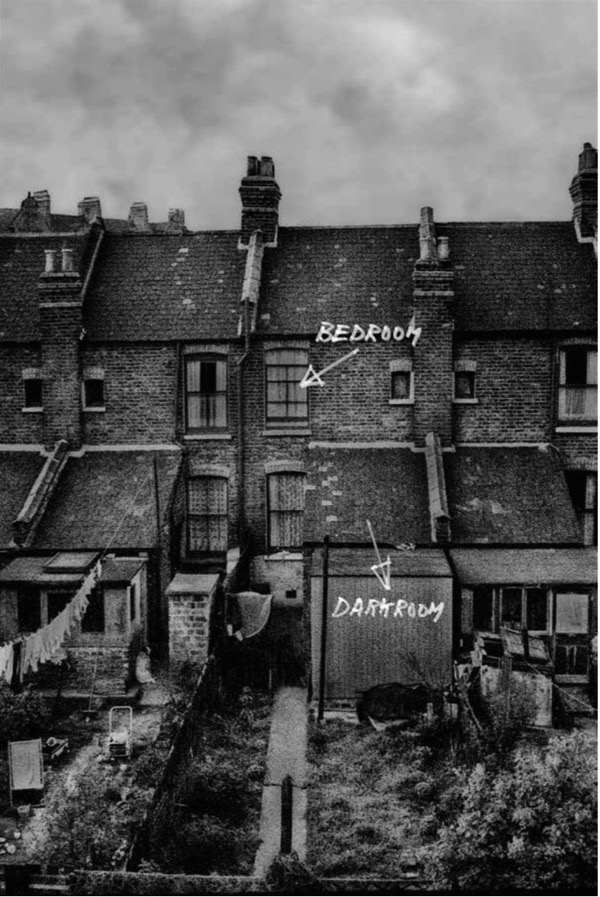
The house in Plaistow where John Claridge grew up
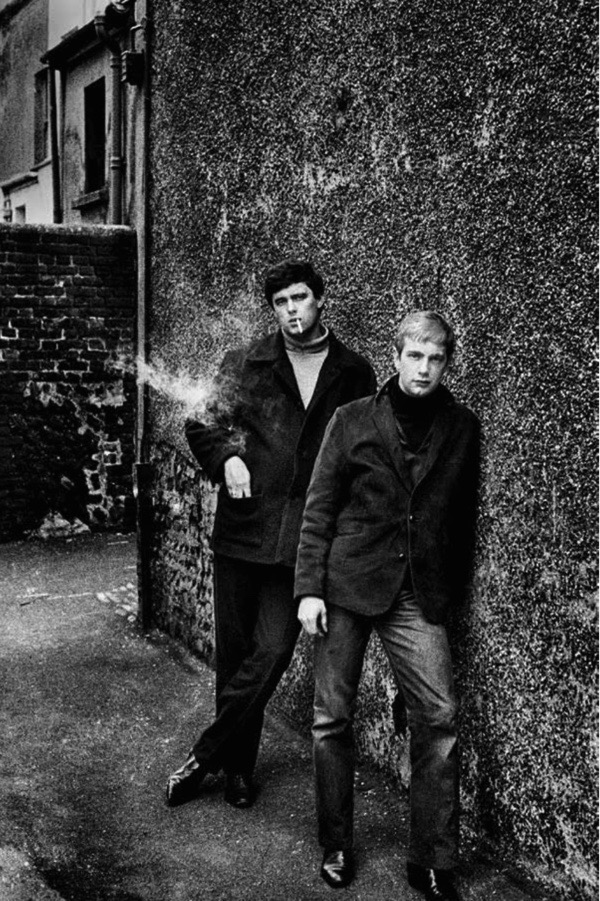
John Claridge (right) with his mate Keith Horton (left), 1961
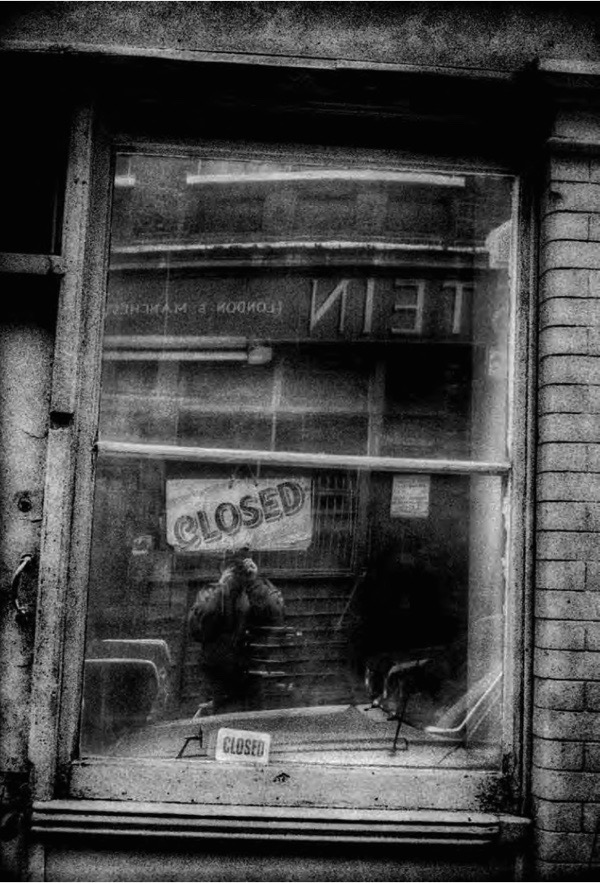
John Claridge takes a photograph in Spitalfields, 1964
Photographs copyright © John Claridge









This is a truly brilliant story and makes me proud to come from the East End .
People who didn’t grow up there don’t know the fight we had and it was a case as we say “ Ducking and diving “.
The photographs depicts the moods and I think it fair when when I say the best and the worst people I ever met came from there .
A broad generalisation but it comes from the heart .
Thank you so much for sharing this brilliant story … ‘an education in wonderment’ … what a magical phrase
That is a Great Story. It shows whats possible with a bit of pluck and a some luck. Wonderful.
I knew nothing about John Claridge. Thank you for the introduction. Such an interesting read. I will go away and learn more about him and his work.
My favourite photographer. I’ve always loved his pictures of Plaistow and the docks. JC understood that the East End wasn’t all about the Ripperesque gothic of the nineteenth century and its cultural remnants so beloved of both the gentrifying vandals and the patronising sentimentalists of the middle class. He knew that above all the East End was about hard manual graft, family, and pragmatic community. John Claridge captured these qualities through the faces and places of the real East End.
So sad to lose him. We have the John Claridge book on the East End sitting on our bookshelf. Thank you, GA, for that and for sharing the photographs and memories of a brilliant photographer.
I had my book of John Claridge photos near me all day yesterday, and last evening I read your interview with him before I went to sleep. I so enjoyed hearing about that unique era when creative people were able to mobilize on their own behaves (with a loan from a girlfriend! smile) and get started in careers. And the story about how he got an early job, over “more qualified” gents. Especially how much he enjoyed prowling through his old neighborhood and interacting.
In my mind, I picture a young strapping neighborhood fellow with a camera chatting people up and casually taking their photos. Yes, that happened. But, REALLY he ended up being the lasting chronicler of a region that was on the verge of disappearance. And today we are still thinking deeply about the place — and the man.
Thanks for shining a light.
Following my comments yesterday, I agree with everything Dick Hobbs has written.
Those of us who grew up in a post war East End, playing on bomb sites and who were part of a real community of hard working people who didn’t have much …were living there long before it became fashionable to have an East End address. We are but shadows now, it’s as if we’ve been airbrushed out to make way for artisan this and artisan that….
Funny how the ‘gentrifying vandals’ have recently discovered both its joys and its proximity to the city.
They’ve even changed many of the pub names that our dads and grandads used to drink in , especially around Victoria Park ‘village’.
John Claridge captured it all, it did exist, we did live there and were proud to do so.
Rest In Peace John….and thank you.
Wonderful peice, RIP you master of the art.
A nice tribute to an important photographer, thank you John.