
Stanley Rondeau At The V&A
Remembering Stanley Rondeau who died on 13th January aged ninety-two
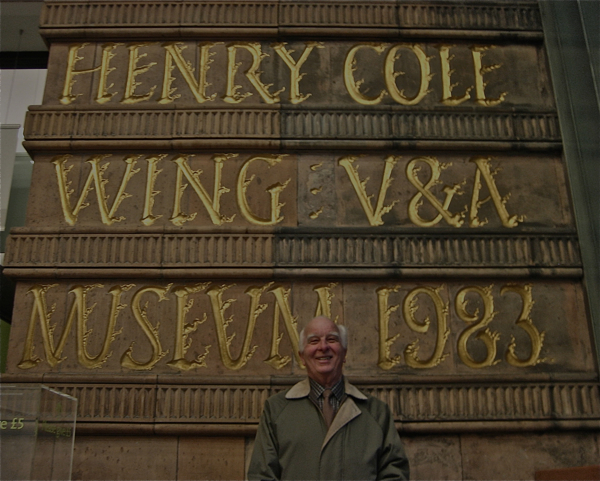
Stanley Rondeau’s great-great-great-great-great-great-grandfather Jean Rondeau was a Huguenot silk weaver who came to Spitalfields in 1685 as a refugee fleeing religious persecution in Paris. Jean’s son prospered in Spitalfields, becoming Sexton at Christ Church, having eleven children, building a new house at 4 Wilkes St and commissioning designs in the seventeen-forties from the most famous of silk designers, Anna Maria Garthwaite, who lived almost next door, in the house on the corner with Princelet St.
Since Anna Maria Garthwaite’s designs were exceptionally prized both for their aesthetic appeal and their functional elegance as patterns for silk weaving, hundreds of her original paintings have survived to this day. So Stanley & I went along to the Victoria & Albert Museum in Kensington to take a look at those done for Stanley’s ancestor Jean the Sexton, nearly three centuries ago. We negotiated our way through the labyrinths of the vast museum, teeming with school children, with a growing sense of anticipation because although Stanley had seen one of the designs reproduced in a book, he had never cast his eyes upon the originals. And up on the fourth floor, we entered a sanctuary of peace and quiet where curator Moira Thunder awaited us in a lofty room with a long table and large flat blue boxes containing the treasured designs that were the objects of our quest.
Moira – chic in contrasting tones of plum and navy blue, and with a pair of fuchsia lenses which hinted at a bohemian side – welcomed us with scholarly grace, and duly opened up the first box to reveal the first of Anna Maria Garthwaite’s designs. Drawn in the wide margin at the top of a large sheet containing an elaborate floral number, this design was the epitome of restraint with a repeated motif that resembled a bugle flower in subdued tones of purplish brown, labelled Mr Rondeau, Feb 5 174 1/2, and intended as a pattern to be woven into the body of a vellure used for men’s suiting.
Stanley was instinctively drawn towards his own name revealed before him, leaned forward to touch the piece of paper – which caused Moira’s eyes to pop, though fortunately for all concerned the priceless design was protected by a layer of transparent conservator’s plastic. Once smiles of amelioration had been exchanged after this faux-pas, Stanley enjoyed a quiet moment of contemplation, gazing with his deep-set chestnut eyes from beneath his bushy white eyebrows upon the same piece of paper that his ancestor saw. I think Stanley would have preferred it if ‘Mr Rondeau’ had been written beside the fancy design below, because he asked Moira whether the other design for Jean Rondeau in the collection was more colourful but, with an unexpectedly winsome smile, Moira refused to be drawn.
Yet while Stanley’s curiosity was understandably focussed upon those designs attributed to his ancestor, I was enraptured by the myriad pages of designs by Anna Maria Garthwaite, whose house I walk past every day. Kept from the daylight, the colours in these sketches remain as fresh as the day she painted them in Spitalfields three centuries ago. The accurate observation of both cultivated and wild flowers in these works suggests they were painted from specimens which permits me to surmise that she had access to a garden, and picked her wild flowers in the fields beyond Brick Lane. I especially admired the sparseness of these sprigged designs, drawing the eye to the lustrous quality of the silk, and Moira, who worked as assistant to Natalie Rothstein – the ultimate authority on Spitalfields silk – pointed out that weavers rarely deviated from Garthwaite’s designs because they were conceived with such thorough understanding of the process.
And then, Moira opened the second box to reveal the second design by Anna Maria Garthwaite for Jean Rondeau, which Stanley had never seen before. Larger and more complex than the previous, although monochromatic, this was a pattern of pansy or violet flowers divided by scalloped borders into a repeated design of lozenges. Again drawn in the margin, at the top of a piece of paper above a multicoloured design, this has the name ‘Mr Rondeau’ written in feint pencil beside it. It was a design for a damask, either for men’s suiting or a woman’s dress, which Moira suggested would be appropriate to be worn at the time of half-mourning. A degree of formalised grief that is unfamiliar to us, yet would have been the custom in a world where women bore many more babies in the knowledge that only those chosen few would survive beyond childhood.
Moira took the unveiling of this second design as the premise to outline the speciality of Master Silk Weaver Jean Rondeau, who appears to have built his fortune, and company of fifty-seven employees, upon the production of cheaper silks for men, unlike his Spitalfields contemporary Captain Lekeux – for whom Anna Maria Garthwaite also designed – who specialised in the most expensive silks for women. In response to Moira’s erudition, Stanley began to talk about his ancestor and the events of the seventeen forties in Spitalfields with a familiarity and grasp of detail that made it sound as if he were talking about a recent decade. And as he spoke, with the unique wealth of knowledge that he had gathered over a lifetime of research, I could see Moira becoming drawn in to Stanley’s extraordinary testimony, revealing new information about this highly specialised milieu of textile production which is her particular interest. It was a true meeting of minds, and I stood by to observe the accumulation of mutual interest, as with growing delight Moira and Stanley exchanged anecdotes about their shared passion.
Recently, Stanley visited the Natural History Museum to hold the bones of his ancestor Jean the Sexton which were removed there from Christ Church for study, and by seeing the designs at the Victoria & Albert Museum that once passed before Jean’s eyes in Spitalfields, he had completed his quest.
‘It was a big day,’ Stanley admitted to me afterwards, his eyes shining with emotion, as he began to absorb the reality of what he had seen.
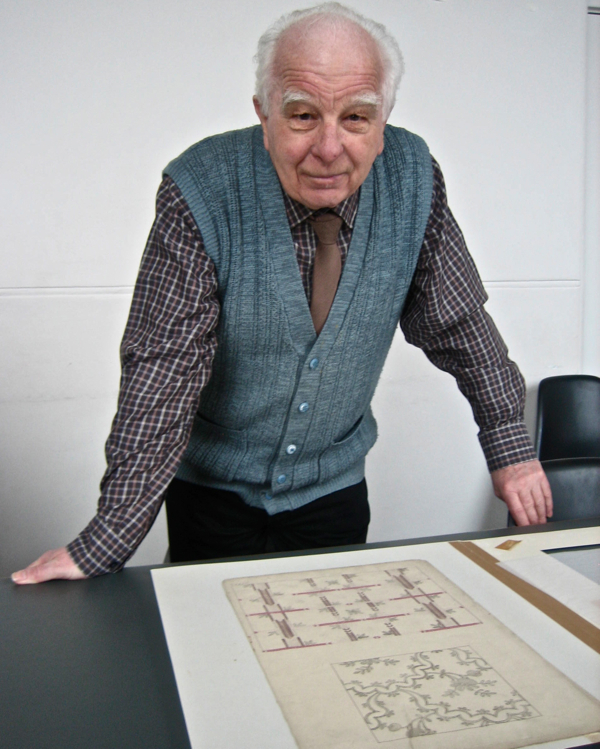
Stanley Rondeau sees the design commissioned by his ancestor in the seventeen-forties for the first time
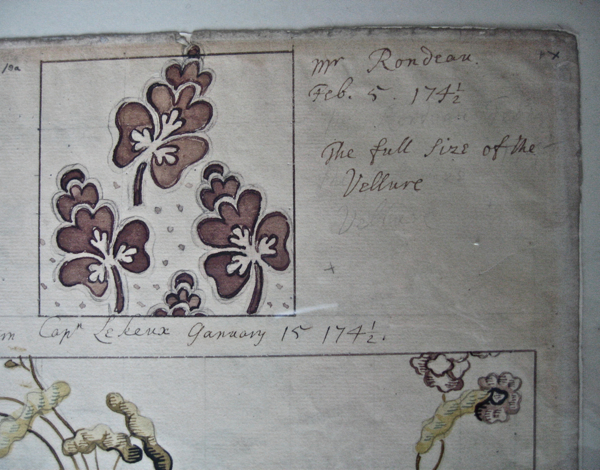
Design for a vellure for Jean Rondeau, by Anna Maria Garthwaite, Spitalfields, February 5th, 1741
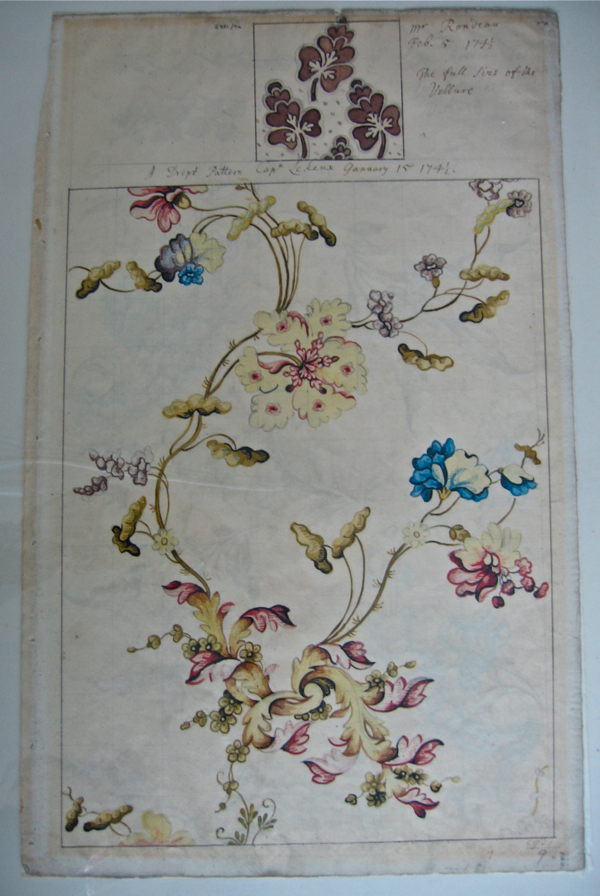
The full page with Jean Rondeau’s design at the top
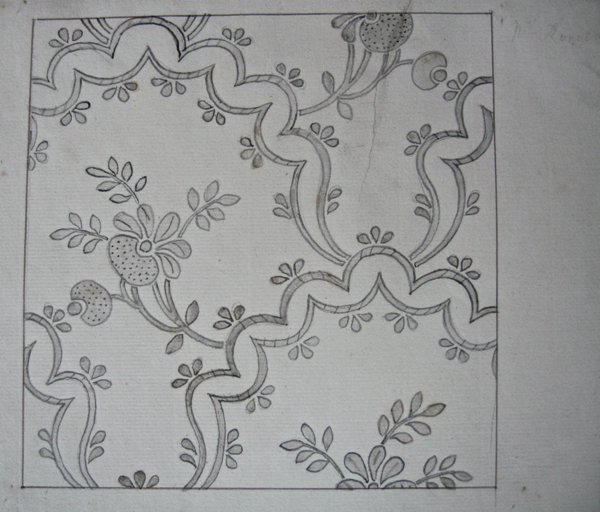
Design for a damask by Anna Maria Garthwaite for Jean Rondeau, possibly for half-mourning
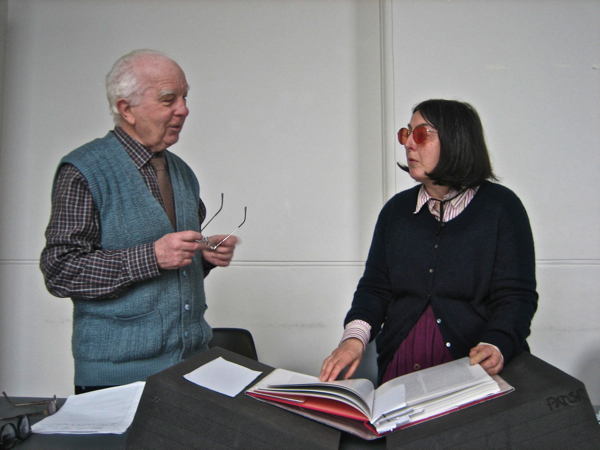
Stanley Rondeau chats with Moira Thunder, Curator, Designs, at the Victoria & Albert Museum, over a copy of Natalie Rothstein’s definitive work “Silk Designs of the Eighteenth Century.”
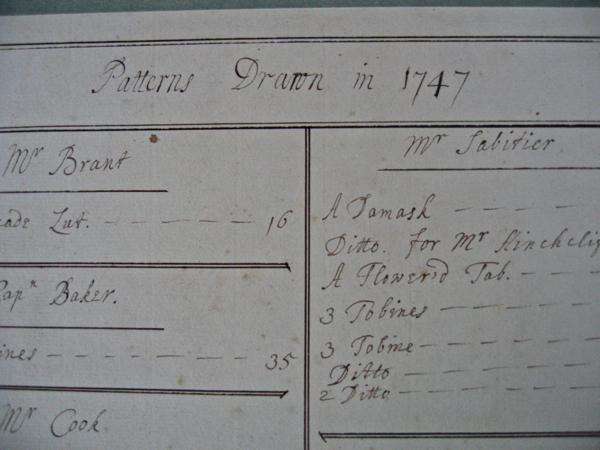
Anna Maria Garthwaite’s catalogue of designs
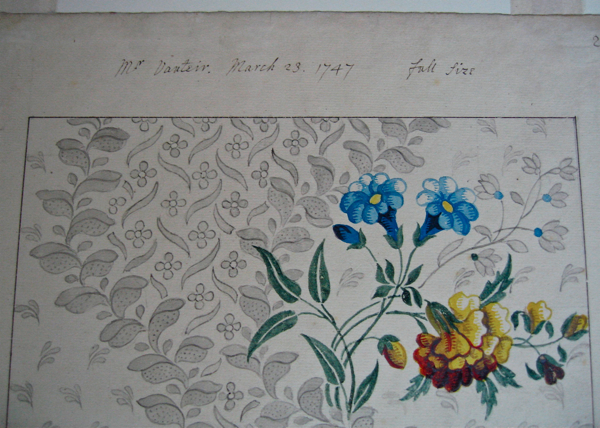
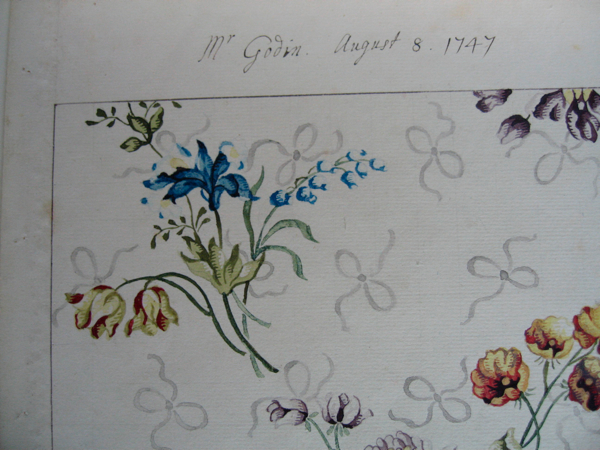
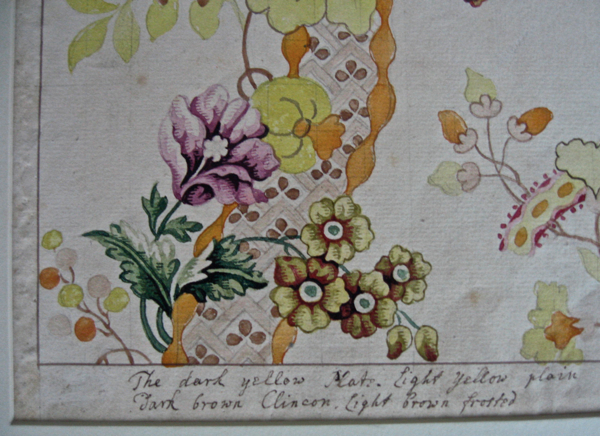
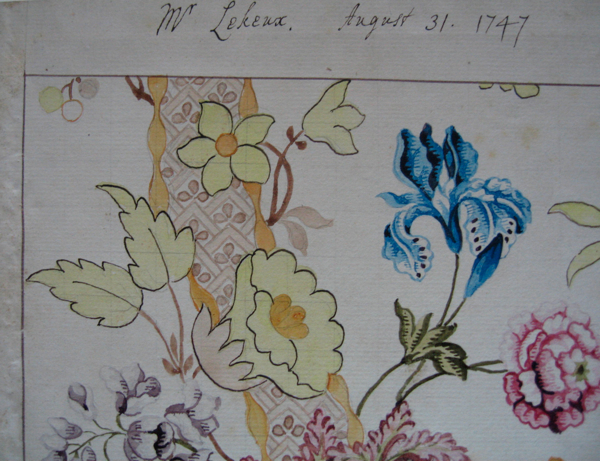
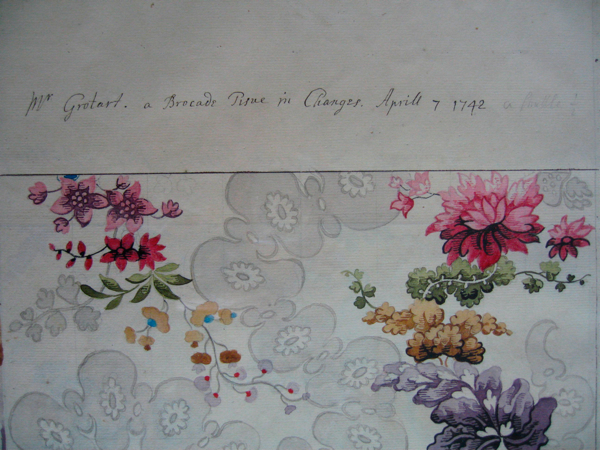
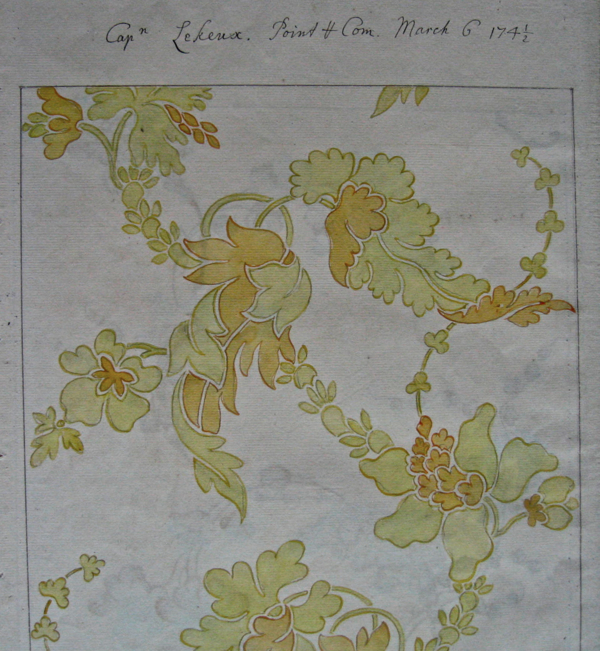
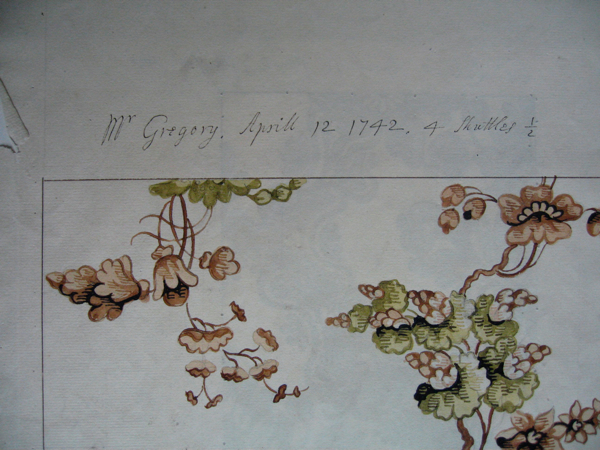
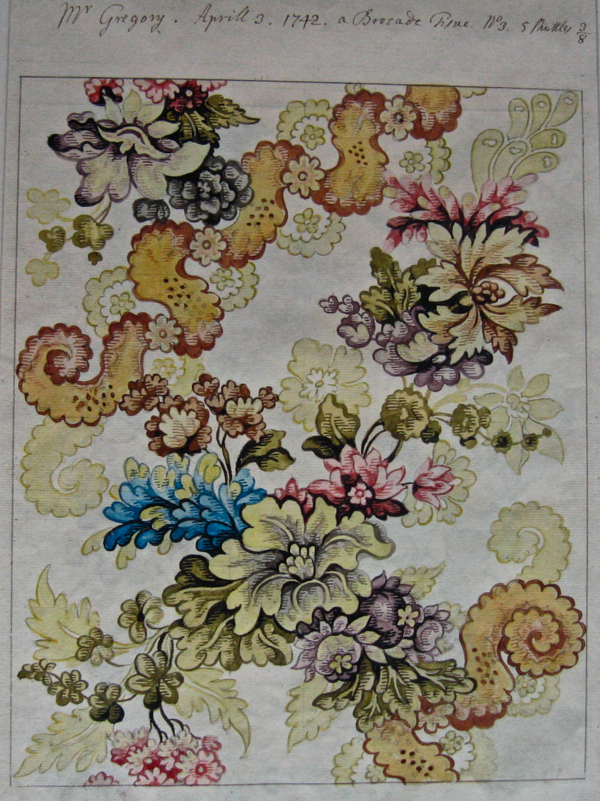
Designs by Anna Maria Garthwaite for Spitalfields silks from the seventeen forties in the collection of the Victoria & Albert Museum.
Textile design photographs by Jane Petrie
Textiles copyright © Victoria & Albert Museum
With grateful thanks to Moira Thunder of the Victoria & Albert Museum for making this possible.
You may also like to read about










What a wonderful day out. No wonder Stanley wanted to reach our and touch Anna Maria’s designs. Such fabulous colours. In particular the shades of blue, which stand out so wonderfully.
Forgive me for posting twice. I hadn’t read the bit at the top, which tells the reader Stanley has passed on. What a smart, handsome man. His engagement with the visit leaps from the photos.
Absolutely delightful! Both of these parts of the Rondeau story!
To pair the history with its evidence in the present: so well done!