
The Oxford Sausage

I am proud to publish these excerpts from THE OXFORD SAUSAGE by a graduate of my writing course. The author set out to write a spicy mix of Oxford stories from a house once belonging to a city sausage maker.
I am taking bookings for the next writing course, HOW TO WRITE A BLOG THAT PEOPLE WILL WANT TO READ on February 7th & 8th. Come to Spitalfields and spend a winter weekend with me in an eighteenth century weaver’s house in Fournier St, enjoy delicious lunches and eat cakes baked to historic recipes, and learn how to write your own blog.
If you are graduate of my course and you would like me to feature your blog, please drop me a line.
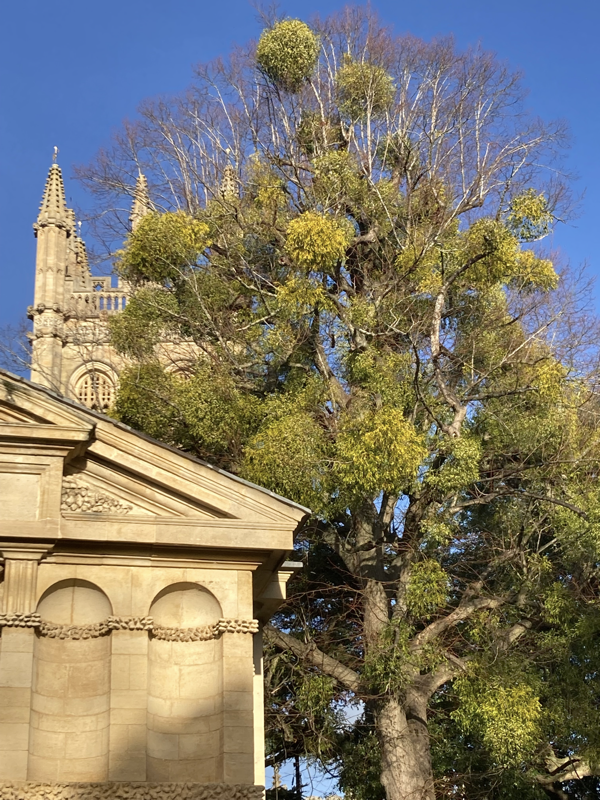
A MISTLETOE TOUR FROM MAGDALEN COLLEGE TO MUSIC MEADOW
At this low ebb of year, it becomes suddenly visible – when the leaves have fallen from the trees, revealing what appear to be giant birds’ nests perched amongst the bare winter branches. These hanging baskets of vibrant green foliage are huge balls of mistletoe, magically, mysteriously, bearing fruit even through the shortest and darkest days of the year.
As it happens, at Oxford, there is an expert on mistletoe matters right here in the city. Oliver Spacey is studying the ecology and evolution of mistletoe for his PhD, and on a bright afternoon recently he was kind enough to take me on a mistletoe meander. I had always associated the plant with the Welsh border counties, Herefordshire, Worcestershire and the like. But it seems, as we strolled around Christ Church meadows and beyond, Oxford also has its fair share. And what a remarkable creature it turns out to be.
Oliver tells me mistletoe has the largest genome of any wild species in the British Isles – holding thirty times more genetic material than humans. It is also one of the very few plants to have no roots. Not restricted by gravity, it simply attaches itself to the branch of a tree, and then – like some alien high wire act – shoots an invisible tentacle into the bark and begins to grow. It takes about five years for it to form natural spheres of wishbone shaped leaves, by which time the female plant begins to produce those famous ethereal pearl-like berries under which we like to pucker up at Christmas. The plants can grow up to two metres in diameter and live for forty years.
‘Mistletoe is spread by birds,’ Oliver enthuses, as he leads me north up Rose Lane and through the gates of Oxford Botanic Garden where a mass of mistletoe balls decorate a giant lime silhouetted against Magdalen College Tower. He explains that birds like the Blackcap, pick the berries, scoff the juicy and then smear the sticky seed on to the bark of the tree, while the well-named Mistle Thrush, eats the soft fruit and poops it out onto a branch. Mistletoe’s common name is derived from the Anglo-Saxon word for ‘dung’ (mistel) and ‘twig’ (tan).
Mistletoe’s ability to flourish in the depths of winter has made it as a symbol of fertility and life through the centuries, but it was the Victorians who popularised the ‘kissing ball’, a collection of evergreens that included mistletoe, as a Christmas institution.
Music Meadow, just behind St Catherine’s College on the banks of the Cherwell is a mass of wild flowers in the spring but is now set aside for sheep grazing. Here a clump of tall poplars are home to the most extraordinary collection of mistletoe – fantastical trees with hundreds upon hundreds of huge pom-poms of foliage, magically, mysteriously hanging in the sky.
I stoop to collect a fallen branch of berries, and take it home where I tie the perfect shaped ball with red ribbon and hang it in the same spot in our kitchen as I always have done, as a Christmas tradition.
Oliver Spacey is supported by The Tree Council. You can help him with his research by registering your own pictures of mistletoe on the MistleGO! app.
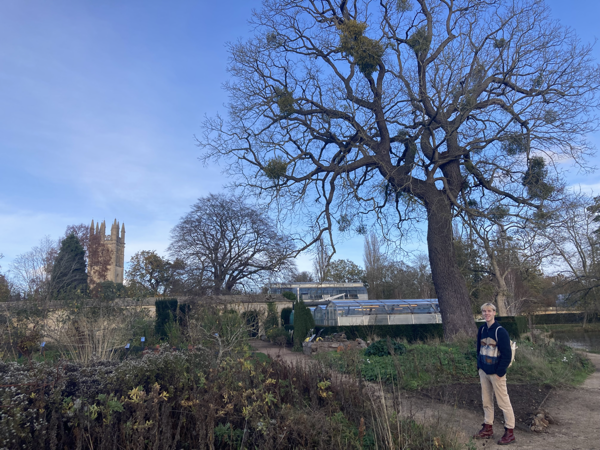
Oliver Spacey from the University’s Department of Biology at Oxford Botanic Garden
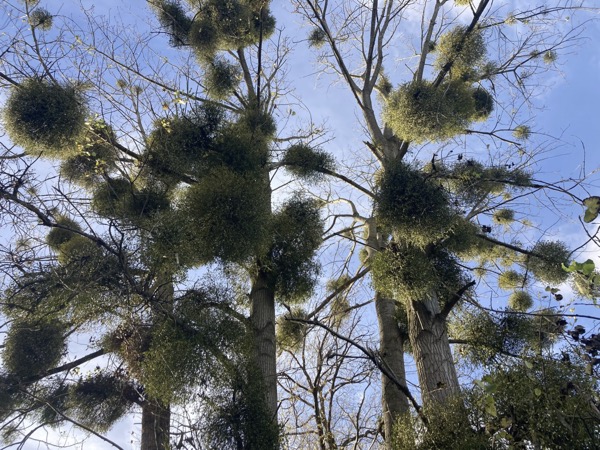
Trees laden with mistletoe in Music Meadow
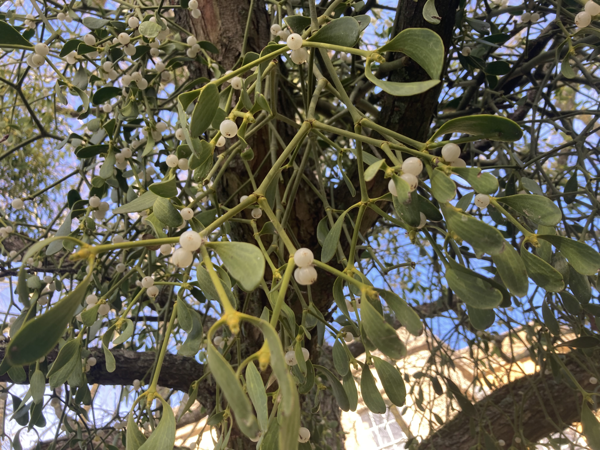
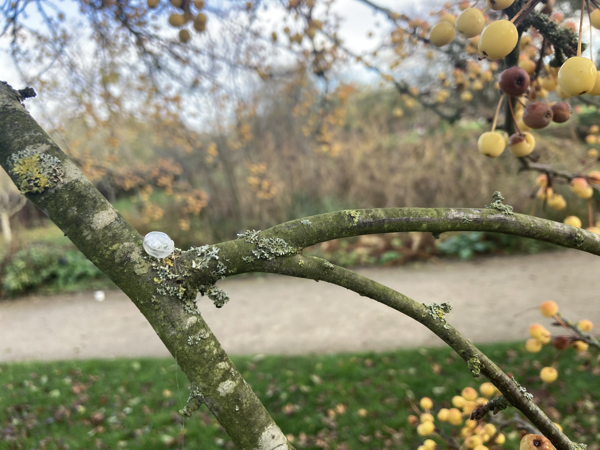
When propagating mistletoe it is important not to press it into a crevice in the bark as it needs plenty of light to grow
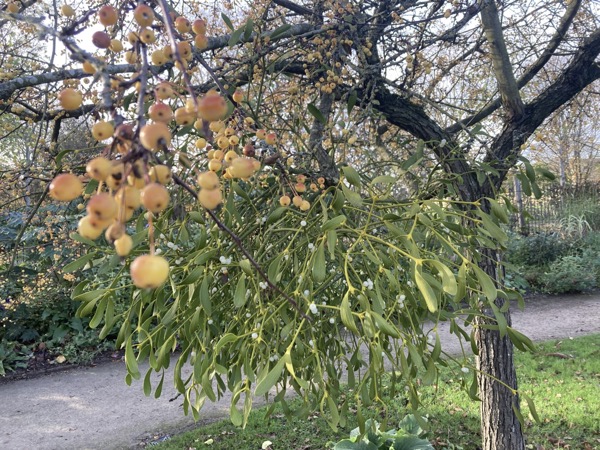
Mistletoe on an apple tree










Although it’s a parasitic plant, it’s fussy as to what trees it’ll grow on.
So interesting to read The Oxford Sausage’s guest spot here and learning of Oliver Spacey’s research. My first home, a cottage, came with a tiny garden but included a couple of trees. I was delighted to find a bunch of mistletoe growing on one tree – I think it was a crab apple. That poplar tree looks amazing. Truly magical.