
Gustave Doré’s East End

Click here for more information
I have been thinking about Gustave Doré lately, as the freezing miasma of winter descends upon the city and I struggle to negotiate the excited crowds thronging in the busy streets. Gazing upon the teeming masses in the flickering half-light outside Liverpool St Station, I see his world where deep shadows recede into infinite gloom and I succumb to its terrible beauty.
Doré signed a contract to spend three months in London each year for five years and the completed book of one hundred and eighty engravings with text by Blanchard Jerrold was published in 1872, entitled London – A Pilgrimage. Although he illustrated life in the West End and as well as in the East End, it is Doré’s images of the East End that have always drawn the most attention with their overwhelming sense of diabolic horror and epic drama, in which his figures drift like spectres coalesced from the ether.

In Bishopsgate

In Wentworth St, Spitalfields
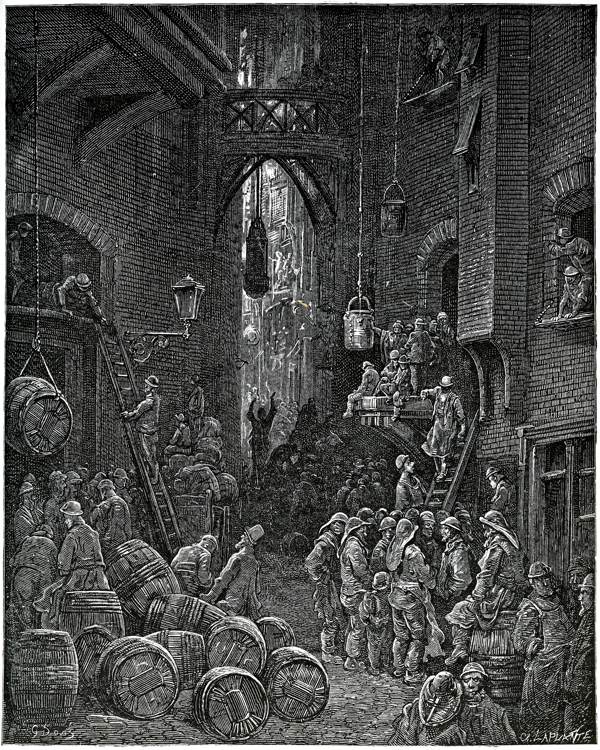
Riverside St
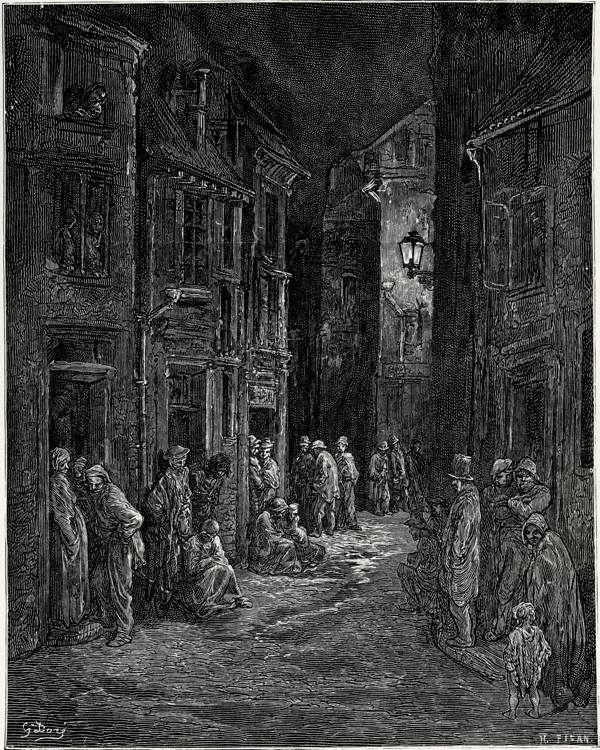
In Bluegate Fields

A City Thoroughfare

Inside the Docks

In Houndsditch

Turn Him Out, Ratcliff

Warehousing in the City

Billingsgate Early Morning
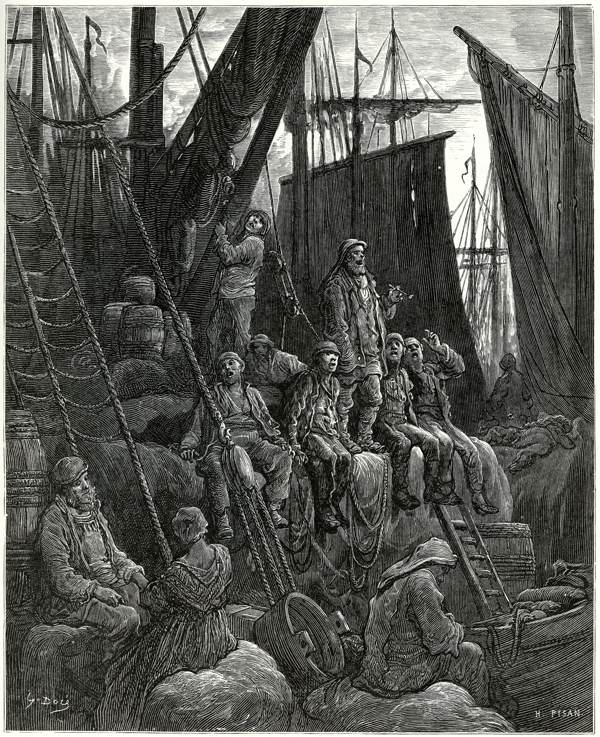
Off Billingsgate

Refuge – Applying For Admittance

Brewer’s Men

Hay Boats On The Thames

Images courtesy Bishopsgate Institute
You may also like to read about













I find his drawings very moving . The drawing of Houndsditch shocked me to the core because my great grandfather in law was born in Harrow Alley in 1872 . You will notice the street sign announcing Harrow Alley . He went on to immigrate to Melbourne Australia and became a very successful bookmaker before losing it all, Dying in a rooming house without his legs thanks to a bottle of whisky and box of cigars a day habit .I guess the damage of his start in poverty was yo haunt him and draw him back . His son though did well and grandson even better
These are an incredible set of engravings and I frequently revisit them. Their depiction of London in the mid to late 19th century help me realise what life was actually like for many at that time and my ancestors would be included among them. My great grandfather died in pretty grim circumstances in Virginia Court, Jacob’s Island in Bermondsey in 1899, after becoming destitute and separated from his family. Many today who bemoan London, complain about its crime and apparent shortcomings might study and learn from these depictions. Many thanks again GE for posting.
Gustave Dore’s dark grey London gloom is unapologetic in reflecting the harsh lives of it’s poor, without sentiment – & yet still manages to draw us into their world of bare foot & threadbare reality with an artist’s eye & sensitivity..
It is both weird and interesting that Gustave Doré’s great-great-grandson, Julien, is a present-day musician and actor with a self-deprecatingly comic bent. His recent TV series ‘Panda’ is the antithesis of gloom; in fact, it is quite funny, in a French sort of way.
The apple has fallen quite far from the tree, in this case?
http://juliendoreofficiel.com/
Strange evocations derived from the same gravers that gave us Dante’s hell. In Bluegate Fields: closed-off lives enacted under a closed-off sky, yet a brilliance of light falling over the immediacy of urgent activity in the docklands, and within all, each and every human figure a convincing testimony of real life lead. Amazing. Thank you.
Stunning. Thank you for bringing them to us.
Weirdly I only found out recently during a visit to my last living aunt in Ain, France that Gustave Doré spent most of of his education from age 11 in Bourg-en-Bresse where I also went for secondary school. Therefore I’ve often walked past the very college, then Collège Royal now Lycée Lalande, loads of times and still do on my now rare visits ‘home’.
So I intend to next visit Musée des Beaux Arts at Brou prieuré solely seeking Gustave Doré’s works when I go there in the spring. I now feel a kinship with him and my connection with East London where I’ve nursed many of the downtrodden before gentrification of the area.
Indeed I arrived at the London hospital not yet Royal in 79 during a strike a rubbish collection: heaps of uncollected household trash were higher than bus shelters which I can now easily picture in my memory as a Doré’s illustration