
John Vanbrugh in Greenwich
Next year will be the tercentenary of the death of John Vanbrugh, the playwright-turned-architect who designed Castle Howard and Blenheim. Charles Saumarez Smith, former Director of the National Gallery and an East End resident, has written a biography John Vanbrugh: The Drama of Architecture. Today he writes about Vanbrugh Castle in Greenwich where Vanbrugh lived at the end of his life. Charles will be talking about Vanbrugh at the Wigmore Hall next Thursday 20th November. Click here for tickets
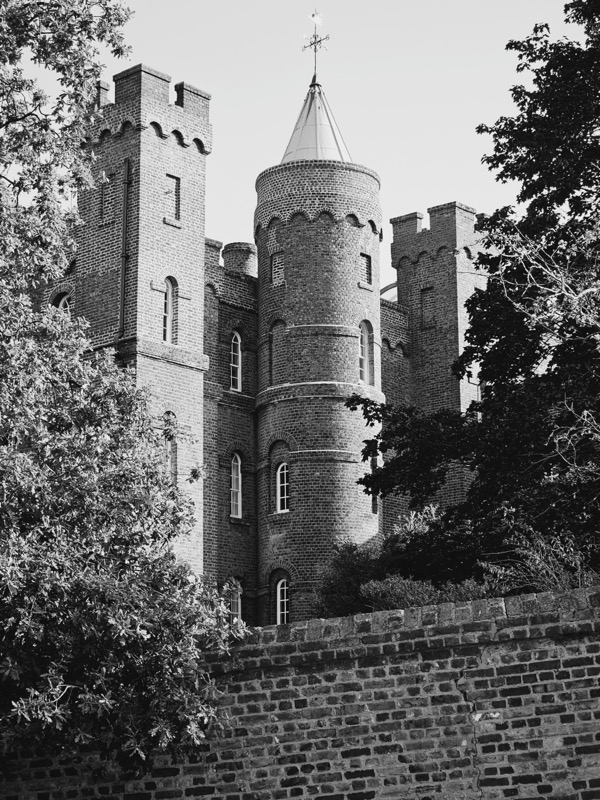
Vanbrugh Castle
If you walk up the hill in Greenwich Park from the Queen’s House or from Greenwich itself, you may spot the battlements of a small, fortified castle poking above the park wall and wonder what it is. Is it an eighteenth-century folly? Or the house of a nineteenth-century antiquarian?
Vanbrugh Castle, as the house is called, was built by John Vanbrugh as a rural retreat for himself, his new wife and their family in the early 1720s. He signed a lease for a small plot of land, immediately next door to the park, together with an adjacent twelve-acre field on 3rd March 1718, apparently planning to build a set of houses for himself and members of his close family — his two younger brothers, Charles and Philip, both officers in the Royal Navy, and two younger sisters, Victoria and Robina.
It was just at the moment that Richard Boyle, third Earl of Burlington, was promulgating the importance of designing in an orthodox Palladian style. Burlington travelled out to Italy in the summer of 1719 and returned with vast numbers of Palladio’s drawings which he bought from the owner of the Villa Maser. Vanbrugh was perfectly capable of designing in an orthodox Palladian style if required as he demonstrated in his design for the Temple of the Four Winds, one of his last works at Castle Howard. But for his own house, Vanbrugh decided to design in a pseudo-medieval style with a circular turret attached in front, with a very inconvenient, steep staircase, and two corner towers with battlements. What on earth made him do this?
When he was supervising the construction of Blenheim, Vanbrugh had become very attached to living in the ruins of the medieval Woodstock Manor which still survived in the grounds of Woodstock Park. Vanbrugh adapted them for his own use, introducing new windows and making small-scale repairs, including adding a bog-house. When the Duchess of Marlborough discovered that he had spent money on this, she was livid and ordered the ruins to be demolished. But Vanbrugh held his ground and, possibly unwisely, sent her a long paper in which he described how important these medieval ruins were, how full of historical associations, and that they were an important historical landmark in the view from the new palace.
At almost exactly the time that Vanbrugh was making plans for his new house, he also encouraged his friend, Charles Howard, third Earl of Carlisle, to build a whole line of medieval fortification on the edge of his estate at Castle Howard. These fortifications are in exactly the same style as Vanbrugh Castle, not intended to be authentically medieval, but in the medieval style, a kind of free-form medievalism in which the house is reduced to a bare geometry.
Vanbrugh not only designed a castle for himself but a number of other buildings nearly, including another large-ish house flanked by turrets for his younger brother, Charles, and a very curious single storey building like a castellated bungalow which was known as ‘The Nunnery’, lived in by his unmarried sisters, although in the early 1720s, it was another brother, Philip, who paid the rates. Maybe all three of them lived there together.
On either side of the Nunnery were two tower houses, known as the White Towers, four stories high in their central section, so, in contrast to the low-level The Nunnery. Imposing, although, as he described the houses in a letter to Lord Carlisle, there was only a single room and closet on each floor. He told Carlisle that he was designing these houses for his sons, although his younger son, John, known as Jack, was dead by 1723.
Plans and outline drawings for these houses survive in a large cache of drawings in the Victoria and Albert Museum, bought in 1992 with help from the National Lottery Heritage Fund. There are many other outline sketches for small houses in this collection. These are freehand, experimental doodles, in which Vanbrugh tries out different ground-floor room arrangements and how even a small house can be made to look interesting through the use of abstract geometry and with a limited amount of, again abstract, articulation, much in the style of Goose-Pie House which he had built for himself in Whitehall and which Jonathan Swift satirised as being like a mud-pie, copied from children playing in the street.
It seems that in the last few years of his life, when Vanbrugh was no longer involved with Blenheim (he had fallen out terminally with the Duchess of Marlborough in November 1716 and was never allowed back), he focused his attention, instead, on designing smaller houses for himself, his family and friends. It may have been an early form of property development.
An antiquary, William Stukeley, Secretary of the recently established Society of Antiquaries, visited Greenwich in June 1721, not long after Vanbrugh Castle had been built and drew it in exactly the same way that he drew medieval ruins, labelling it ‘Castellum Vanbrugiense apud Grenovicum’. The following August, he returned to draw his brother’s house which he called a ‘castellulum’, a baby castle. It is a very odd idea: an earnest antiquary drawing them as it they were authentic medieval buildings.
Another Scottish antiquary, Sir John Clerk of Penicuik, visited in 1727, the year after Vanbrugh’s death. He was equally surprised and wrote:
‘Vanbrugh was a famous architect but of an odd taste. These houses of his consist of great heaps of brick and thick walls but little accommodation within. There is scarcely a room in them above 8 or 10 foot square and some much less. The ornaments are such which the Goths and their successors used to place in Castles and Prisons, viz. battlements, round-towers, little windows and doors. And yet this was the man chosen to build Blenheim House for the Duke of Marlborough!’
Vanbrugh was a very independent-minded man. Was he, when he came to design a house for himself, nostalgic for his youth when he had served in the army? Or was it an elaborate stage-set built to impress his young wife ? He had been a playwright in his youth.
After being kicked out of the ruins of Woodstock Manor by the Duchess of Marlborough, he was no doubt enjoying the fact that he had been able to build a castle for himself, cocking a snook at the Duchess and enjoying the view from his own little castle over Greenwich. I like to imagine him at the gate with his spy-glass.
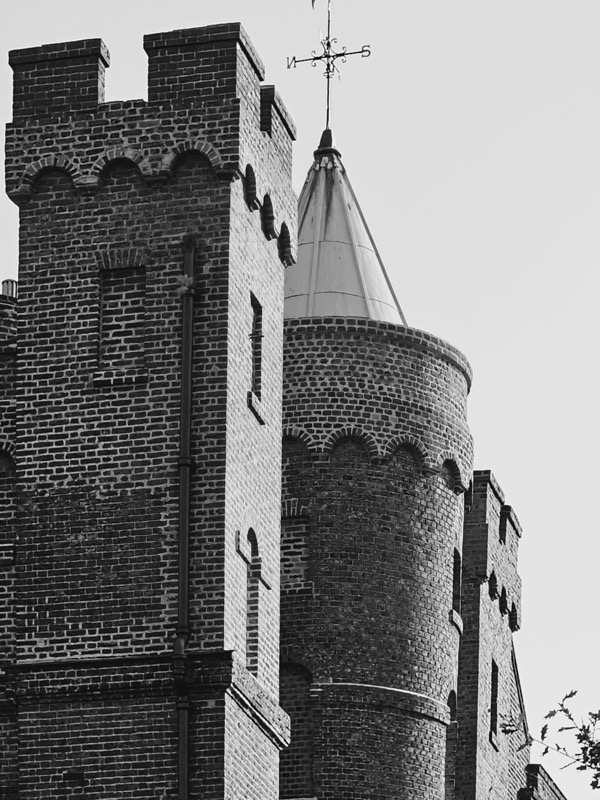
Photograph by Charles Saumarez Smith
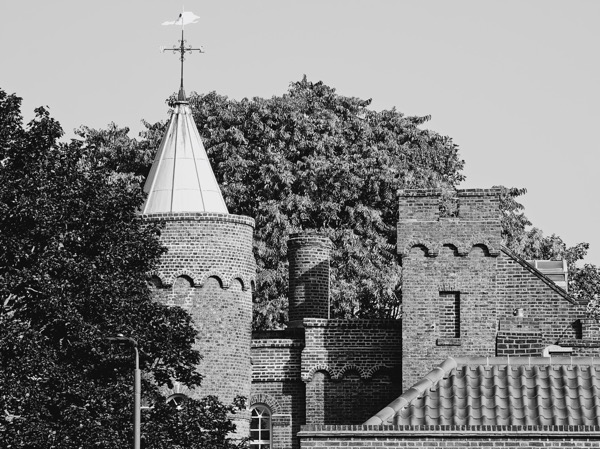
Photograph by Charles Saumarez Smith
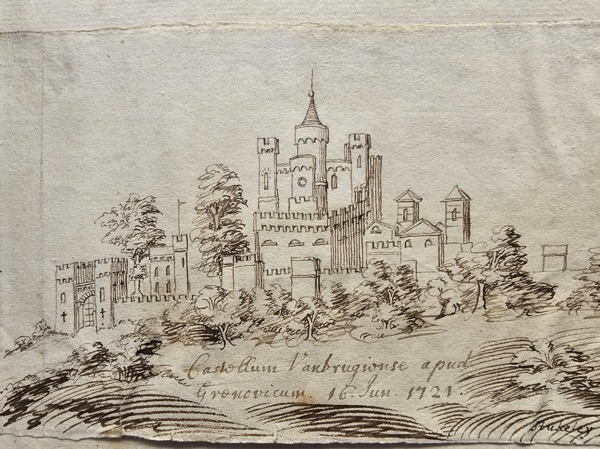
Vanbrugh Castle, drawing by William Stukeley 1721
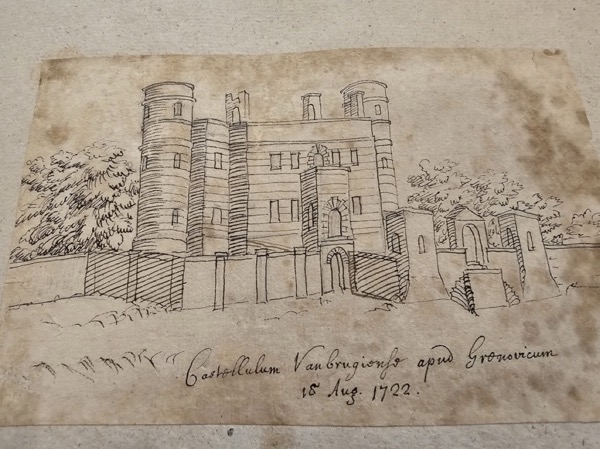
Vanbrugh Castle, drawing by William Stukeley 1722
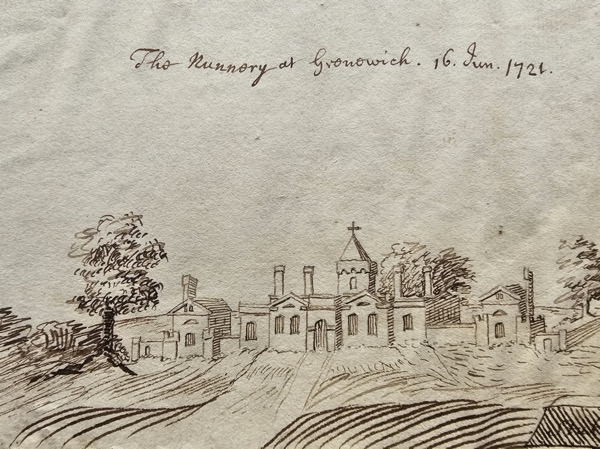
The Nunnery, drawing by William Stukeley 1721
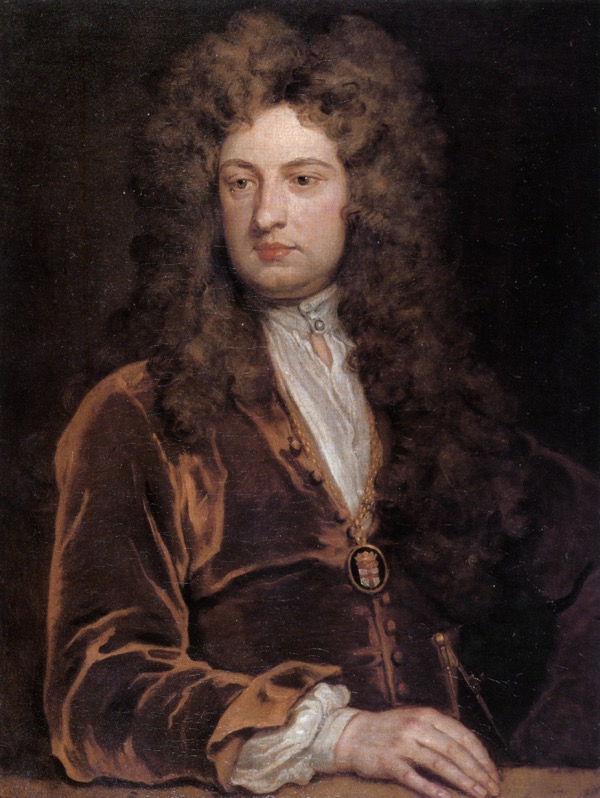
John Vanbrugh by Godfrey Kneller, c. 1704 and c. 1710 (courtesy of National Portrait Gallery)
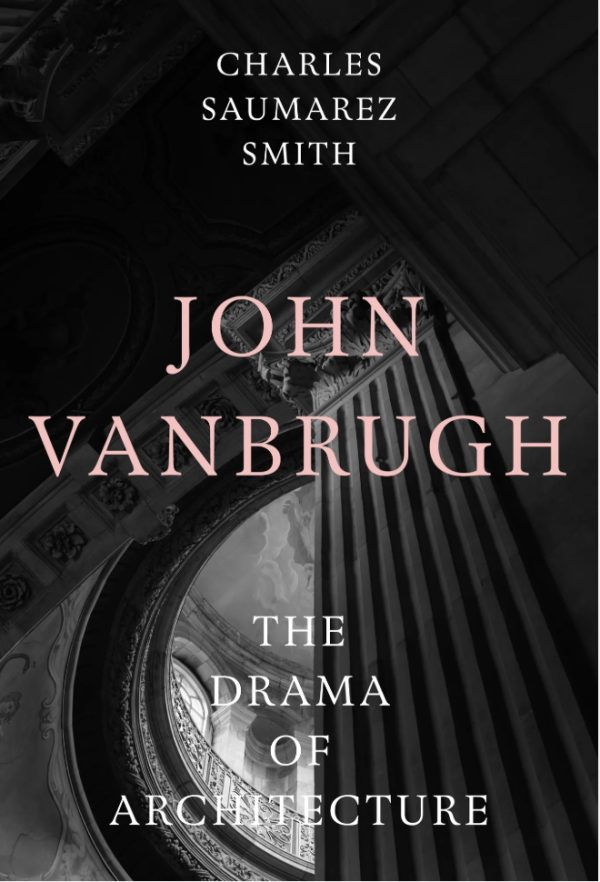
Charles Saumarez Smith’s John Vanbrugh: The Drama of Architecture will be published by Lund Humphries on 20th November 2025. An exhibition of Vanbrugh’s drawings opens at Sir John Soane’s Museum on 4th March 2026.










All news to me, Vanburgh Castle, but strange. The book should be interesting.
Vanbrugh looks very flamboyant and theatrical in his portrait. I studied a bit about him on an architecture and furniture course as part of my history degree back in the 90s.