
On Publication Day For ‘Journal Of A Man Unknown’
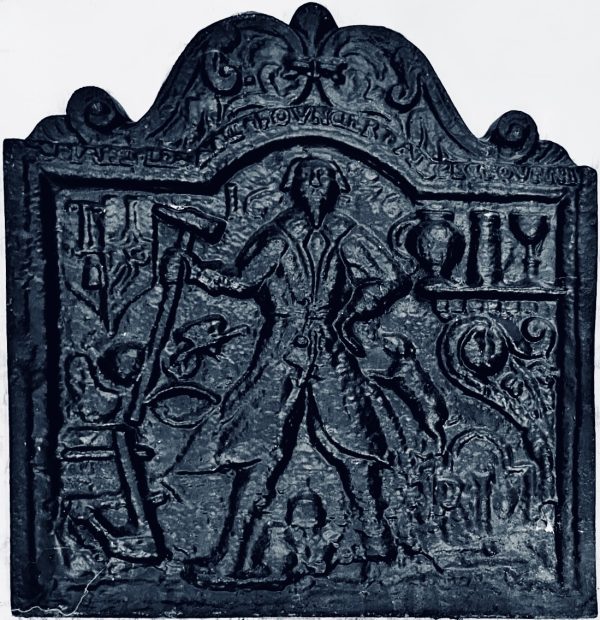
Seventeenth century fireback of an iron worker
Today is publication day for Gillian Tindall’s novel Journal Of A Man Unknown. As readers will know, Gillian died last month at the age of eighty-seven. Although I am deeply sorry that she did not live to see her book published, I take consolation in the knowledge that it is here and ready to be distributed to thousands of readers, thereby fulfilling her dying wish.
Below I publish an extract, recounting the protagonist’s first year in London, to give you a flavour of the novel.
Culminating a distinguished career spanning more than sixty years, historian Gillian Tindall wrote Journal Of A Man Unknown as her final statement. In an astonishing feat of literary imagination, she projected herself back onto one of her forebears to conjure a compelling vision of seventeenth century England.
The main character is a Huguenot iron worker, an occupation that leads him from the Sussex Weald to the Whitechapel Bell Foundry, and beyond to the North Country.
This is a hymn to those who pass through life not leaving a trace, except in the hearts of those into whose lives they have been cast.
If you have not already booked to attend the publication party at Hatchard’s Piccadilly on 19th November when Colin Thubron will speak and Alan Cox will read from the novel, please drop me a line to spitalfieldslife@gmail.com
CLICK HERE TO BUY JOURNAL OF A MAN UNKNOWN FOR £10
TOM HARTHURST’S FIRST YEAR IN LONDON
An edited extract from ‘Journal of A Man Unknown’ published today
The reality of my aloneness truly came to me in London. So used I was to a world in which nearly every face, if not actually known to me, was of a familiar kind that I felt that in London I was moving through the innumerable, unknown noisy crowds as if I were a ghost – as unperceived by others as they were alien to me. It must be like this, I thought for a dead man to return after many years to the world of the living, when all he once knew are gone.
I believe I spent that time mainly walking around with nothing to do but solve the problem of what to do next. How was my new life to begin? I knew, of course, that I must somehow get a job within my trade and my abilities: I had my hand tools with me for that purpose. But what job, exactly? I had not made any proper plans. Wandering in Clerkenwell, I noticed a number of clockmakers, but though I knew my skills with blade-making and ring-fittings were good I doubted if I would be what an employer there wanted.
And so far I had failed to find the community of the French with metal-workers among them. Exploring the City, and the districts expanding fast on the western side of it, I had not ventured upon the Spital Fields outside the City walls, further to the east.
I was also much bothered by the continuous noise of the Town streets – shouting vendors, quarrelling idlers, continuous wheels on stones, chiming bells. All that which I had found exciting now oppressed me, a dweller in woodland pathways.
Later, of course, I too, like any Londoner, learnt to ignore the tumult and also many of the poor misshapen wretches whose only home is the street, and to pick my own way through the labyrinth, but at first I felt stunned and belittled by it all.
Meanwhile, I ate sparingly: mainly of bread and cheese bought in pen’orths, though tempted on all sides by the mass of street sellers crying wares of everything from fresh-baked sardines to winter-kept pears. I had my lodging to pay, meagre as it was, and dreaded using up all the money I had brought with me.
Today, when there are many more Huguenots come to live in London and elsewhere in England, and the Spital Fields are builded up with their houses, some of them quite fine, many an Englishman will tell you `Ah, they’ve all come since ’85’. But the truth of the matter is Huguenots had been escaping to our shores all this past century and especially once King Charles was back on our throne. They crossed the Channel by some means, often in perilous little boats, and so up the River Thames under cover of night. And they brought their skills, as weavers or jewellers or metal-workers, which they hastened to put to use.
The very first Sunday I went to the Huguenot Chapel in Threadneedle Street, I made contact with a man employed as a metal-worker at the White Chapel Bell Foundry. His name was Jean Orange, of the town of Orange in the far-distant southern regions of France. I owe to him my reception into their world and hence the whole course of my life since.
As was natural in that place and time, he addressed me first in French. But when he saw my confusion he switched at once to the heavily accented English he had acquired, and soon I was explaining to him my origins among the French iron-workers of Sussex. Then he introduced me to another from his own workplace. A workplace which, within a couple of weeks, also became mine.
It was not a job that used all my skills, or that was very well paid. But it was work within my capacity, and I was infinitely relieved and thankful to find myself, for the time being, in that situation. Also, men were proud to work in the White Chapel Foundry. Bells from there, as they said, go out not only all over England but these days to far off lands. And bells are at the heart of human life: they mark the hours, they ring in joy and celebration, and in warning, and they toll for our losses and our dying.
I felt that, like a cat foolishly jumping from a high place, I had nonetheless landed on my feet. At first I was wary of spending much money (for everything was in money in London, whereas in Sussex much then was done between ourselves by exchange of work, food-stuffs, grain, and unspoken understanding), so I remained in my attic room high up in Field Lane.
By and by I felt secure enough in my job to ask Jean Orange if he knew of anyone who might rent me a room on the east side of Town nearer to our work?
He suggested me to a family of silk-weavers called Regnier. They lived not far from him in a new row of houses called Flower-and-Dean Street, leading out of Brick Lane. The Lane, I came to understand, was an old one, and it still led then to smoking brick-kilns, but the products of the kilns were rapidly being used to cover the land about. Brick Lane itself was now lined with houses and new small streets ran out of it filling in the land in some places all the way back to the Bishops Gate, though there were still open tenter fields then in which London’s washing blew to dry.
The Regniers were the hardest working family I ever met, which is how skilled silk-weavers make a good deal of money. Their son had lately married into a family of weavers based near St Giles Church, beyond Holborn, where there was another nest of Huguenots, so a small room in the house in Flower-and-Dean Street was free for me to take. I did so, and soon came to find the sound of looms on the floor above me, sometimes far into the evening, not disturbing but reassuring.
On the occasional evening, I made the effort to dress myself in my best and visit Garraway’s Coffee House again. I saw and talked anew to Richard Hooke, and it was at this time that he showed me the museum in Gresham College: a remarkable assemblage of Egyptian mummies, skeletons of men and beasts, serpents, crocodiles, beautiful – but dead – birds from far off places, and even a unicorn’s horn. In which last I did not, on reflection, entirely believe. I was grateful to Hooke for his attentions to me, but I came to realise, after that visit, that I do not really appreciate museums or `cabinets of curiosity’ as they are termed. Beasts, birds and other living things only seem to awake feelings in me when they are in their natural habitat.
He told me that, in spite of all the deaths in Plague-years that the century had seen, the growth of population was inevitable and, taking one ten-years with another, essentially constant. London, he reckoned, doubled in size each forty years. And that the whole population of England did so every three hundred and sixty years.
‘The growth of London,’ he said, ‘should, I have calculated, stop by the year eighteen hundred. It will by then be eight times the size it is now. More than large enough. At any rate it must stop by 1840.’
At the time – my first year in Town, 1674 – the year 1800 seemed too far off to trouble about. But now, of course, as I write this in the year 1708, I reckon that some babes born in Town today might indeed, if gifted with truly long life still be alive to confront the problem lying in wait at the century’s end.
Another time he remarked to me that, if the present rate of building beyond the City continued, in two hundred years, or three at the most, London would extend from Bedford in the north to the coast by Newhaven in the south. There were others present then, and the idea provoked some laughter, as if at something quite fantastical, but I do believe he meant it. And, following his computations, that he was right.
And thus the winter passed – not so cold in Town as on the Sussex Weald, as if all those coal-smoking chimney stacks conspire to keep Londoners from the frost – and it would soon be a whole year since I had left my native place.













I am so sad that Gillian has passed away. I have several of her books and cherish every one of them. I greatly look forward to reading what I know will be her finest book yet. Thank you for all the great reading you have given me, Gillian Tindall 🌹📕