
At Great Eastern Buildings
CLICK HERE TO BOOK YOUR TICKETS FOR TOMORROW
Steven Harris sent me this candid memoir of his childhood in Great Eastern Buildings off Brick Lane
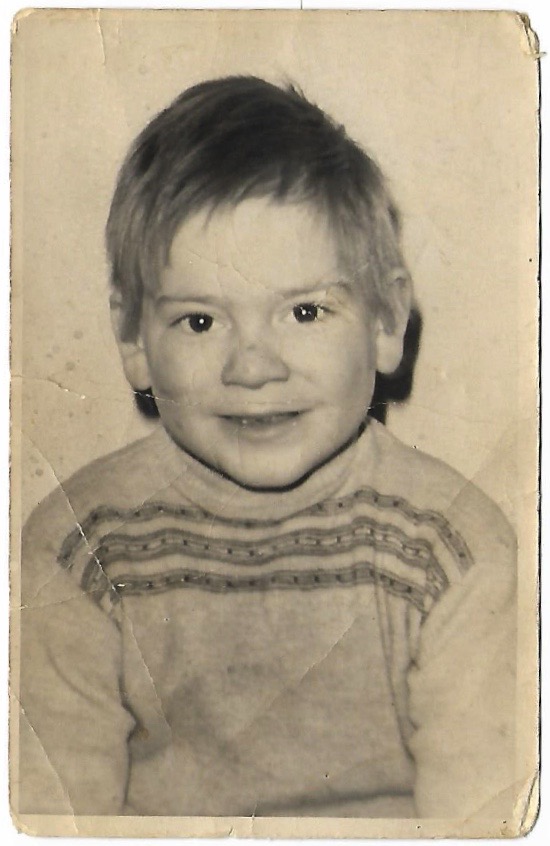 Steven Harris aged five, 1963
Great Eastern Buildings were a product of the Great Eastern Rail Company which ran services from East Anglia to Liverpool St Station and erecting the Buildings in the nineteenth century as cheap workers’ accommodation to support the development of the railway line. However, by the sixties, ‘great’ was the most unlikely epithet and no one had ever known them to be anything better than the lower end of the housing market.
The two tenements were subdivided into three sections with each section having a staircase running the height of the building. Each section had four flats on either side of the staircase, thereby providing a total of eight homes in each section. The first and third sections of the left hand block consisted of both one and two bedroom dwellings complete with inside toilet and bathroom, but those unfortunate enough to occupy the second section of the left hand block still had the pleasure of outside toilets and washrooms as per the original Victorian design.
The size of the dwellings – no flat had more than two bedrooms – often had little bearing on the number of people occupying them. Large families were not uncommon and I was one of four siblings. The usual rules applied, the parents had one room and the children had bunk beds in the other. Those on low incomes who could only afford low rents did not find themselves in a position to debate the complexities of the situation. It was how life was then and people did the best they could.
On the other hand, if you were fortunate enough to have an extra bedroom there was a chance to earn a few quid by renting it out. My grand parents did this. They occupied a two bedroom flat and, in the fifties, they rented their spare room to Davy. He was a short, stout man with a slightly crazy laugh, bald head and National Health Service spectacles – who always paid careful attention to his tie knot, his white starched shirt and his precision shaving on a Saturday night when he hoped to get lucky. I remember being strangely fascinated by Davy’s shaving and would frequently watch him as he exercised his careful linear strokes, followed by vigorous swirling of the razor in water to clean it. I believe Davy was a friend of my uncle Tom from their days of military service who simply needed a few weeks of lodging to sort himself out and find his own flat, yet by 1970 – when I moved out of the buildings – he was still there.
The construction of Great Eastern Buildings left much to be desired, both inside and our. The coal-grey brickwork, which had not been cleaned for decades, had not stood up well to weathering. Word had it that there was red brick incorporated in the Buildings but, apart from a line of red bricks traversing the length of the roof, it was hard to recall. Maybe this is reflective of a grey and dull existence?
Yet life in and around the buildings was punctuated by colour. ‘Barmy Park’ in Bethnal Green (named after the asylum that once stood there), Vallance Rd Park (known as Weavers’ Fields) and Victoria Park (the biggest and best known) were no more than a ten minute walk away, where we could see trees, ponds, birds and enjoy running around on the grass. In some ways these three parks marked the boundaries of our hinterland beyond which we rarely ventured. Within the immediate vicinity of the buildings there simply wasn’t anything of greenery that I recall.
There was the Truman Brewery just across the road which, in the fifties, still used horses to pull cartloads of beer. So it was that nature and beauty broke in to reveal itself to us, as my friend Sheila Butt remembers, “In the summer we used to go up on the roof and watch the Truman’s draymen go by on their carts, drawn by beautiful white horses, with large barrels of beer on the back and two men up front in white rubber aprons. And just to add to the sense of season, the waft of hops could often be detected on the light breezes passing through the buildings”
My Aunty Pat informed me that Great Eastern Buildings were owned in the fifties and the sixties by none other than the notorious racketeer and slum landlord Peter Rachman! His acolytes were always there when the rent was due but never when repairs were needed which, given the state of dilapidation, was very frequent. In fact, it was only in the early sixties when Rachman sold the buildings that any work was done, and indoor bathrooms and toilets were installed.
For many of the residents, avoiding paying the rent was a priority, hence weekly rent collection day – normally a Monday – was an interesting game of cat and mouse. The tendency to live it up at the weekend often left shortfalls and so the visit of the rent man was greeted with absence or no answer. It was not uncommon to be told ‘keep quiet and don’t make a sound,’ accompanied by threats of physical chastisement, should the rent man turn up when we were at home. On several occasions I was told by my ‘live-in stepmother’ Lotty not to make a sound when there was an unexpected knock on the door. In her case it could have been any amount of reasons, since she was implicated in many dubious activities, but the rent man was always unwelcome.
Rent was the biggest outgoing that anyone faced. In 1969, it stood at 25 shillings weekly for my Aunty Pat’s family with an income of £12 per week, but for those living on benefits it was a bigger imposition. I do not recall anyone ever discussing the concept of buying a home and, certainly, I never heard of the word ‘mortgage’ until my twenties. Nobody seemed to even dream about it, as if renting was the only way. And we performed this never-ending dance with the rent collector. I’m not sure what we hoped to achieve because the rent had to be paid whether we liked it or not, but I think that such avoidance won enough time to source other forms of income, thereby allowing the rent to be found.
Although Aunty Pat had sufficient control over her finances to pay the rent, many others – like my folks – did not. Yet even for the ‘good ones,’ it was always possible to discover a ‘cash flow difficulty’ by trusting payment of the rent to those it might be better not to. This was the fate of Aunty Pat when she trusted my stepmother, Lotty, to pay the rent on her behalf one week. Normally Pat would pay it herself, but her working hours had changed, so she could not be there to pay it. On this particular occasion, she was approached by the rent collector, asking ‘Pat, why haven’t you paid the rent?’ which drew the reply, ‘I have, Lotty paid it for me.’ At this point, Pat produced the rent book which had been signed by the rent man to indicate receipt of the rent, only to be informed ‘that’s not my signature.’ It was painfully obvious. When confronted, Lotty broke down, admitted the forgery and agreed to pay it off at two shillings a week. Fortunately, it never went any further, though Pat was more careful with whom she trusted her rent money afterwards.
Of my step-mother Lotty it must be said that she was an interesting character. I should know since I spent five years living with her. For better or worse, Lotty did help to raise myself and my sister, as well as her own son, Tony, and later my half-brother Edward. She was generally reasonable towards all of us, and kept us fed and clothed but she did periodically give me a good hiding. On one notable occasion, I managed to upset her mother and Lotty flew into the bedroom and laid into me. I never did know why but I do remember the pain, the stinging sensation, the confusion and sense of injustice. I suspect my sense of injustice was furthered by her not being my real mother – ‘Who the bloody hell did she think she was anyway?’
My father could deal out that sort of thing too. Somewhere around the age of eight or nine I managed to upset him, again how I did this I can’t recall – perhaps this lack of awareness is the hallmark of childhood? – but he charged into the front room, threw me onto the sofa and proceeded to punch me in the back. Though he could have hurt me much more than Lotty, I didn’t feel the same anger or need for retribution, perhaps because he was my natural father. Neither was I alone, physical chastisement being a way of life for children in the building, as was physical conflict for adults. Yet my father didn’t commonly behave like this towards me – being something of a laid back character, much more likely to crack a joke or puff an exotic cigarette than to be violent. I can only imagine that on this occasion, as with Lotty, I must have done or said something to really anger him.
Because of the physicality of life in the buildings, my father had to give an impression of being able to ‘handle’ himself and so his teddy-boy background proved helpful. Later, it became increasingly evident that my father preferring to interact with my cousins than me. I think this was due to the path that I took in life. After moving in with my uncle and aunt, and gaining entry to the local grammar school, I became increasingly academic and more middle class. Or at least was seen like that. It was a problem for my father who evinced disappointment during my teenage years, giving the impression of wanting a son who was more working class and manually inclined. There were always taunts about not being able to do anything practical – ‘Good at reading books but can’t fix a plug, can ya?’ Fixing a plug was a skill needed in the buildings, whereas reading Geoffrey Chaucer or William Blake was not going to improve the quality of life. In the tough environment of the buildings you would not find what might be described as a culture of praise. People did not compliment each other overtly. Today I understand the practice of sarcasm, which may have been a means for people to compliment each other without being seen to do so.
When I passed the 11+ for entry to the local grammar school in 1969, no one, as far – as I can recall – said ‘Well done’ or anything else for that matter. It was as if it hadn’t happened. I can now recall that sense of disappointment at not being recognised for achieving something no one else had done. It was the foreboding of a sense that grew stronger and stronger through my teenage years – of not belonging and of not being one of them.
I suppose my dad’s behaviour in giving me a walloping should not be surprising as he was a product of his environment. That existence, apart from rendering physical chastisement acceptable, looked on education in a contradictory way. Learning was to be admired yet also regarded with contempt since it didn’t produce any tangible reward. So it was that he liked having a ‘clever son’ – which conferred status on him – but couldn’t identify with me because I was never going to be productive in a way he understood. This reality was painful: with a mother who had abandoned me and a father who seemed disdainful to me, my internal emotional turmoil was immense.
My Dad didn’t always get things his own way. I recall an incident around 1965 when I had wandered out of the buildings and was heading down Quaker St towards Wheler House. About 50 yards along on the left hand side, facing Leon’s shop, was the Grey Eagle. Out of the pub hobbled my father, covered in blood, with torn clothing and clearly in distress. He sank to the ground against a wall. Later, it transpired he had broken his leg or had it broken for him. Then another man came out of the pub and started kicking him. Upon seeing me, my father called out ‘Alright Paddy, pack it in, my boy is watching.’ Paddy glanced in my direction, swore at my father, kicked him once more and then went back to the pub.
Lest I give a negative impression of my father, I have a wonderful memory that endures. One morning, around 3am, in the summer of 1969, my father came into the bedroom and woke me up. ‘Steven, Steven, you’ve got to come and see this,’ he said. I hadn’t a clue what he meant or what was happening, but I got up and followed him into the front room. He was staring at the TV, and he ushered me to sit down and do the same. In that slightly fed up and rather bored manner so beloved of children, I sat there and looked at our little black and white TV set.
There appeared to be little to see – just a piece of empty ground from what I could tell. After several minutes of looking at this nothingness, a small shiny cylindrical object hovered into view and appeared to settle on this piece of ground. A little time later, a man completely enclosed in a heavy suit emerged from the object. I didn’t appreciate that I was watching a piece of history – the first man on the moon – but from my fathers’ demeanour I knew it had to be of significance. Looking back on it, my dad clearly wanted me to be part of something special, something that was a landmark moment in human existence, and in this he succeeded.
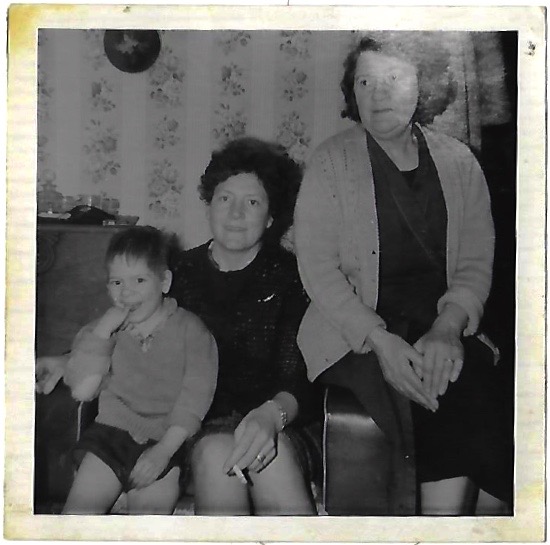
Steven with his Aunty Ena and his nan, c.1963
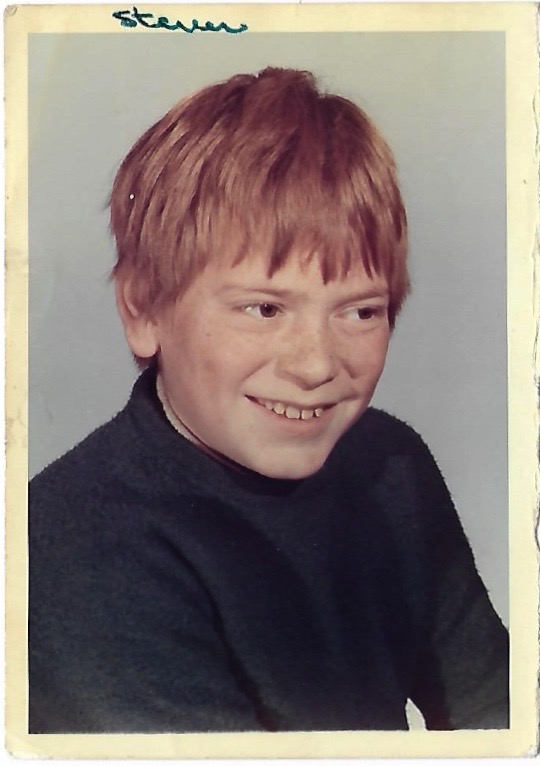
Steven aged twelve, 1970

Great Eastern Buildings photographed by Tony Hall in the sixties

Children at Great Eastern Buildings photographed by Homer Sykes in the seventies
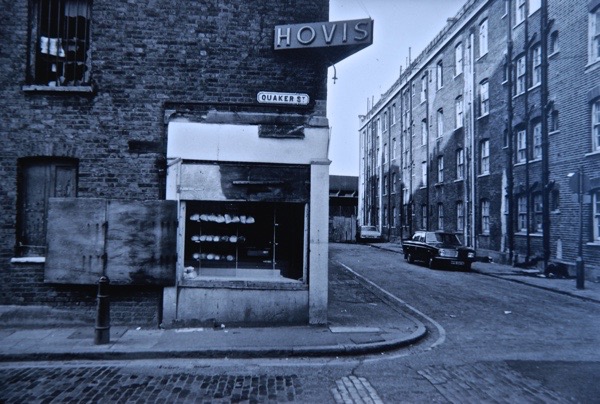
Great Eastern Buildings seen from Quaker St photographed by Dan Cruickshank in the seventies
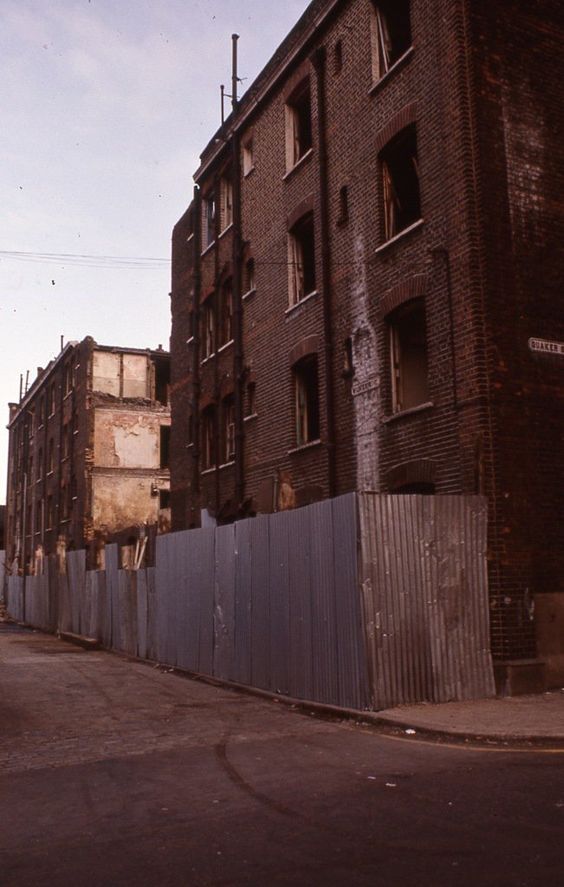
Demolition of Great Eastern Buildings, 1978
You may also like to read about













What an evocative piece of writing. I too grew up in less than ideal housing over in Stepney . Stevens account of growing up in such dwellings brought back memories and characters from my childhood. Shadwell Park was our natural oasis , albeit ran along the side of the Thames with the docks and it’s cranes still in operation. Unlike Steven I have only happy memories of my childhood , which furnished me with the opening line for my successful application to university , “ We’ve got rats as big as cats “ , that being the words on the placard that I was given to hold at my very first protest , that eventually resulted in residents being rehoused. Thank you for an enlightening account and the memories that it has evoked.
Regarding The Rent Man calling, at the beginning of the week, one of the reasons many women begged a little extra time to pay, was so that they could rush to the pawn shop with whatever was available- the last resort would be their wedding ring-& then these would be redeemed on Fridays when the men got their pay.
Having worked at the Truman Brewery in the 1980’s , I used to pass my favourite pub name, in Stoke Newington, on my drive into work. The pub sign was a back view of a man in a brown raincoat, wearing a bowler hat, knocking at a front door-this was The Rent Man. And the pub name? The Nobody Inn-just brilliant & unique, I believe…
PS I too was woken in the middle of the night by my father to: “come & see this”, so he & I watched the first moon landing together in glorious black & white, whilst the rest of the house slept.
We had moved from my grandparents’ house in Balaclava Road, Bermondsey, to Enfield, where my Mum & Dad were the first on either side to buy a house rather than rent. As far as my Bermondsey grandfather was concerned, Enfield was ‘The Country’ ….