
So Long, Nelson St Synagogue
After more than a century of operation, Nelson St Synagogue is to be auctioned off on 12th February. Since part of the roof collapsed at the time of the pandemic in 2020 it has been disused. Click here for details of the auction
Below you can read my account of a visit there in 2012.

Leon Silver
When Leon Silver opened the golden shutter of the ark at the East London Central Synagogue in Nelson St for me, a stash of Torah scrolls were revealed shrouded in ancient velvet with embroidered texts in silver thread gleaming through the gloom, caught by last rays of afternoon sunlight.
Leon told me that no-one any longer knows the origin of all these scrolls, which were acquired as synagogues closed or amalgamated with the departure of Jewish people from the East End since World War II. Many scrolls were brought over in the nineteenth century from all across Eastern Europe, and some are of the eighteenth century or earlier, originating from communities that no longer exist and places that vanished from the map generations ago.
Yet the scrolls were safe in Nelson St under the remarkable stewardship of Leon Silver, President, Senior Warden & Treasurer, who had selflessly devoted himself to keeping this beautiful synagogue open for the small yet devoted congregation – mostly in their eighties and nineties – for whom it fulfilled a vital function. An earlier world still glimmered there in this beautiful synagogue that may not have seen a coat of new paint in a while, but was well tended by Leon and kept perfectly clean with freshly hoovered carpet and polished wood by a diligent cleaner of ninety years old.
As the sunlight faded, Leon and I sat at the long table at the back of the lofty synagogue where refreshments were enjoyed after the service, and Leon’s cool grey eyes sparkled as he spoke of this synagogue that meant so much to him, and of its place in the lives of his congregation.
“I grew up in the East End, in Albert Gardens, half a mile from here. I first came to the synagogue as a little boy of four years old and I’ve been coming here all my life. Three generations of my family have been involved here, my maternal grandfather was the vice-president and my late uncle’s mother’s brother was the last president, he was still taking sacrament at ninety-five. My father used to come here to every service in the days when it was twice daily. And when I was twenty-nine, I came here to recite the mourner’s prayer after my father died. I remember when it was so crowded on the Sabbath, we had to put benches in front of the bimmah to accommodate everyone, now it is a much smaller congregation but we always get the ten you need to hold a service.
I’m a professional actor, so it gives me plenty of free time. I was asked to be the Honorary Treasurer and told that it entailed no responsibility – which was entirely untrue – and I’ve done it ever since. As people have died or moved away, I have taken on more responsibility. It means a lot to me. There was talk of closing us down or moving to smaller premises, but I’ve fought battles and we are still here. I spend quite a lot of hours at the end of the week. We have refreshments after the service, cake, crisps and whisky. I do the shopping and put out the drinks. The majority here are quite elderly and they are very friendly, everyone gets on well, especially when they have had a few drinks. In the main, they are East Enders. We don’t ask how they come because strictly speaking you shouldn’t ride the bus on the Sabbath. Now, even if young Jewish people wanted to come to return to the East End there are no facilities for them. No kosher butcher or baker, just the kosher counter at Sainsburys.
My father’s family came here at the end of the nineteenth century, and my maternal grandfather Lewis (who I’m named after) came at the outbreak of the First World War. As a resident alien, he had to report to Leman St Police Station every day. He came from part of the Austro-Hungarian Empire and he came on an Austrian passport, but when my mother came in 1920, she came on a Polish passport. Then in 1940, my grandfather and his brothers were arrested and my grandmother was put in Holloway Prison, before they were all interned on the Isle of Man. Then my uncle joined the British army and was told on his way to the camp that his parents had been released. My grandparents’ families on both sides died in the Holocaust. My mother once tried to write a list of all the names but she gave up after fifty because it was too upsetting. And this story is true for most of the congregation at the synagogue. One man of ninety from Alsace, he won’t talk about it. A lot of them won’t talk about it. These people carry a lot of history and that’s why it’s important for them to come together.
When Jewish people first came here, they took comfort from being with their compatriots who spoke the same style of Yiddish, the same style of pronunciation, the same style of worship. It was their security in a strange new world, a self-help society to help with unemployment and funeral expenses.”
Thanks to Leon, the shul to existed as a sacred meeting place for these first generation immigrants – then in their senior years – who shared a common need to be among others with comparable experiences. Polite and softly spoken yet resolute in his purpose, Leon Silver was custodian of a synagogue that was a secure home for ancient scrolls and a safe harbour for those whose lives were shaped by their shared histories.

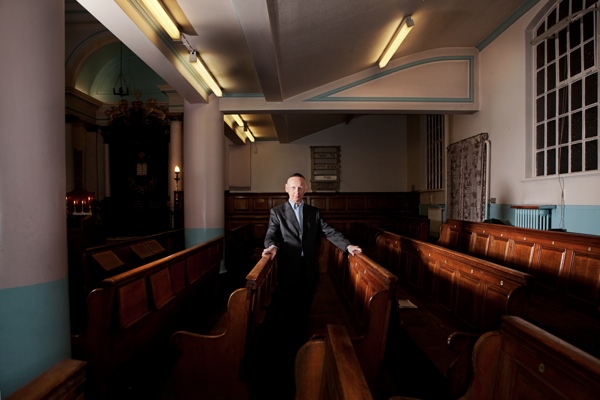

Photographs 2 & 3 © Mike Tsang


As a former attendee of Nelson st synagogue and my parents got married here and my two brothers and I got Barmitzvah here it feels a massive betrayal to sell it by the owners .
If the synagogue has been in North London where the headquarters of the Federation of Synagogues is,they have sold it ?
All those memories of people telling jokes , laughing forging the Kiddish , warrants a poem so I shall write one .
Good Nelson street synagogue
By Andy Strowman
Copyright
Goodbye Nelson st synagogue,
May the walls you breathe and stories you tell ,
Be remembered by me before the funereal bell .
Moishe , Dad singing in his American voice ,
Kind Yiddie, Anne Mendel , gone without choice .
Let all the children who lined up for chocolate be my friends again,
And those who live and died be remembered in the rain .
Written with great sadness as this place was the only Jewish sanctuary left for me where I feel safe
4th February 2026
An amazing old building where the synagogue was housed & sheltered its peoples from the storm of their cruellest shared history.
So sad to see yet another part of East End history lost to the developers & their endless flats overwhelming the landscape..
Thanks for that lovely tribute to Leon Silver and the Nelson St synagogue and its congregation.
It is always sad when an old place of worship goes, thinking of all the people who have brought their joys and woes, fears and hopes there and found solace.
I hope something decent comes out of it.
Oh, that’s so sad but I can understand the practicality of keeping the synagogue open has reached an end.
We will just have to hope that whoever buys the building will retain the beauty of the interior in the redevelopment.
I really appraciate your stories of the Old East End though I have only ever been a visitor to the areas you focus on though I came close, living in Islington for 15 years.
Even being in Southeast Asia for the past 21 years has not dulled my appetite for your endeavours but for some reason Leon Silver’s life resonated even more than usual. Recognising that times change and communities move on is very humbling and I yearn for an opportunity to see the Nelson St Synagogue interior before the auction and to breath in the history.
Alas, it cannot be so as I am now based in the North of England and I cannot justify the trip. But I do wholehearetedly hope and pray whoever purchases the building will bring it back into use where people can gain access to admire the historical architectual character and that it won’t be demolished and replaced by an anonymous office monstrosity.
All power to you and your associates’ great work!
My main concern is the future of the Torah scrolls. Where will they be housed? I believe my family shul (synagogue) New Road, which closed down several years ago, sent their torahs to Nelson St upon its demise, along with several other smaller synagogues. And the memorial plaques – lovingly donated by so many East End families, what are to become of them? Praying the younger generations in their Northwest London grand houses don’t forget their families’ humble roots.
So much history and so many memories. As Adele writes I hope the Torah scrolls and memorial plaques are saved.
I am not a Jewish person, but I have an interest in the traditions and way of life of Jewish people. During Open London weekends I have been to Bevis Marks Synagogue, Sandys Road Synagogue, Princelet Street Synagogue and the Synagogue approximately half way down Bayswater Road.
So of course I am saddened to read that Nelson Street Synagogue will be no more. I distinctly remember entering the Synagogue and the warm welcome I received from the ladies there. I could sense the amount of history that was there by the furniture and fittings and such a unique atmosphere.
Despite my secular Jewish identity today, I decry the federation’s auction decision.
The synagogue that hosted my childhood and barmitzvah should have survived.
It ought to have undergone essential repair for those who still wished to worship there.
Our Stepney family lived in a cramped home, with no bathroom or indoor toilet.
Other congregants faced similar hardship.
Prayers for the royal family seemed bizarre.
These included the then Prince Andrew, born in the year that I came of age.
But, notwithstanding atheism, my understanding remains for the religious.
Nelson Street’s temple served as a continuity haven for spiritual Jews.
Recent years have seen me speak out even louder for a just peace in the Middle East.
I flayed Hamas atrocities and kidnaps on
7 October 2023, during Simchas Torah.
Then my condemnation switched to the IDF’s carnage and aid siege in Gaza.
Like Israel, the Whitechapel shul’s disposal casts another Jewish shadow.
So, its devotees – who hoped to return “home” – should pray on elsewhere?
This recalls the ship’s captain who rescued a man whose boat sank near a desert isle.
When the captain steps ashore, he looks up to see not one, but two synagogues.
“Well, blow me, how many shipwrecked Jews live on this island?,” he asks the man.
“Just me,” comes the reply.
“Why did you build two synagogues?”
The man points to the further building.
“That one, I’d never visit.”
Although probably the only thing that could happen, there is something so sad about this. I do hope anything of value from inside has been secured and rehomed.
Such a beautiful building so sad to know it’s starting to collapse. Such moving stories of those who came to live here, not always welcomed by the local community. I especially feel ashamed of those who were ‘invited’ to come over on Windrush, although not Jewish, they met prejudice with signs in people’s windows saying No Blacks, No Jews. I loathe prejudice, and feel ashamed of my fellow man at times. Thankfully, many did manage to have a good life here. My mother worked for a lovely Jewish couple in Chelsea, who were so kind to me growing up. Although they didn’t celebrate Christmas, ironically, they owned the Christmas Turkey business at Spitalfields. I kept in touch with them until they too had passed. They had no children themselves, but were very close to their two nieces.