
Rodney Archer, Aesthete
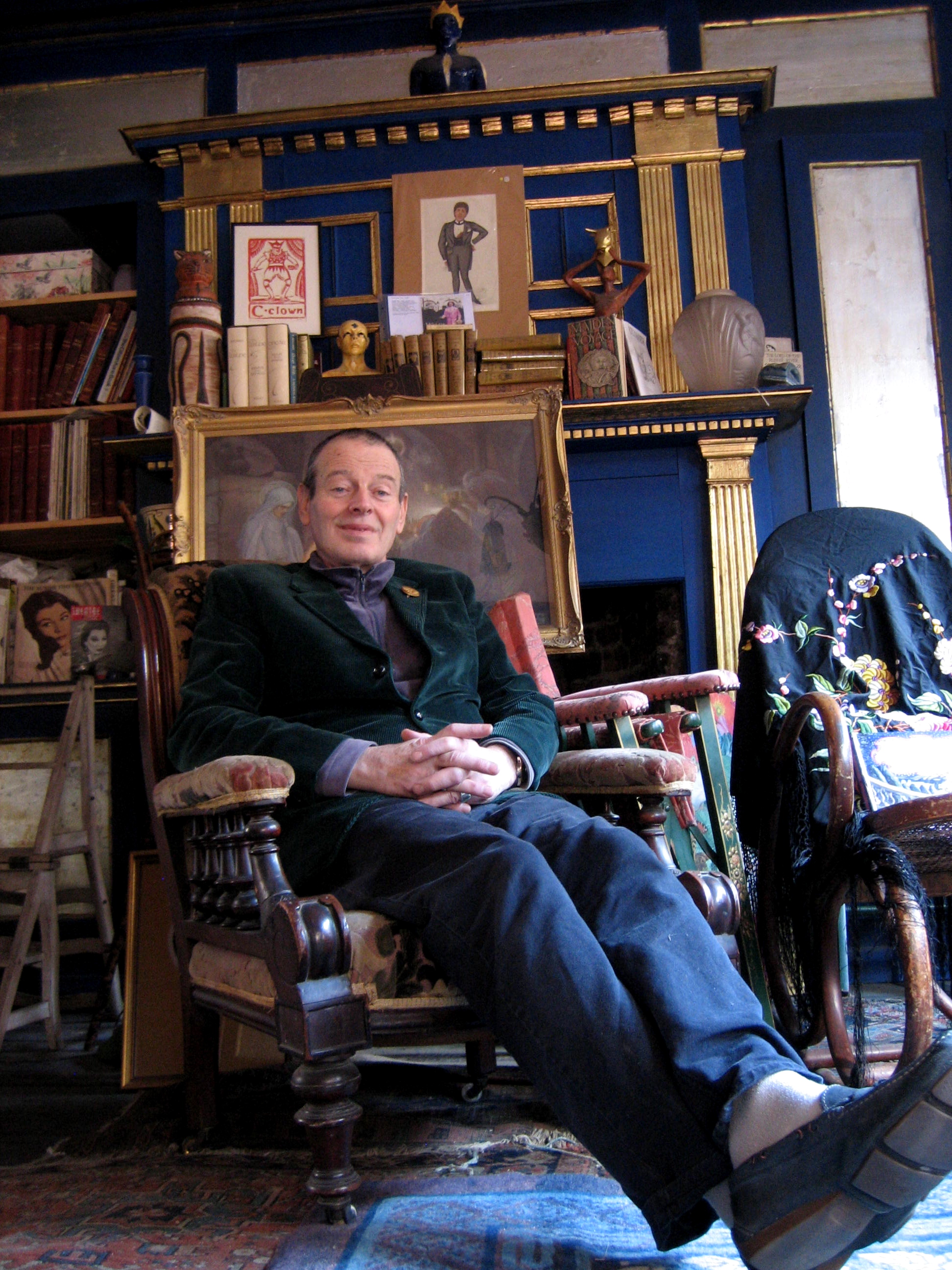
Rodney Archer kindly took me to lunch at E.Pellicci yesterday, but first I went round to his eighteenth century house in Fournier St to take this portrait of him in front of his cherished fireplace that once belonged to Oscar Wilde. One day in 1970, Rodney was visiting an old friend who lived in Tite St next to Wilde’s house and saw the builders were doing renovations, so he seized the opportunity to walk through the door of the house that had once been the great writer’s dwelling. The fireplace had been torn out of the wall in Wilde’s living room as part of a modernisation of the property and the workmen were about to carry it away, so Rodney offered to buy it on the spot. For ten pounds he acquired a literary relic of the highest order, the fine pilastered fireplace with tall overmantle that you see above, and which today has become a shrine to Wilde that is the centrepiece of Rodney’s first floor living room in Fournier St. You can see Spy’s famous caricature of Wilde up on the chimneypiece, but the gem of Rodney’s Wilde collection is a copy of Lord Alfred Douglas’ poems with pencil annotations by Douglas himself. Encountering these artifacts in this environment – that already possess such a potent poetry of their own, amplified by their proximity to each other – is especially enchanting.
Rodney has allowed the patina of ages to remain in his house, enhanced by his sensational collection of pictures, carpets, furniture, books, china and god-knows-what, accumulated over all the years he has lived in it, which transform the house into three-dimensional map of his vigorous mind, crammed with images, stories and all manner of cultural enthusiasms. In Rodney’s house, anyone would feel at home the minute they walked in the door because the result of all these accretions is that everything has arrived in its natural place, yet nothing feels arranged. It is a relaxing place, with reflected light everywhere, and although there is so much to look at and so many stories to learn, it is peaceful and benign, like Rodney himself. Rodney’s style can never be replicated by anyone else, unless you became Rodney and you could live through those years again.
Rodney made his home in London’s most magical street in 1980. It came about after his mother fell down a well at The Roundhouse and broke her hip while visiting a performance of “The Homosexual (or The Difficulty of Sexpressing Yourself)” by Copi in which Rodney was starring. It was the culmination of Rodney’s distinguished career of just eight years as an actor, that included playing the Player Queen in Hamlet at the Bristol Old Vic in a production with Richard Pasco in the title role and featuring Patrick Stewart as Horatio.
After she broke her hip, Rodney’s mother told him that her doctor insisted she live with her son, much to Rodney’s surprise. Gamely, Rodney agreed, on the condition they find somewhere large enough to live their own lives with some degree of independence, and rang up his friends Riccardo and Eric who lived in Fournier St, asking them to keep their eyes open for any house that went on sale. Within three months, a house came up. It was the only one they looked at and Rodney has lived there happily ever since. Thirty years ago, Spitalfields was not the desirable location it is today, “My mother thought I was joking when I told her where I wanted live,” declared Rodney, raising his eyebrows, “Now it would nice if there were more people living here who were not millionaires. I visit people in houses today where there are ghosts of people I used to know and the new people don’t know who they were, it’s sad.”
Rodney’s roots are in East London, he was born in Gidea Park, but once his father (a flying officer in the RAF) was killed in action over Malta in 1943, his mother took Rodney and his sister away to Toronto when they were tiny children and brought them up there on her own. Rodney came back to London in 1962 with the rich Canadian accent (which sounds almost Scottish to me) that he retains to this day, in spite of the actor’s voice training he received at Lamba which has imparted such a mellifluous tone to his speech. After his brief years treading the boards, Rodney became a teacher of drama at the City Lit and ran the Operating Theatre Company, staging his own play “The Harlot’s Curse” (co-authored with Powell Jones) in the Princelet St Synagogue with great success.
“When I retired, I decided to do whatever I wanted to do,” announced Rodney with a twinkly smile, at this point in his life story. “Now I am having a wonderful third act. Writing about that time, my mother, the cats and me…” he said, introducing the long-awaited trilogy of autobiographical fiction that he is currently working on, in which the first volume will cover his first eight years in Spitalfields concluding with the death of his mother in 1988, the second volume will conclude with the death of his friend Dennis Severs in 1999 and the third with the death of Eric Elstob. (Elstob was a banker who loved architecture and left a fortune for the refurbishment of Christ Church, Spitalfields.) “There is something about the nature of Spitalfields, that fact becomes fiction – as you become involved with the lives of people here, it gets you telling stories.” explained Rodney, expressing a sentiment that is close to my own heart too.
Now it was time for lunch and, as we walked hungrily up Brick Lane towards Bethnal Green in the Spring sunshine, the postman saluted Rodney and, on cue, the owner of the eel and pie shop leaned out of the doorway to give him a cheery wave too, then, as if to mark the occasion as auspicious, we saw the first shiny new train run along the recently completed East London Line, gliding across the newly constructed bridge, glinting in the sunlight as it passed over our heads and sliding away across Allen Gardens towards Whitechapel. This is the elegant world of Rodney Archer, I thought.
Turning the corner into Bethnal Green Rd, I asked Rodney about the origin of his passion for Wilde and when he revealed he once played Algernon in “The Importance of Being Earnest” at school, his intense grey-blue eyes shone with excitement. It made perfect sense, because I felt as if I was meeting a senior version of Algernon who retained all the wit, charm and sagacity of his earlier years, now having “a wonderful third act” in an apocryphal lost manuscript by Oscar Wilde, recently discovered amongst all the glorious clutter in a beautiful old house in Fournier St, Spitalfields.


What an interesting read! Thanks a lot for sharing!
Great story, and facinating photographs!
Love that dark atmospheric hallway in the second photo.
Fascinating character and great photos!
what a delightful and insightful read ,from an interesting character.
Wonderful to discover that Rodney is doing so well. Has he seen Wilde`s The Duchess of Padua at Pentameters theatre in Hampstead? Performances continue until 15th.May. Rodney taught me Theatre studies in the 80`s, he was a wonderful teacher, so erudite. while i was at the City lit I tried to hide my previous connections with the Ballet, but I always suspected Rodney of knowing far more than he let on. Nowadays I am painting and making small playful scultures. Sometimes I write a poem, but I am scared of any sort of acting because I have arthritis in my hands and do not want people to notice. I am looking forward to reading Rodney`s Autobiography. My daughter Natasha sends her best wishes. She is now married and lives in Ireland with husband and 4 frightenly intellegent children.Please give Rodney my very Best Wishes, i would like to meet him again one day soon.
I am really looking forward to Rodney’s autobiography; I am sure it will be a great read.
Rodney taught me drama and directed me in productions of Elizabethan and Jacobean plays at The City Literary Institute (The City Lit) during the late Seventies. He was an inspirational director with an extremely creative mind – who would have thought that you could set Thomas Middleton’s ‘The Changeling’ inside an R.A.F. parachute? – Rodney did with absolutely amazing results. By the way, I still have photos of the production if people are interested. It was the most talked-about production that year (1976 if my memory is working well).
His vision and interpretation of art and life is all-encompassing: paintings, photographs, sculptures, poems and plays… I always remember that he was the first person I met who ever made me ‘look up’at buildings . It’s well worth doing. Believe me and Rodney, it’s well worth doing.
I have just been listening to Mike Oldfield’s “Tubular Bells” which reminded of Rodney’s wonderful production of “Midsummer Night’s Dream” at the City Lit in the 70’s which prompted me to look him up on the Web. I was delighted to find this article which I read with great interest and equally excited to see the comment from Tony Murphy who I acted with in many productions at the Lit during that time. What happy days they were!!
Jacqie
JUST MADE A GLANCE AND YOUR NAME CAME UP AS A COMMENT ON RODNEY ARCHER’S CITATION.
ARE YOU THE JACQIE I ACTED WITH IN ‘TWELFTH NIGHT’ AND DID YOU ALSO KNOW JACK…. PLEASE EMAIL ME @antonbook@hotmail.co.uk I am intrigued!
Rodney,
I dont know if you remember me my name is john buckle. Im now divorced from Bernadette and I’m living in Bangkok with my wife sio Dow. I have wonderful memories of you and your thousand little kindness to me. I particularly remember going to saddlers Wells with you to see Marcel marceau it was a wonderful evening and i felt both priviledged to have been with you and to have seen Marcel. You are a very special person and I wish you much love and happiness.
Anybody who knows Rodney and has met him will know that there is nothing bad you can say about him. I feel I am privileged to have met him and honoured to be one of his so many students at Citylit. I auditioned at all the Drama School of London and after 7 years of constant rejections, I just stumbled into CityLit and almost in tears I expressed my wish to become an actor. I was surprised to see that Rodney did not laugh (Everybody had laughed upon my statement of becoming an actor, even my parents, Rodney is one of three people who has not laughed). He shook my hand and said I am at the right place, where the requirement is only a desire in your heart. That as many years ago, I told the story to my daughter who is determined to become and actor wished Rodney was still a teacher today. I am sure Rodney remembers me, because a few years ago, just before he retired from Citylit I called him and when I asked if he remembers me; “Vividly” was his answer. And, that was a good few years after I was his student, and thefinest moment was when I invited him to come see my performance of ‘The Hypochondriac’ (Moliere) he turned up and sat in the front row… Rodney, you are the greatest teacher in my world, I take my hat off to salute you. I simply look forward to read whatever yo have written so far, I remember you said you were going to write, but thought you were joking, because you did have a wonderful sense of humour, but I now realise that you never joked and you always mean what you say. All the best.
When I read the article, in today’s Guardian, about the Gentle Author and her/his fantastic blog on the characters of Spitalfields I just knew that Rodney would be one of them. We have been friends for about 30 years now since Rodney taught me drama at the wonderful City Lit. He is a lovely, lovely man and I feel honoured and flattered that he is a friend. He was a brilliant teacher with great patience (sorely needed with some of us) and the most terrific sense of humour. He tells you the most outrageous things with a totally deadpan face.
Rodney’s house and garden which he has lovingly restored are a joy and, as the author says, full of marvellous bits and pieces most of which he has picked up in markets and junk shops.
Rodney, you are one of my favourite people!
Was thinking about Rodney the other day, and missing him, as I frequently do, and so was thrilled to find this article online when I looked him up. I too was fortunate to have Rodney as an acting teacher at the small international university in London where I took my degree. I was also fortunate to consider him a dear friend, though we haven’t spoken since I visited him in the late 90’s at his lovely home in Spitalfields. I was also pleased to see a message on this site from Anthony Murphy–I was so lucky to play Beatrice-Joanna in Rodney’s production of The Changeling–wearing that memorable parachute!! Rodney is not only the ‘gentle author’ but as you noted, Anthony, a truly great theatre artist–and I would love to see any photographs you have of the production. Please feel free to contact me. Knowing Rodney was a major event in my life, as anyone who has ever been close to him will agree, I’m certain. I can’t wait to read his memoirs, if only to spend time with him again. Since my days in London I’ve gone on to do a lot more theatre and am currently living and working in Los Angeles–and while I love my life here and now, it still pales in comparison with the memories of my life then–and–Rodney, if you’re reading this–I repeat my earlier proposal–will you marry me?
x
Barbara
Wagner sends his best wishes from Berlin and would like to know if you still have the famous orthopaedic bed!!
Hope you get this message and get the chance to reply. He would love to hear from you.
Rodney was a brilliant and inspirational teacher at the CityLit. He was greatly loved by his pupils. It was a golden age for me. My fondest memory of Rodney was when at a staff concert he sang “Nobody wants a fairy when she’s forty”. Three cheers for Rodney!
Just got here from doing a search on Rodney Archer right after I watched a 2 minute video on Aljazeera about his love for his historic house. What a lovely house and a lovely man, and yes, a lovely article 🙂
Interesting to read about the Oscar Wilde fireplace too!
I am so delighted to have found this article and photo of Rodney Archer. I had the distinct pleasure of being one of Rodney’s students in at voice and text class at BESGL (British European Studies Group London) in 1977. Although I was a theatre “techie” and a frustrated filmmaker/photographer, Rodney was able to coax a few bits and pieces of performance out of me. What’s more, he gave me an insight into the world of acting that I have never forgotten. He and Powell, were among the most memorable university instructors I had.
I hope that he will have the opportunity to read this message and discover what a lasting, wonderful impact he has had on my life.
Rodney- everything a drama teacher should be. And a great citizen
Thanks for giving me a “taste” of old Spitalfields. This site was recommended to me by cousin Stella, who’s roots are firmly planted in the City, and I have not been disappointed. Although I am a Kentish girl my roots too go back to the City and it is fascinating to read of its characters and see the old buildings that my ancestors would have known.
I was lucky enough to have been taught by Rodney at the City Lit over two years. I’d come from art school, Central School of Art, round the corner and the projects he set were the next step in what Central taught us – how to think. I’m so grateful. What he and his teaching partner taught are the foundations of what I do now. So thank you Rodney for your generosity, warmth and opening my mind. Love Rozelle
Rodney and Powell Jones taught me voice 30 years ago at BESGL (British and European Studies Group London). Both were tremendously encouraging. It is good to know the Millennium has benefited from Rodney’s gentle and lively presence. What of Powell Jones, I wonder.
RBW
Is this the Rodney Archer who appeared at Lincoln Theatre Royal in the days of Philip,Claire and Brian producers and Directors ? I also worked at the theatre and have many happy memories of all the actors and correspondence from Rodney and other actors. Very happy times
Rodney taught me acting at the City Lit along with Valerie Colgan. He was such a character! Incredible sage! I never became an actor, but I will never forget Rodney! He has such a nimble wit and great theatrical timing! Thanks Rodney!
G.W. Godwin devised the interiors at 34 Tite Street. The great Godwin! And butchers were allowed to rip out this monument of Aestheticism and toss it into the street!
Butchers!
So glad your friend salvaged some relic from this desecration. From what I understand, Godwin had much of the interior painted white, I don’t know if the dining room was, too. The ceiling was painted by Whistler, I think. I imagine that’s all gone, too.
I hope the barbarians are happy with their swank new decor. I wish you had more pictures of Mr. Archer’s abode!